



Small business owners across the Garden State are reflecting on a landmark Tax Day. New state-specific reports from the National Federation of Independent Business (NFIB) highlight the sweeping economic benefits and permanent tax savings now available to New Jersey’s Main Street under the Working Families Tax Cut Act, signed into law on July 4, 2025.
By making the 20% Small Business Deduction (Section 199A) permanent, federal lawmakers have officially 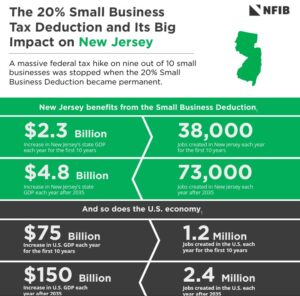 the threat of the massive tax hike that had been looming over the 2025 year-end.
In a state where small businesses face some of the highest combined tax burdens in the country, the permanency of this deduction is being hailed as a stabilizer. For the nine out of 10 New Jersey small businesses organized as pass-through entities, the deduction prevents an effective tax rate spike that could have hit 50.35% (combining the 39.6% federal top individual rate and New Jersey’s 10.75% top rate).
“By making the Small Business Deduction permanent, Congress and President Trump replaced the threat of a massive tax hike with long-term tax certainty,” NFIB President Brad Close said. “This historic accomplishment frees up resources for small business owners to better serve their employees and the local communities they support.”
The NFIB report outlines several key provisions that have now become permanent fixtures of the tax code, providing the predictability needed for New Jersey’s long-term commercial growth:
- 20% Small Business Deduction: Allows pass-through businesses (LLCs, S-Corps, Sole Proprietorships) to deduct up to 20% of their business income.
- Small Business Expensing (Section 179): The expensing cap was doubled to $2.5 million and indexed for inflation, allowing owners to deduct the full price of equipment in the year of purchase.
- 100% Bonus Depreciation: Permanently restored to 100%, allowing for immediate first-year deductions on qualified property and assets.
- Estate Tax Relief: Exemption levels were permanently increased to $15 million for individuals ($30 million for joint filers), protecting multi-generational family businesses from forced liquidation to pay the “Death Tax.”
The economic impact on New Jersey is expected to be profound. According to the NFIB’s analysis, the permanency of these tax cuts is projected to:
- Generate an estimated 38,000 new jobs annually in New Jersey over the next decade.
- Contribute to a $4.8 billion increase in state GDP over the same period.
The reports emphasize that these tax wins help level the playing field against large corporate competitors. With tax liabilities now predictable, local entrepreneurs can move away from defensive tax planning and focus on reinvesting their “hard-earned money” back into the New Jersey economy.
For Garden State business owners, the passing of yesterday’s deadline marks the beginning of a new era of fiscal certainty, allowing them to scale operations with the confidence that their federal tax structure is here to stay.


