


In Salem and Cumberland counties, the challenges of accessing health care are well understood, with longer drives for specialty services, changes in what local hospitals can offer and fewer resources to meet the needs of the region’s growing communities.
As with much of the country, health systems across New Jersey are rethinking how care is delivered to ensure the communities they serve can still access the services they need while staying close to home and still cover a broad, regional network.
For Inspira Health, which serves three counties (including two of the most economically challenged in the state), that approach is taking shape by expanding services at its Mullica Hill campus in Gloucester County while focusing its more rural hospitals in Elmer and Mannington on the services their communities need most.
“We have a board that’s tremendously committed to these three counties,” Warren Moore, the system’s president and chief operating officer, said. “Two of our counties are the poorest in the state. Our commitment, if we look at it from a mission and vision standpoint, goes beyond traditional health care.”
That’s why, on a campus that opened only a few years ago, the system is now in the middle of a major expansion: A multi-hundred-million-dollar expansion project that will add more than 86 patient rooms, create new critical care and mother/baby capacity and give the hospital the kind of flexible, post-COVID infrastructure that can shift between routine care and high-acuity needs on any given day.
The strategy is ambitious but straightforward: Expand access to advanced, high-acuity services in centralized locations while strengthening the services that matter most within the broader network. At Inspira, that means continuing to grow complex care capabilities in Mullica Hill and Vineland while enhancing access to primary care, behavioral health, chronic disease management and other essential services throughout Salem and Cumberland counties.
“It allows us to better align our services with what each community needs most,” Moore said. “At the same time, we’re making sure patients across our region can access higher levels of care without having to leave South Jersey.”
***
Inspira is now more than halfway through the $257 million project, which will add 168,000 square feet of clinical space, including approximately 150,000 in the five-story tower.
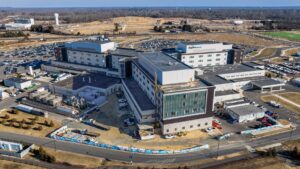
The project also includes an overbuild to the right of the hospital’s main entrance, the renovation of various clinical and non-clinical spaces on the first floor and increased parking capacity — all of which will expand access and capabilities in the intensive care unit, medical/surgical units, maternal/child health, medical imaging and graduate medical education.
Of course, the tower is what is getting the most attention. And it’s causing some confusion.
“The tower façade is up, so it looks finished,” Moore said. “People ask, ‘When are you going to open?’”
The interior is expected to be completed in the fourth quarter of 2026, with patients moving in after inspections and regulatory approvals in early 2027.
The expansion will push Mullica Hill’s capacity from just over 200 patient rooms to more than 300, including a dedicated observation unit designed to reduce crowding and cut the number of patients boarding in emergency bays or hallways.
“Flexibility is central to the design,” Moore said. “We’re looking for the highest level of flexibility in every room we build,” he said. “We’re building the infrastructure to be close to ICU-compliant, and then outfitting rooms for med/surg, stepdown or ICU care. So, you always have that flexibility if there’s a surge in acuity.”
Here’s how that plays out: Inspira is adding 10 ICU beds but built capacity for 20.
“We’re fitting out the other 10 in that hyper‑flexible mode,” Moore said. “If we need to put an ICU patient in there, we can. If we need step‑down, we can. If we need it for EEG, we can.”
And the demand is already there.
“We opened in 2019 and by 2023 we were running fully occupied — it’s incredible,” he said. “It speaks to the trust our communities place in us to be there when they need us most, and we’re grateful to be a resource for them. I’m really excited that we’re getting close to completion, because it means we’ll be able to better meet the demands of the community in the best way possible.”
***
A major pillar of Inspira’s strategy is ensuring strong, sustainable access to obstetrics and maternal care.
Like many health systems nationwide, Inspira has had to evaluate how to best deliver these services in a way that maintains quality and safety, particularly in areas with lower patient volumes.
“We relocated a highly regarded maternity program from Elmer to Mullica Hill about a year ago after seeing where patients were choosing to go for care,” Moore said. “It wasn’t an easy decision, but it was important to ensure we’re meeting patients where they are while continuing to provide the highest level of care.”
Nationally, many OB closures are happening in regions with aging populations and declining birth rates. Salem County fits that pattern. It is one reason Inspira is centralizing deliveries at Mullica Hill while rethinking what services should remain local.
“The strategy is already proving out,” Moore said.
“People coming from Salem County to our Mullica Hill facility have quadrupled. That was our thought and strategy when we first made the decision. But, more importantly, it reflects what our community needed. We just didn’t realize it would happen so fast or work this well for our community.”
The shift has also kept more patients from crossing into Delaware or Pennsylvania for deliveries. And for physicians, consolidation brings advantages.
“They want to practice where there’s volume, where they have nurses with deep expertise and where their patients will get good care,” Moore said. “That’s a huge part of the story behind this expansion.”
Even as services grow in Mullica Hill, Inspira continues to invest across its footprint, including in Cumberland County, where Inspira Medical Center Vineland provides comprehensive maternal/child health services, including the region’s only neonatal intensive care unit.
***
If Mullica Hill serves as a hub for advanced care, the broader goal is to strengthen what Inspira can deliver across its entire footprint, including in communities like Bridgeton and Salem.
“This expansion allows us to better align some of the services in our region,” Moore said.
As care continues to evolve, Inspira is using that added capacity to expand access to the services most needed in its communities. In its more rural locations, that means growing programs that support patients close to home while ensuring seamless access to higher levels of care when needed.
Wound care is one example.
“We have an aging population,” Moore said. “Wound care is a big need, and we’re looking to grow those services in the more rural areas because people need easy access to them.”
Behavioral health and addiction treatment services will benefit.
“Mental health services — and very specific slices of mental health services — are critically needed in these communities,” Moore said. “Substance-use disorder is a huge issue in our rural communities, as it is across the country.”
Inspira has partnered with Cooper on a new substance use disorder program that was initially piloted in Mullica Hill and is now expected to expand into Vineland. The program allows for direct referrals to an addiction specialist, something Inspira could not previously provide.
“I’m proud that we’re not just consolidating services, but we’re closely studying the communities we serve in order to strategically reinvest in what they need,” Moore said.
***
For the Mullica Hill tower, the ultimate measure of success will be its impact on residents in the surrounding counties. But the project is as much an economic story as a clinical one.
“We’re the largest employer in many of the communities we serve,” Moore said. “We have longstanding partnerships with Rowan College of South Jersey and Rowan University to create programs where people can get the certifications or degrees they need to work for Inspira.”
The workforce pipeline is already strong.
“We’ve had well over 1,000 employees in the last three years go through Rowan College to advance their careers,” he said. “Supporting our workforce and strengthening communities is what being a nonprofit is all about.”
The build itself is generating other economic activity. Five hundred trades workers are employed during construction. And when the tower opens, Moore expects Inspira will need at least 120 additional caregivers and support staff — and possibly 200 to 300 within a few years.
For patients who have watched services move farther away, the goal is to ensure access to safe, high-quality care — and opportunity — whether it is closer to home or within Inspira’s broader regional network.
“That’s why we feel we’re really planting the seeds to change the outlook for a community long term,” Moore said.

