


The N.J. Department of Environmental Protection processes roughly 20,000 permits a year — and approves 97 percent of them. The bottleneck is not the problem. It’s the wait.
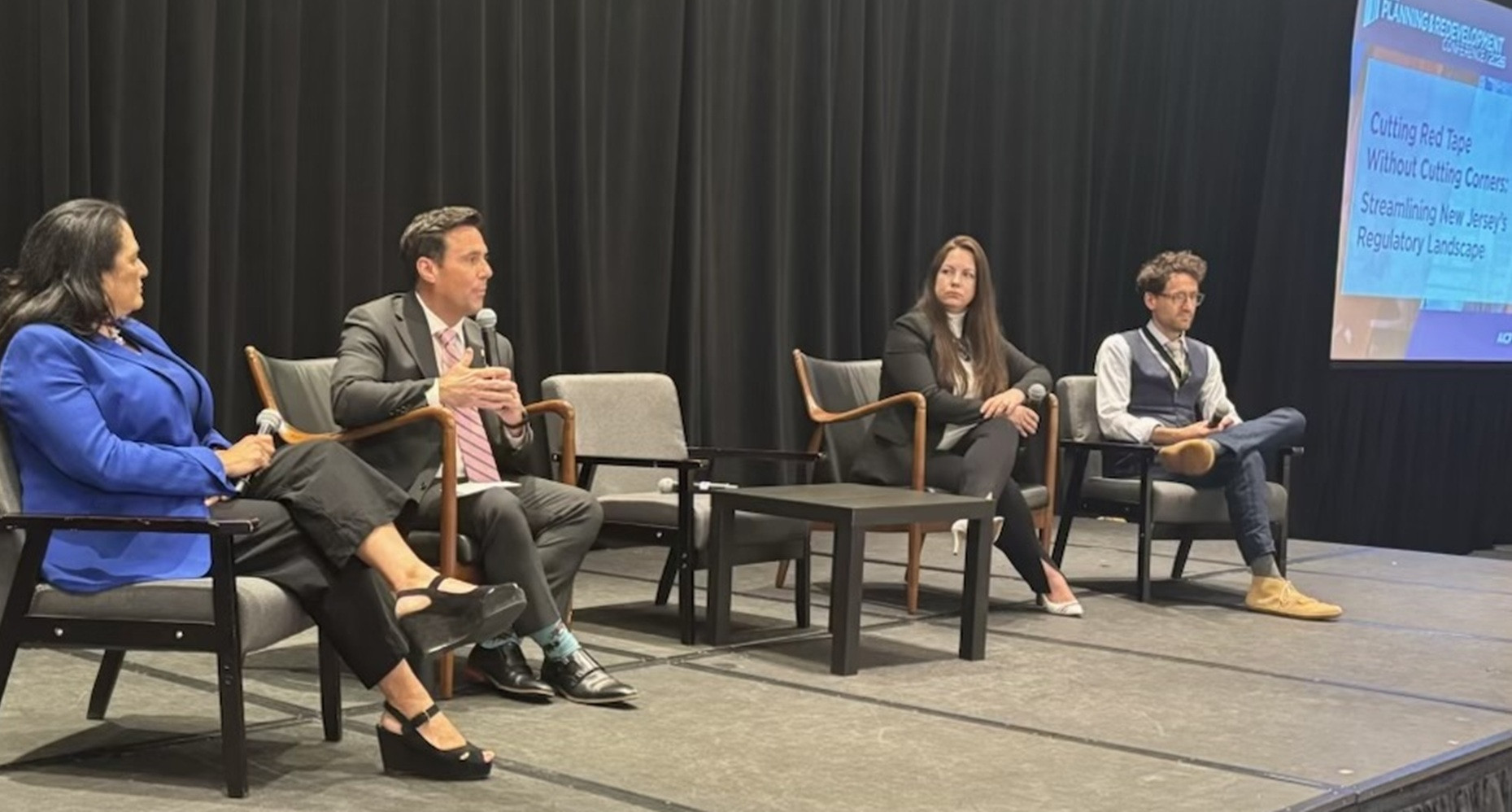
So said acting DEP Commissioner Ed Potosnak during a panel of four top Sherrill administration officials at the annual conference of NJ Future last week in New Brunswick.
Potosnak told a group of a few hundred that the department is shifting its posture from authoritative gatekeeper to working partner.
If you go into every meeting ready to say no, he said, you change the relationship and drag out the process even when the outcome was never in doubt.
Potosnak also said the department is launching what it calls Operation FAST — Facilitated Approvals for Sustainable Transformation — a coordinated effort across division heads to accelerate critical projects, starting with energy.
“We’re not changing the outcome, not changing the regulations or the protections for health, safety, and environment — but literally the amount of time that sits on a desk, to shorten that up to deliver those good projects,” he said.
Potosnak, along with Chief Operating Officer Kellie Doucette, DCA Commissioner Jacqueline Suarez and EDA CEO Evan Weiss discussed this and more in a conversation that included thoughts on the long-delayed State Development and Redevelopment Plan, the paused REAL Rules, affordable housing production and the permitting dashboard the administration is building in real time.
The group not only said things are going to change — they put timelines on the table, all the while warning that change will not be easy.
“If this was easy,” Doucette said, “it would have been done a long time ago.”
Here are 10 things we learned from the panel (which was moderated by BINJE editor Tom Bergeron):
10. New Jersey has a road map — and this administration is actually using it
Since 1986, the state has been required to maintain a State Development and Redevelopment Plan — a strategic guide for where growth should happen, how agencies should coordinate, and what the state’s priorities look like on a map. For years, it collected dust. The Murphy administration, in December of 2025, provided the first update in more than two decades.
The Sherrill administration is treating it differently. Doucette said the plan gives the cabinet a shared north star — a way to align agencies that have historically operated in their own lanes. Governor Sherrill recently signed Executive Order 17, the housing EO, which directs the state planning office and Department of State to lead a mapping effort that pulls together tools from multiple agencies into one place.
“We don’t have all the answers coming in,” Doucette said. “We want to hear from everybody.”
9. The REAL Rules are on pause — but not dead
The Sherrill administration announced a one-year delay in implementing the REAL Rules, a sweeping set of environmental regulations finalized at the very end of the Murphy administration. The rules were heavily criticized by stakeholders.
Potosnak said the pause was not an abandonment but an opportunity to gain more information. He said he spent his early weeks in office in listening mode — meeting with local practitioners, contractors, and community members — and heard consistent concerns that the rules as written would slow permitting rather than speed it up. The goal now is targeted amendments that preserve the environmental protections while removing the friction.
Any proposed changes would go out for public comment by early fall, Potosnak said, with a goal of having revisions in place before the one-year extension expires next July. Comments on the legacy extension period are open through July 31.
8. When one team has a big pile and another has a small pile, swap them
It sounds almost too simple to be a government initiative. But one of the more practical ideas Potosnak floated was cross-training DEP staff across divisions — so that when one team is buried in permits and another has cleared its queue, trained staff can shift over and help dig out.
No environmental protections change. No standards get lowered. It is purely a question of deploying people where the work is, rather than letting backlogs calcify because of rigid organizational lines.
For an agency processing 20,000 permits a year, even modest gains can add up fast.
7. Wetlands letters have been a hidden disaster. That’s changing
Before a developer can design a project, they need to know where the wetlands are on a property — so they know where not to build. That determination comes in the form of a letter of interpretation from DEP.
When Potosnak walked in the door, projects were waiting more than 18 months for those letters. He called it shocking, dismaying, and unacceptable — particularly for projects that communities depend on, like hospitals, schools, and medical centers.
The department has launched a blitz to clear the backlog. Getting those letters out faster doesn’t change what gets built. It just means the next step can finally happen.
6. Serial review is over. Simultaneous review is the goal
One of the most maddening inefficiencies in the current permitting process: agencies review projects one at a time, in sequence. Agency A takes two weeks. Agency B takes a month. Agency C takes two months. Add them up and you’ve lost nearly a quarter of a year before a shovel hits the ground.
Potosnak said DEP is working toward simultaneous review — all agencies at the table at the same time, so the clock runs in parallel rather than in series. It sounds simple. It has never been the norm.
5. A permitting dashboard is being built — and 10 pilot projects just launched
Doucette said the administration’s first permitting dashboard is now tracking 10 pilot projects selected earlier this week. The goal is to understand what information is most useful, where the holdups actually occur, and what a real-time, publicly accessible dashboard would need to show.
Getting all state agencies — with their decades of decentralized IT systems — onto a single platform will take time. But the pilot is the first step toward a future where anyone can log in and see exactly where their permit stands, which agency has it, and how long it has been sitting there.
Suarez said DCA is pursuing its own piece of this: a one-stop shop for plan review, permits, and inspections, built on the department’s existing e-plans system, that would eventually be available statewide regardless of which agency a project touches.
4. Affordable housing has a rebranding problem — and DCA is fixing it
The words “affordable housing” have become toxic in many New Jersey communities. Suarez decided to stop fighting that and start reframing it.
Her department launched NJ Homes — Housing Opportunities for Municipal Equity Success — and went directly to municipalities that had previously sued over their affordable housing obligations. Rather than lecture them, she asked what they didn’t want. Then she showed them what they actually needed.
The conversation shifted when officials started talking about lifecycle housing — starter homes for young people, accessible units for aging parents, affordable rentals for nurses, CNAs, and first responders. Two municipalities that had previously litigated their obligations joined the first cohort of 10 under NJ Homes. A second program, the Affordable Builders Club, launches in June, with cohorts of 30 municipalities planned for July and October.
“When people feel like they have the tools to figure out how to do the work,” Suarez said, “the conversation shifts.”
3. NJ Transit land could produce 20,000 housing units
One of the most concrete near-term opportunities the panel identified: state-owned land, starting with NJ Transit properties. Doucette said the transit agency has already released a land plan that could support 20,000 units — and generate revenue for NJ Transit in the process.
The administration is directing all agencies to inventory state-owned land for housing potential. It is, Doucette said, a place where the state can move more quickly than it can on private land — because it already controls the asset.
2. EDA is still cleaning up programs from the Christie and Whitman eras
Weiss offered one of the more candid moments of the panel: more than half of EDA’s current workload involves administering the back end of programs that date to the Christie and Whitman administrations. Staff who should be working on today’s challenges are still processing compliance for decisions made decades ago.
He said the agency is looking at ways to streamline the compliance process — including self-certification options — so that the team can stop living in the past and start delivering on the governor’s current agenda. Until that compliance backlog clears, he said, it acts as a brake on everything else.
“I just want to think about today’s challenges,” Weiss said, “instead of what we had back then.”
1. They gave themselves a one-year deadline. Hold them to it
At the close of the panel, each official was asked the same question: a year from now, sitting in the same room, what do you hope to be able to say you accomplished?
Doucette said she wants measurable, shareable results from the permitting pilot — real data showing that the process takes less time and less energy than it did before.
Potosnak said he wants the agencies to still be working together — and for the state to have a plan to address the looming federal funding cliff on drinking water, stormwater, and wastewater infrastructure.
Suarez went on record: thousands of housing units underway. She said hold her to it.
Weiss said he wants to be working on today’s problems — not still untangling those from yesterday.


