


New Jersey’s capital city has no shortage of assets. It sits between New York and Philadelphia, brings together legislative leaders from all corners of the state, is home to major organizations and associations — and is loaded with historic commercial corridors and underutilized properties that developers elsewhere seemingly should covet.
What it has lacked, according to a new nonprofit launching this week, is a way to connect all of it.
Trenton Forward, a Trenton-based 501(c)(3), is positioning itself as the missing link between the city’s potential and its execution — a “home for ideas, a platform for partnerships and a catalyst for Trenton,” the group writes in an impressively done 35-page prospectus.
Rather than competing with existing planning efforts, the organization describes its role as activation: taking information, relationships and capital that already exist in the ecosystem and making them easier to find, navigate and act on.
Simply put, the city needs to stop working against itself.
***
Trenton Forward’s four-person founding board brings experience — and a plan.
Executive Director Kwaku Dokyi (a Trenton-based social entrepreneur and founder of The Kooman Company) created Trenton Forward to expand opportunity in the capital city.
He’s joined by Chairman Larry Krampf, a marketing and communications executive with more than four decades of business and civic leadership; Secretary Michael Hierl, the retired founder of the Princeton-based Pacesetter Group of Companies; and Treasurer Mike Reagan, a former BellSouth chief information officer and CGI senior vice president.
The case Trenton Forward makes for its own existence starts with a diagnosis of what’s holding the city back — and it’s not a lack of opportunity. Consider:
- Information about funding, redevelopment projects, incentives and available properties is scattered across disconnected sources, making it hard for anyone to find or act on it.
- Organizations across business, government, healthcare, and nonprofits often work in silos, duplicating effort and missing chances to team up.
- Investors and developers struggle to identify trusted local partners or confidently deploy capital in a market that can feel opaque from the outside.
- Promising projects can stall simply because the right people and resources never come together at the right moment.
This is not good.
***
All of this is a familiar story in mid-sized post-industrial cities: the ingredients for a comeback exist, but nothing is stirring the pot.
Trenton Forward’s answer is to position itself as a trusted intermediary rather than another layer of planning. The group says it identifies and connects business leaders, developers, institutions, entrepreneurs, investors, nonprofits, and public officials whose interests naturally align — then works to turn those connections into partnerships around specific projects.
Much of that work will run through Trenton Forward Atlas, an AI-assisted platform the organization describes as its “ecosystem intelligence” tool.
Atlas is designed to take a user’s stated goal — finding a property, locating funding, identifying a partner — and turn it into a guided pathway of relevant information and next steps, drawing on property and GIS data, funding and incentive databases and a network of vetted organizations. The platform is built to be private by default, with high-stakes recommendations routed to Trenton Forward staff for human review before anything moves forward.
Beyond the technology, the organization has built a recurring calendar of relationship-building — executive breakfasts and evenings, a podcast, quarterly market-intelligence white papers, and an annual public summit — intended to keep Trenton in the conversations where regional investment decisions get made, and to bring those conversations back to the city itself.
***
Here’s how it will work.
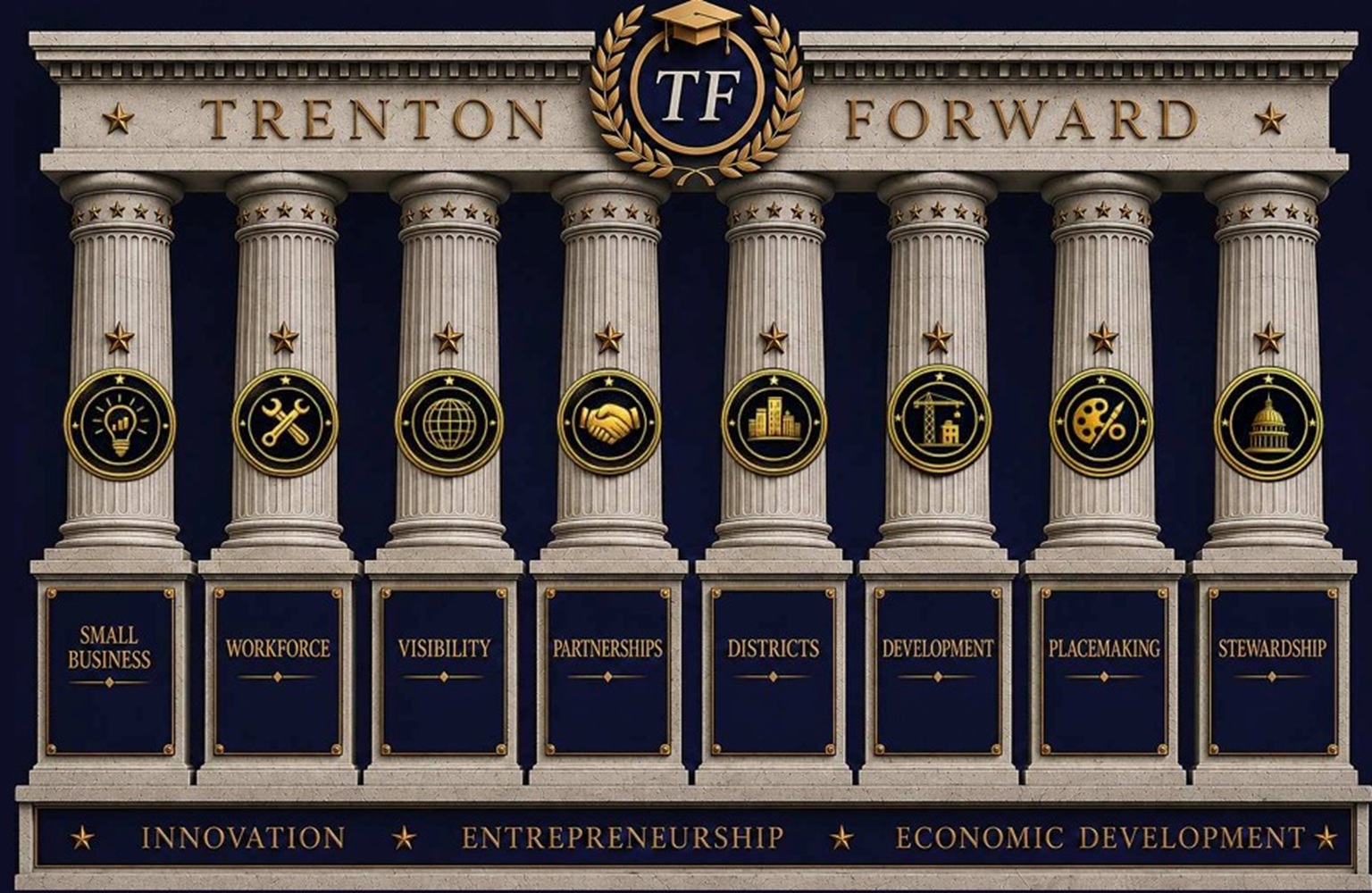
Trenton Forward has structured its work around eight focus areas, grouped under four broader priorities:
- Building the Economy (entrepreneurship and workforce development);
- Building Connections (ecosystem visibility and institutional partnerships);
- Building Places (corridor activation and mixed-use property development);
- Building Community (arts/culture and civic stewardship).
The framework is meant to give the organization’s growing list of members and advisors a shared vocabulary and set of priorities to organize around, rather than having each institution pursue its own agenda in isolation.
Trenton Forward is currently recruiting founding members — individuals, businesses, institutions and government entities — ahead of its inaugural year. Membership and sponsorship tiers ranging from a few thousand dollars to $50,000, plus commitments tied to its first annual summit, planned for January of 2027, at the Trenton War Memorial.
Whether the model works will likely come down to something harder to measure than membership dues: whether a nonprofit built to connect other institutions can actually get them to act together — and whether visibility and relationship-building translate into the redevelopment, investment and jobs the city needs.
For now, Trenton Forward is betting that the biggest barrier to the capital city’s next chapter was never a shortage of opportunity — just a shortage of coordination. And activation.


