


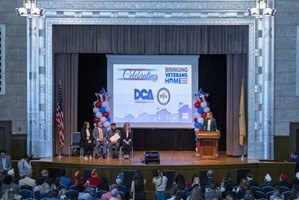
For years, New Jersey veterans leaving service or falling on hard times could end up homeless for one simple — and arguably shameful — reason: No one was connecting them to the help that already existed.
DCA Commissioner Jacquelyn Suarez, speaking Wednesday at a Trenton event celebrating the Bringing Veterans Home initiative, said the fix for the problem wasn’t complicated.
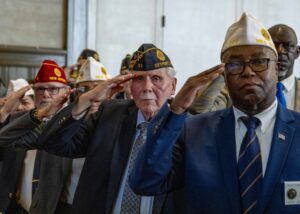
Suarez said it was about building what she called a “connective tissue of communication” — linking veterans directly to the dozen-plus organizations that can house them, without the gaps in between where people used to fall through.
“It was about getting back to basics,” she said. “We know where the veterans are, we know who can provide them services — how do we create that connective tissue where veterans are the nucleus?
“This system does that.”
That system, state officials announced, has pushed New Jersey to what’s known as “functional zero” on veteran homelessness, meaning fewer veterans are becoming homeless each month than the state can house within 30 days.
State Sen. Raj Mukherji (D, Jersey City), a Marine Corps veteran who chairs the Senate’s Military and Veterans’ Affairs Committee, put the ultimate aim plainly.
“The phrase ‘homeless veteran’ shouldn’t be a thing,” Mukherji said. “For too long, as a country, we have failed the men and women who answer our country’s call.”
Mukherji said the root of the problem was never a mystery — a lack of access to affordable housing, mental health care and support services — but closing that gap had eluded the state for years. Bringing Veterans Home, he said, finally filled it.
Launched in late 2024, the initiative pairs the Department of Community Affairs with the Department of Military and Veterans Affairs, along with federal partners and veteran service organizations, to identify both homeless veterans and those at risk and route them directly into housing and support services. Since it began, the program has permanently housed more than 2,500 veterans.
Officials were careful to frame Wednesday’s announcement as a beginning rather than a finish line, with Gov. Mikie Sherrill — herself a former Navy helicopter pilot — telling the crowd the model shouldn’t stop with veterans.
“As we take care of our veterans, these are lessons we can learn and apply elsewhere,” Sherrill said. “This to me is just the starting point, and it makes sense to start with veterans.”


