


After explaining to one of my teenage kids why they needed to get a job and learn the value of a dollar (dare I say sounding much like the speech I got decades ago), I “encouraged” them to put on a tie, create the best resume a 16-year-old could have, walk up to the local store with the “help wanted” sign in the window, look the manager in the eye and tell them in a clear voice that you wanted to work there.
They were told they had to go to an online portal and fill out an application.
They were told the local store had no say in the hiring process.
They were told it might be weeks before they heard back.
Oh, boy.
***
We (the collectively grumpy group of people doing the hiring these days) often complain about how people don’t want to work. Especially young people.
But instead of talking about how it was back “in my day,” perhaps it’s time to adjust to the present day. I recently saw an example of this on display in Tuscaloosa, Alabama.
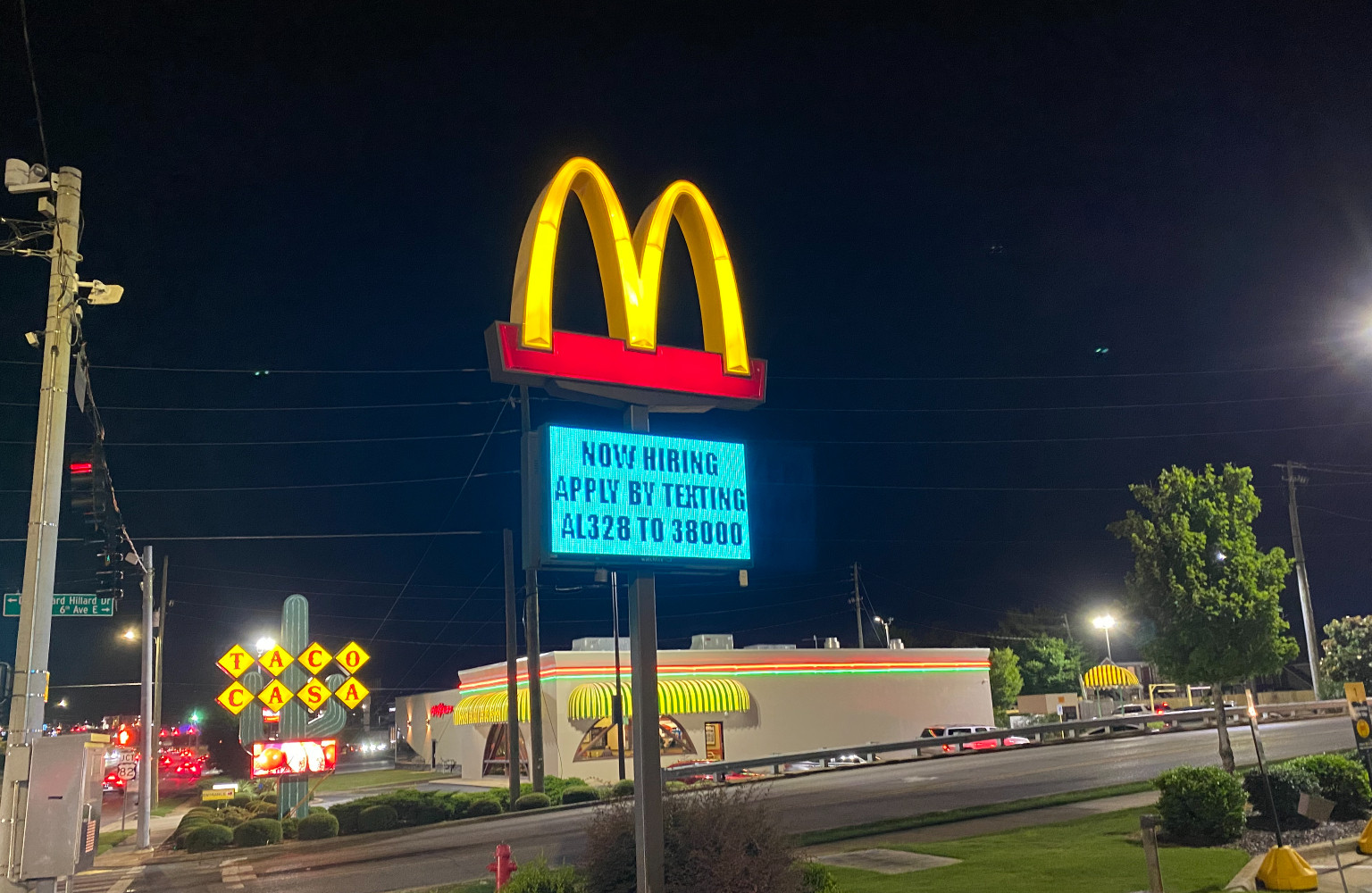
College kids were showing up, mixing with the locals. And the McDonald’s on the local strip needed help.
“Now Hiring: Apply by Texting,” the LED sign in the parking lot said.
They might be on to something here.
***
Data from the National Center for Education Statistics shows teen employment has been sliding for decades. Roughly a third of high-school-age teens worked in both 1970 and 2000 — but that share has steadily fallen, landing at just under 28% in 2022. It’s a long, slow decline that mirrors the shift from walk-in hiring to digital gatekeeping.
Numbers from the U.S. Bureau of Labor Statistics tell the same story across a wider age range. Youth labor-force participation (ages 16–24) topped 70% around the turn of the century. Today, it hovers near 60%. Fewer young people are in the pipeline — not because they’re unwilling, but because the on-ramps have changed.
Even with a tight labor market, teen participation (ages 16–19), according to BLS data, sits in the mid-30% range — well below what earlier generations saw. The numbers show fewer teens working, yes. But they also show a hiring system that’s become slower, more automated and far harder to break into.
What can be done?
***
To be clear: This isn’t just a first-job, teenage problem.
Anyone who has applied for an adult job online in the last few years knows the same frustration: the portal that swallows a resume without a trace, the “we’ll be in touch” that never comes, the algorithm deciding whether a human ever sees your application at all. Teens are just experiencing, for the first time, what the rest of us have been grinding through for years.
Let’s be honest: The hiring process stinks.
And there’s enough blame to go around on both potential employers and potential employees.
If the “dress-up-nice and look-them-in-the-eyes” approach is now outdated — if we have to move to technology — let’s at least find ways that make sense for a new generation.
***
The person working the counter at that particular Tuscaloosa location couldn’t tell me if the “text-to-hire” concept was working well. They didn’t have time for a chat. They were just trying to get through the non-stop orders of the drive-thru.
It’s part of the conundrum of hiring in 2026: We’re so short-staffed that we barely have time to hire the people who could fix the short-staffing.
But we salute the idea of trying something new — meeting the next generation where they actually are, texting and all — something that certainly beats filling out an application to an online portal that gets read (likely by a non-human) in some other state.
It’s a small anecdote about the state of hiring, but it may offer an insight into a bigger truth: the narrative around young workers doesn’t match the reality they’re walking into.
Simply put: We need to change.
BTW: BINJE always is looking for good candidates.
Text me if you’re interested at 973-294-4863.


