


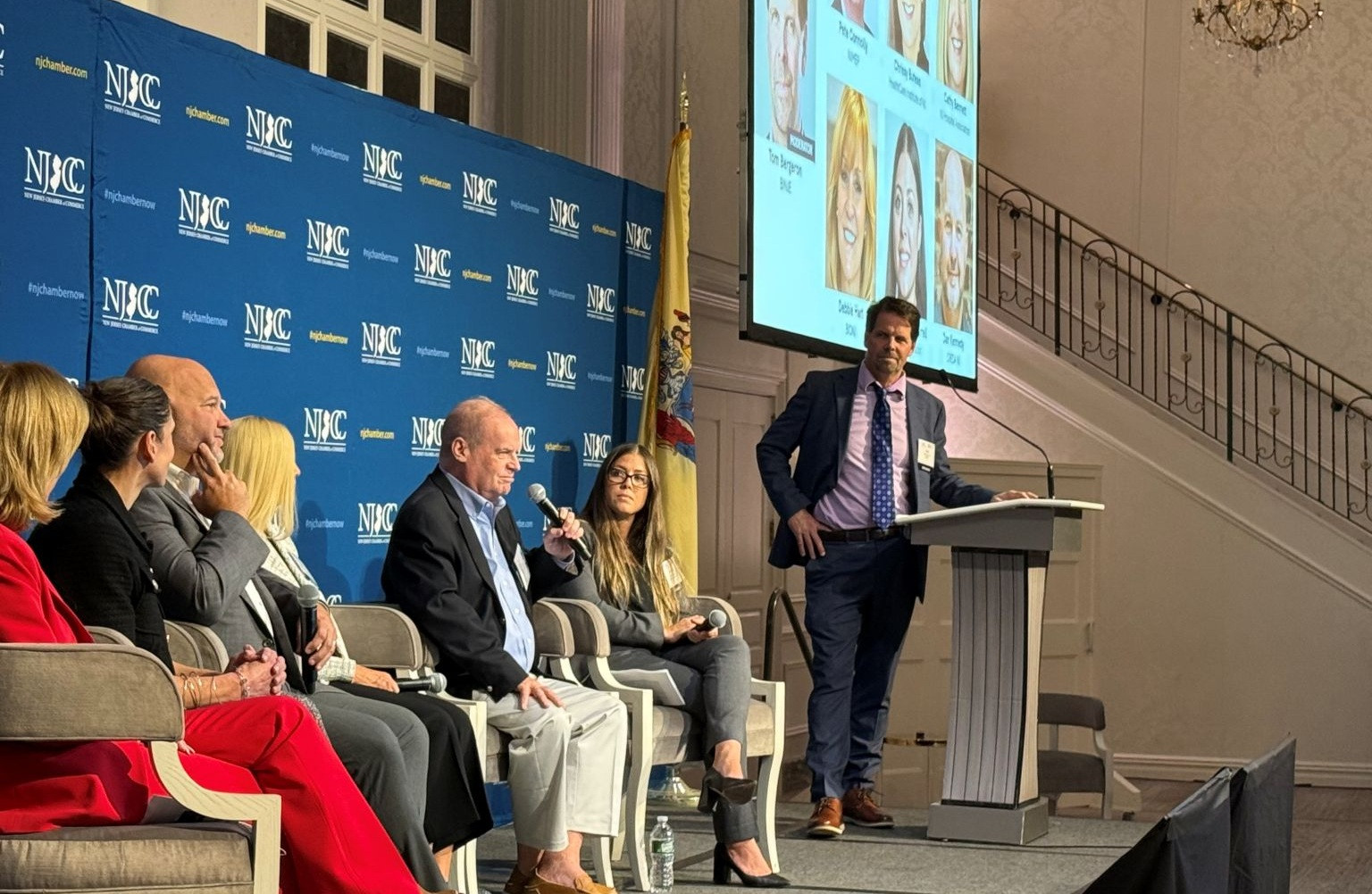
On paper, the five industries on stage Wednesday night don’t have much in common. One makes things. One powers things. One cures things. One heals people. One builds the places where all of them work.
Ask them about the challenges ahead, though, and you get one answer five different ways.
New Jersey Hospital Association CEO Cathy Bennett got there first.
“There are a lot of challenges, and they’re the exact same ones you’ve heard,” she said. “We need to have training opportunities. We need to have childcare in place. We need a transportation system that works.”
The comments came during a panel at the New Jersey State Chamber of Commerce’s NJ250: New Jersey Powers America celebration, held Oct. 7 at The Palace at Somerset Park. The event marked the nation’s 250th anniversary by honoring the companies and people who built the state, and by asking what comes next.
The night had plenty of headliners. Former PSEG chairman and CEO Ralph Izzo was honored as a Business Icon and used his time to urge the crowd to read beyond their feeds and vote in primaries [LINK]. Retiring Hackensack Meridian Health CEO Bob Garrett closed the night with a “what if” wish list for the state’s next chapter [LINK].
In between came the panel, “How New Jersey Built America — and How We Build the Next 250 Years,” which I moderated. Each leader was asked about the opportunities and challenges facing their sector.
The opportunities were all different. The challenges were the same.
The panelists:
• Pete Connolly, CEO, New Jersey Manufacturing Extension Program
• Christina Gordillo Farrell, vice president, New Jersey Utilities Association
• Debbie Hart, CEO, BioNJ
• Chrissy Buteas, CEO, HealthCare Institute of New Jersey
• Cathy Bennett, CEO, New Jersey Hospital Association
• Dan Kennedy, CEO, CREDA NJ
Here are 13 other great comments:
Manufacturing has jobs. It needs people.
Connolly’s group works with the state’s 10,000 small and midsize manufacturers. He said their biggest issue is workforce.
“We have an aging workforce. There are probably 10,000 boomers retiring every day. There are 40,000 manufacturing jobs open,” he said. “How do we get the workforce and students into their manufacturing career?”
NJMEP is working with partners such as the African American Chamber of Commerce, Rowan University and the New Jersey Council of County Colleges to find the answer.
Photonics is a bigger deal than you think.
Connolly pointed to a cluster that stretches from Rowan University in the south to Thorlabs in Sussex County.
“There are over 250 photonics companies in New Jersey, and we need to highlight that more,” he said.
Utilities are the lifeline.
Farrell said every other sector on stage depends on hers.
“We believe we’re the lifeline that other industries need to be successful in our state,” she said.
She boiled the future down to two words: growth and investment.
“Utilities will continue to grow. We are literally embedded here. We have been embedded here for the last century, and will continue to be. But in order to grow, we need to be able to make investments,” she said.
That means replacing aging infrastructure and preparing for storms that, since Sandy, keep getting more severe.
Life sciences finally has a home base. Several, actually.
Hart remembers when the industry had nowhere to gather.
“When we started BioNJ in 1994, we didn’t have a hub,” she said.
Now there’s SciTech Scity in Jersey City, an incubator in Newark, the Nest in Kenilworth and HELIX in New Brunswick, where BioNJ just took space.
“We have so many cool spaces now in New Jersey, and so our companies are investing in them,” she said.
The medicine chest is still open.
Hart said it takes 10 to 15 years and $2.6 billion on average to bring one drug to market. Most never make it out of the lab.
New Jersey, she said, still gets more than its share of those that do.
“Companies with a footprint in New Jersey are each and every year responsible for anywhere from 30 to 50 percent of all novel FDA drug approvals,” she said.
The industry’s real product? More time.
Buteas said HINJ’s members “have essentially given all of New Jersey residents and the world more time.”
“Our life expectancy has grown by 20 years in the last 100 years,” she said. “More time with your loved ones, the ability to go to a birthday party, a wedding.”
She recalled what a patient advocate from the National Organization for Rare Disorders once told a HINJ summit.
“He said, ‘New Jersey’s life sciences, without them, people die,’ and he’s absolutely right,” she said.
The next cures will come faster.
Buteas said the life sciences have extended lives by working with public health officials, universities, health systems and academic partners. There’s still a long list of unfinished work: thousands of rare diseases without a cure.
“I am confident that we are going to accelerate that through artificial intelligence and precision medicine,” she said.
People are living longer. They’re also sicker.
Bennett pointed to a recent NJHA report. Over the past 10 years, the number of patients who come into the hospital severely ill, with eight or more serious conditions, has grown by more than 15%.
“Yes, lifespans have increased, but lifespans have increased for people who are a whole lot sicker,” she said.
Hospitals innovate, too.
Bennett said one NJHA member developed a COVID test in under a week. Newark Beth Israel created the process for monitoring and managing pacemakers, which was then adopted around the world. Now hospitals are turning to AI.
“We have people that are looking at AI and saying, ‘How can we use it for neuro oncology? How can we use it to detect bladder cancer earlier?’” she said.
Everyone wants predictable.
Three panelists, three ways of saying it.
Farrell on permitting reform: “Predictable regulation, timely permitting, that’s key.”
Bennett on public policy: “We need something that’s stable and predictable in terms of public policy decisions.”
Kennedy on development: “What we need in New Jersey is for developers to feel comfortable enough in the regulatory environment so that these opportunities can continue to take shape.”
Developers follow the money. Now the money is in the cities.
Kennedy, a trained planner, said planners have dreamed for decades of reviving downtowns. For a long time, the market didn’t cooperate.
“They build where they can make money. So they built in suburbs,” he said.
Times changed. Kennedy pointed to the Jersey City and Weehawken waterfront, once blighted port land, where developers took on the environmental risk and remade the area. He said private money has done the heavy lifting on cleanups across the state.
“We have invested more private money in cleanups, probably twentyfold over any public money that’s been put in,” he said.
Learn about nature in nature.
CREDA NJ supports the New Jersey School of Conservation, which brings kids outdoors for a few days at a time. Kennedy said the goal is for kids to “learn about the environment in the environment and not on Facebook.”
New Jersey won the Revolution. Just ask a manufacturer.
Connolly wanted the 250th anniversary to get its due. American manufacturing started in New Jersey, he said: in Paterson with Alexander Hamilton, and at Batsto Village, which made cannonballs.
“Who won the American Revolution? New Jersey,” he said, ticking off Trenton, Princeton and Monmouth.


