


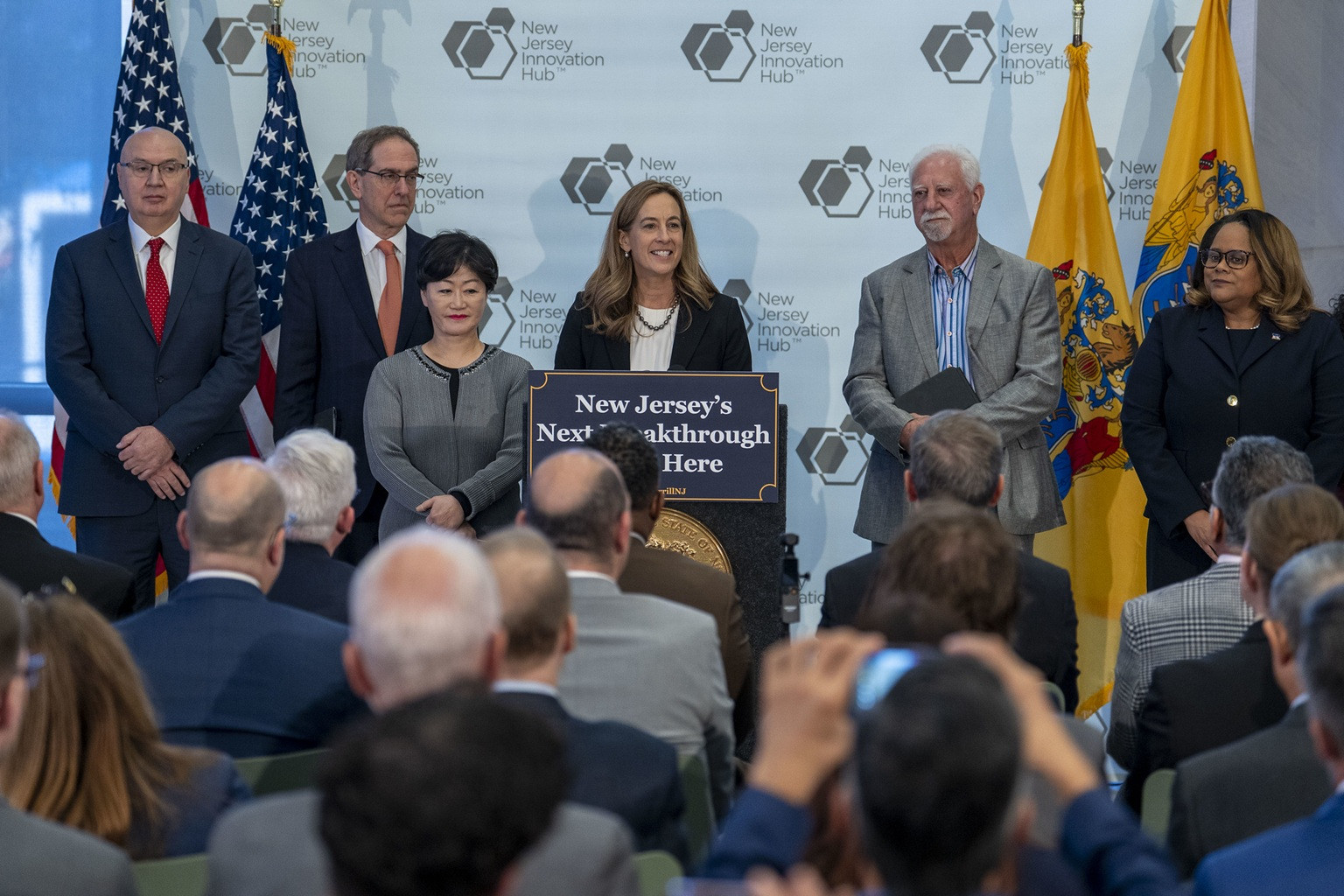
Gov. Mikie Sherrill’s New Jersey Supercomputer Initiative puts more than $125 million behind one machine shared by the state’s research universities.
We did some computing on our own and came up with two dozen facts about the moment:
Read more on the Supercomputer
- State launches $125M New Jersey Supercomputer Initiative
- What does the supercomputer mean for N.J.? Let us count the (two dozen) ways
- Supercomputer gives N.J.’s research universities a shared edge
24. Turing would approve: Sherrill opened by reaching back to 1938, when a 25-year-old Alan Turing was finishing his dissertation at Princeton. “The supercomputer embodies Alan Turing’s vision,” she said.
23. Twice the muscle: The initiative is expected to double the supercomputing capacity available across New Jersey’s research universities. Sherrill said it will increase their most advanced capabilities tenfold.
22. Big money, three sources: Chris and Melody Malachowsky are giving $75 million, SHI International is investing $25 million and the state is putting in $25 million through the NJEDA, from the FY2026 budget.
21. A hometown donor: Malachowsky co-founded NVIDIA and grew up in Monmouth County. This year marks 50 years since he graduated from Ocean Township High School.
20. Two governors, one project: Malachowsky credited former Gov. Phil Murphy, whose visits to California got the ball rolling. Murphy introduced him to Sherrill when she was governor-elect, and she drove it to the finish.
19. A homegrown giant: SHI, which will host the machine, was founded in New Jersey in 1989. CEO Thai Lee said it has grown from a little less than a few hundred thousand dollars in revenue to a projected $18 billion in gross sales this year, with nearly 2,500 employees in the state. Sherrill called it the nation’s largest minority- and women-owned business enterprise.
18. Rivals on the same team: All eight research universities are in: Kean, Montclair State, NJIT, Princeton, Rowan, Rutgers, Seton Hall and Stevens. They co-designed the plan with the state over the past few months, and each plans to contribute annually.
17. Community colleges get a seat: The NJ Council of County Colleges is part of the partnership, bringing the state’s 18 community colleges along.
16. More schools are coming: Pathways for other colleges and universities to join will be announced in 2027.
15. Startups and investors next: Sherrill said the state will explore partnerships with startups and investors next year.
14. Nonprofit governance: Starting in 2027, the supercomputer will be administered by NJSCI, an independent nonprofit. The state says it will be guided by principles of transparent governance and equitable access.
13. It stays in Jersey: SHI will host and operate the machine in its existing New Jersey facilities.
12. Clean power: The state says the initiative will bring new clean energy onto New Jersey’s grid. That’s worth noting at a time when data centers are drawing scrutiny for their energy use.
11. A grant magnet: At the University of Florida, a supercomputer Malachowsky helped build has attracted $800 million in federal and nonprofit research grants, eight times its initial investment, according to Sherrill.
10. Cancer research: Earlier cancer detection and treatment is among the projects under review. Rutgers researchers are already using advanced computing to study how immune cells develop, work that could lead to childhood leukemia treatments.
9. Flood defense: NJIT works with 25 communities and the state Office of Emergency Management on flooding, and every simulation takes hundreds of computers. Rutgers has built an AI digital twin of the state’s coastline.
8. Better drugs, faster: At Rowan, Ph.D. student Tiana Noll Walker said watching a single protein for one-millionth of a second takes 500 million data points. That kind of work is what a supercomputer is for.
7. Alzheimer’s: A Rutgers team used high-performance computing to study the brain’s waste clearance system and found a potential therapeutic approach for Alzheimer’s disease and children with neurological disorders.
6. Safer AI: Projects under review include improving the safety of large language models.
5. Classroom time: Some of the computing power is reserved for coursework and research capstones, so students get hands-on experience with advanced machines.
4. Not just for students: Malachowsky said he’s especially excited about extending access beyond research, so workers already on the job can build new skills and prepare for emerging roles. The state Department of Labor is part of the effort.
3. A jobs pipeline: The state is building new curricula, training programs and apprenticeships in AI, data science and advanced computing. That builds on the first-in-the-nation AI data science apprenticeship the NJ AI Hub launched with community colleges.
2. Bell Labs, take two: Sherrill pointed to Bell Labs, which drew thousands of scientists and engineers to New Jersey, many of whom went on to launch startups. The goal is for the supercomputer to do the same.
1. A model for the country: Malachowsky said his broader vision, which he has been promoting around the country, is for all 50 states to have computing resources like this. New Jersey is among the first to step up.


