


New Jersey’s eight research universities compete for students, faculty and grant money. Now they’ll share a supercomputer.
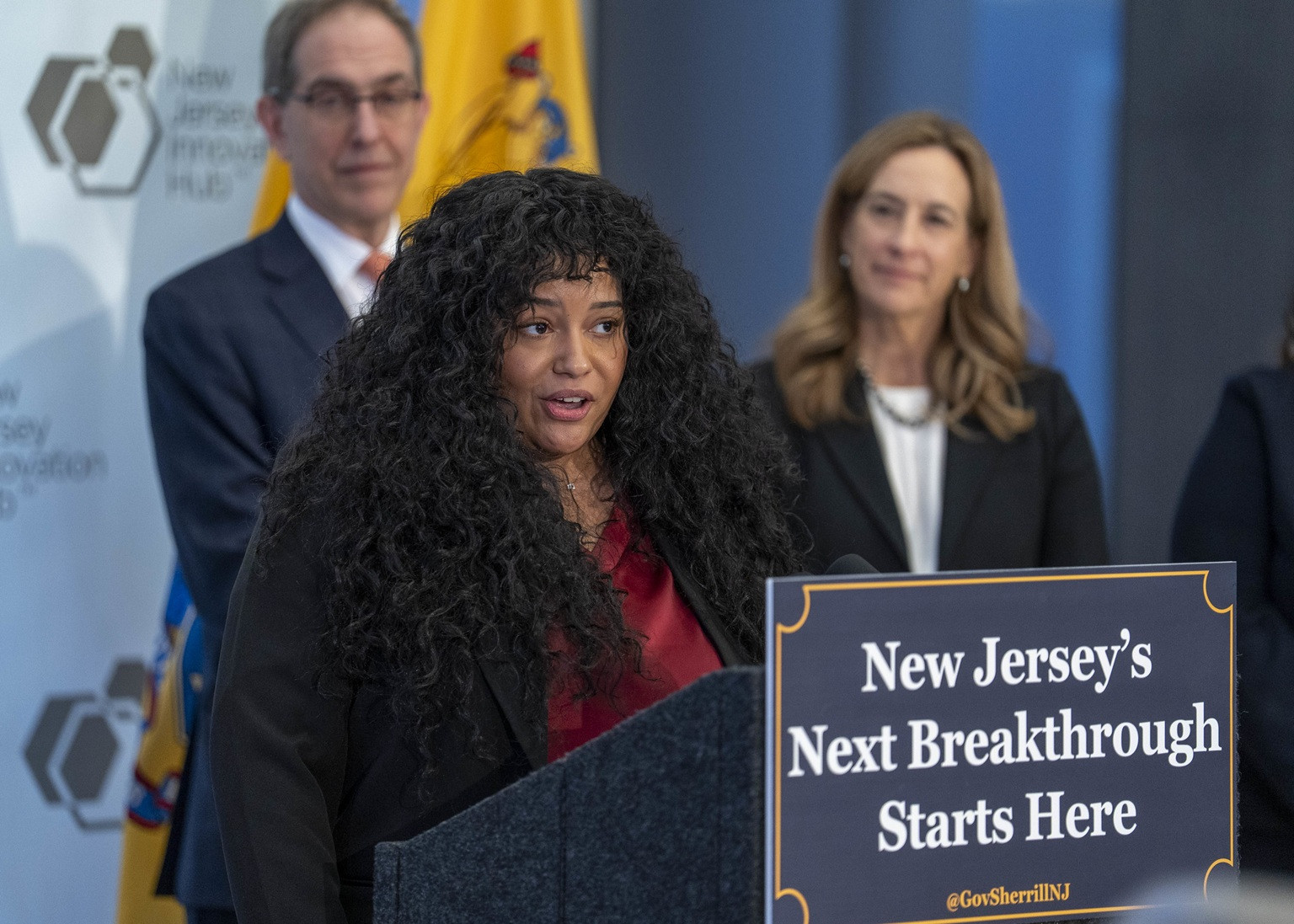
Kean, Montclair State, NJIT, Princeton, Rowan, Rutgers, Seton Hall and Stevens are all partners in the New Jersey Supercomputer Initiative, which Gov. Mikie Sherrill launched Tuesday in New Brunswick. Each plan to contribute to the initiative’s budget every year, and Sherrill said the schools spent the past few months co-designing it with the state.
Read more on the Supercomputer
- State launches $125M New Jersey Supercomputer Initiative
- What does the supercomputer mean for N.J.? Let us count the (two dozen) ways
- Supercomputer gives N.J.’s research universities a shared edge
The payoff is capacity. The initiative is expected to double the supercomputing capacity available across all of the state’s research universities and dramatically increase capacity on the most advanced hardware.
Sherrill said that changes what researchers can attempt.
“In research, computing power acts like a currency,” she said. “There’s a ceiling on the types of questions that scientists can afford to take on with their machines. The supercomputer will raise that ceiling, so researchers can ask and answer more complicated problems.”
NJIT Interim President John Pelesko said in a statement that the machine has been the bottleneck.
“Large-scale computing has become one of the real limits on what we can discover,” he said. “Many good ideas, whether in a lab or a classroom, wait because the machine needed to test them is out of reach.”
***
The universities already have submitted projects. Dozens are under review for 2027, according to the state, covering everything from cancer detection to coastal flooding.
Keena Arbuthnot, executive vice president for academic affairs and chief academic officer at Rutgers, said the stakes go beyond any single project.
“The institutions that invest in AI infrastructure today would define higher education for the next generation,” she said.
She pointed to a Rutgers team that used high-performance computing to study the brain’s waste clearance system and found a potential therapeutic approach for Alzheimer’s disease and children with neurological disorders. Another Rutgers team used AI to build a digital twin of the state’s coastline.
At NJIT, Michel Boufadel, a distinguished professor of civil and environmental engineering, works with the state Office of Emergency Management on flooding in 25 communities. Each simulation needs hundreds of computers.
“Supercomputing is really helpful for us here in New Jersey because it allows us to move from big data to well-informed action,” he said.
Tiana Noll Walker, a Ph.D. student in computational biophysics at Rowan, said watching a single protein move for one-millionth of a second takes 500 million data points.
“That is a ton of data, and AI and supercomputers are able to help us work with that data and find patterns within that data so that we can design better, safer drugs for people,” she said.
There’s money in it, too. At the University of Florida, a supercomputer NVIDIA co-founder Chris Malachowsky helped build has attracted $800 million in research grants, eight times its initial investment, according to Sherrill. Malachowsky and his wife, Melody, are giving $75 million to the New Jersey effort.
***
The machine isn’t reserved for faculty. Some of the computing power is set aside for coursework and research capstones, so students get hands-on time with advanced hardware.
Kean University President Lamont Repollet said in a statement that the goal is bigger than job training.
“By expanding access to advanced computing, we can accelerate discovery and prepare students not merely to enter emerging fields, but to shape them,” he said.
Community colleges are part of the deal. The NJ Council of County Colleges is a partner, and the state is building curricula, training programs and apprenticeships in AI, data science and advanced computing.
Aaron Fichtner, president of the council, said in a statement that the initiative “will greatly expand cutting-edge research and educational opportunities for community college students across the state.”
Pathways for more colleges and universities to join will be announced in 2027, the same year NJSCI, an independent nonprofit, begins administering the machine.
Princeton President Christopher Eisgruber said that kind of collaboration will be essential.
“Continued collaboration will be essential if we are to meet this extraordinary moment,” he said.
For eight schools used to competing, that may be the biggest change of all.


