


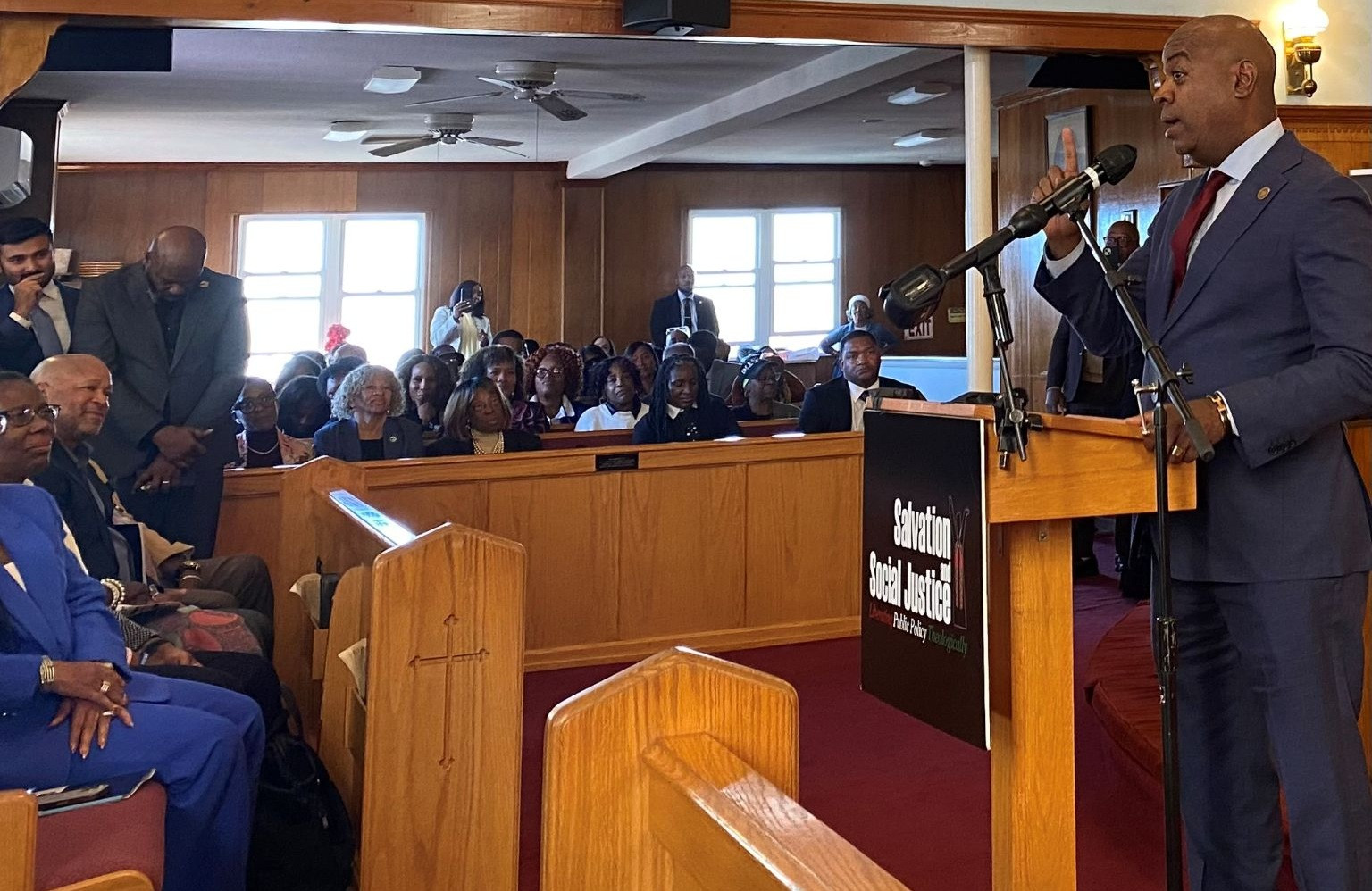

Newark Mayor Ras Baraka, after watching what happened on election night in the South — in Georgia, in Mississippi — said he came to Atlantic City envious.
Not angry, he insisted. Envious.
“You probably be better off if I was angry, but I have clarity,” he said. “I’m clear on what needs to happen and where we are. And I’m a little envious of what I saw in the South that did not happen here in New Jersey.”
Standing in the sanctuary of St. James AME Church on New York Avenue in Atlantic City, before an overflow crowd at the 2nd Annual New Jersey Statewide Black Agenda Convening, Baraka said Black voters in the South showed what a community can win when it moves together. In New Jersey, he said, too many are settling for leftovers — and spending their energy fighting each other instead of fighting together.
“We’re fighting each other for concession prizes,” he said. “We’re at each other’s throat for third place. To be the emissary, the voice for somebody else.”
Then he pointed to Georgia.
“Georgia got the governor, the secretary of state, the Department of Labor, the schools,” he said. “And we’re here fighting for just a lieutenant governor (selection) — and are willing to go at each other just to be next to power.
“What are we doing here?”
It was the question of the day.
Baraka asked it about 10 times in a talk that ran roughly 20 minutes, turning it over and coming back to it the way a preacher comes back to a text. Baraka is a poet, the son of one, and a former high school principal. He is easily the best orator in the state, and he showed why: the rhythm, the repetition, the call and response.
The crowd kept rising to its feet.
The League of Municipalities is a three-day event in Atlantic City filled with parties, panel discussions, municipal workshops, executive orders — even a committee hearing. But the most powerful moment of the week came Wednesday afternoon, at the end of a 90-minute gathering that was far from the glitz and glamour of the casinos.
This was real.
***
The convening, organized by the Rev. Charles Boyer’s Salvation and Social Justice, drew more than a half-dozen speakers, including Gov. Mikie Sherrill, who delivered remarks and signed an executive order, and Lt. Gov. Shirley Emehelu, who attended.
Baraka didn’t let the state off the hook.
“What do you do when the state is blue and still deeply racist? — so much so that they refuse to even acknowledge it,” he asked the crowd.
He pointed to failing schools in urban districts and state contracting efforts that fail minority businesses.
“It’s not enough to say you’re going to have restorative justice in school, and then before the Supreme Court argue that segregation is okay,” he said. “It doesn’t make sense for you to say separate is equal in the spirit of a disparity study that you know is unequal.”
He pointed to homes, too.
Baraka said county and city governments are taking ancestral homes from Black families in Salem, Bridgeton and Whitesboro.
“You can’t talk about Black wealth and watch Black families lose their homes,” he said.
But his sharpest words were for the people in the pews. The problem, he said, isn’t one person — it’s a whole system. And the infighting only feeds it.
“Don’t get on the news and defame one another,” he said. “Don’t make videos that drag each other down. It’s nonsense. It’s foolishness.”
His fix: Settle it behind closed doors.
“Stop running 10 of us for one seat,” he said. “Somebody call a meeting. Let’s fight inside and come out with two choices.”
And then he offered one of the many lines that brought the room up.
“We need to stop the violence in here,” he said. “Never mind the violence in our streets. Stop the violence in this room.”
***
To make his case, Baraka went to the Bible — and to Black history.
He reminded them of Elijah, who defeated the 450 prophets of Baal, then fled and hid in a cave, convinced he was alone. God reminded him that 7,000 others had remained faithful.
“I know you think that you’re by yourself,” Baraka said. “The reality is God is waiting for you to fight, and when you begin to fight, the soldiers will show up.”
Then came the roll call.
“And so, the question becomes: What are we doing here?” he said in a booming tone that captured the room.
He noted the relative inaction of the present with famous efforts of the past:
How Mary McLeod Bethune, starting with little more than faith and determination, sold sweet potato pies and raised money to build a school that eventually became Bethune-Cookman University.
How Robert Smalls, born into slavery, commandeered a Confederate transport ship, sailed it to freedom and later used the prize money and rewards from that daring act to buy the home where he had once been enslaved.
How Richard Allen and Absalom Jones, unwilling to accept segregation in worship, built institutions of their own and helped lay the foundation for independent Black churches in America.
How Black entrepreneurs, barred from opportunities elsewhere, built the thriving Greenwood district in Tulsa, known as Black Wall Street, only to watch it be destroyed during the Tulsa Race Massacre of 1921.
“They wouldn’t put us in their schools. We built our own school,” he said. “Wouldn’t let us in their fraternities. We started our own.”
Which is why, he said, he has never bought the idea that Black communities are asking for handouts.
“Nobody has ever handed us anything,” he said. “I’m still waiting for the handout.”
***
Baraka said he wasn’t there to entertain.
“I write poetry, but I ain’t no rapper,” he said. “I’m not here to make you feel good or to make them feel good. The reality is the reality, and the truth is the truth.”
He offered an orator’s apology.
“I’m sorry I had to bring it like this,” he said at one point, and later, “I apologize if I am offending you, but it’s for the person that’s sitting next to you.”
In truth, it was all part of his call to action — all part of the answer to the question: What are we doing here?
In the end, he came back to the historic night in the South and to the Black women he credited with the results there.
“I am super excited about that,” he said, “but I would be more excited if New Jersey, where I live, did the same thing.”


