


As she stood in front of hundreds of Latinas, all on their feet and clapping in honor of her remarkable career, Zulima Farber, the state’s first Latina attorney general, struggled to find her words and hold back her tears.
“This is truly overwhelming,” she said.
When she found her words, she spent them on other people.
Farber looked out at the crowd at the Latina Civic Foundation’s inaugural Latina Excellence Breakfast, held Oct. 9 at The Rutgers Club in Piscataway, and saw a career’s worth of colleagues.
“You know, I think I know every person in this room,” she said. “And at one time or another, we have worked together on something.”
She saved special thanks for Lowenstein Sandler, the Roseland law firm where she was the first woman partner. The firm was a founding donor of the breakfast, and several of its partners, including former Attorney General Christopher Porrino, came to see her honored.
“Lowenstein Sandler has always stood by me,” she said. “They have stood by me from the very beginning, from when I was an associate. Stood by me through the good times and the bad times.”
The firm backed the causes she championed, she said, with more than kind words.
“Not just with their voice, but with their resources, with the platform that they created for me, that made it possible for me to open all those other doors,” she said.
For all the thanks she gave out, much more came back.
U.S. Rep. Nellie Pou (D-9th Dist.), herself the first Latina to represent New Jersey in Congress, said Farber was a big part of her own rise. When Pou started in politics, she said, few women held leadership roles, and even fewer Latinas.
“We were fortunate to have someone who really helped to allow many of us and create that opening for us,” Pou said. “Zulima was a true pioneer.”
***
Farber’s impact is generational.
Pou reminded the room how long ago Farber became attorney general.
“Let me just say that was 20 years ago, guys,” Pou said. “20 years ago, guys.”
Farber’s personal journey began many years before.
She was 16 when she fled Cuba with her siblings after Fidel Castro took power. They lived with an aunt until their parents could get out too. She graduated from Memorial High School in West New York, then worked her way through Montclair State College and Rutgers School of Law–Newark. At Rutgers, she helped found the Association of Latin-American Law Students.
Then she started stacking up firsts, along with a few jobs nobody else could claim.
She was an assistant prosecutor in Bergen County and an assistant counsel to Gov. Brendan Byrne. From 1992 to 1994, she served as state public advocate in Gov. Jim Florio’s cabinet. She was the last person to hold the job before Gov. Christine Todd Whitman abolished the office.
In 2006, Gov. Jon Corzine named her attorney general, the first Latina to hold the post. That February, she held a bigger job, briefly. Corzine, the Senate president and the Assembly speaker all left the state at the same time for a dinner in Washington, D.C. Under the state constitution, that made Farber acting governor. She was the first Latina to serve in the role, for as long as it took one of them to get back across the state line.
 ***
Along the way, Farber did things her own way.
When an adviser first told her to apply to Lowenstein, she told him it wouldn’t be a good fit. He told her he knew her and he knew them, and it would work.
“He was right, and I was wrong,” she said.
She left the firm for public service more than once, and the firm kept taking her back.
“I think I’m the only partner that got voted in as partner three times because I kept leaving and coming back,” she said.
Farber retired from Lowenstein 15 years ago but the bond continues. The firm brought a handful of attorneys and associates to the event, a symbol of the bonds she created there.
Those bonds were everywhere.
Farber has a knack for finding people, building bridges.
Patricia Campos-Medina, president of Latina Civic Action, remembers when Farber found her. It was 2004. Campos-Medina had come up from Washington, D.C., to help settle a strike in Atlantic City and was all over the news. Her office phone rang. It was Farber, inviting her to lunch in New York.
Over that lunch, Campos-Medina said, Farber laid it out. She was building an organization to grow Latina political power, and she wanted the labor movement on her side.
Campos-Medina signed on. She’s been there ever since.
“You never gave up on us, and you were the first,” Campos-Medina told her. “But you have always opened doors for all of us.”
That effort grew into Latina Civic, which Farber helped found. Five years in, the group has helped send two Latinas to Congress. To mark the moment, the foundation announced it is naming its year-long leadership academy for her, the Zulima Farber Cívica Leadership Academy, which will train cohorts of Latinas for public life.
***
The hundreds of Latinas in the room that day told their own Farber stories.
Cumberland County Commissioner Yolanda Garcia-Balicki was a young lawyer working in state government when Farber was appointed.
“I was fan-girling so badly,” she said. “Thank you for your trailblazing. It made it possible for me to pursue my career.”
Wilda Diaz, the former mayor of Perth Amboy, called Farber “the special, special woman that opened the doors for all of us.”
Those doors knew no genders.
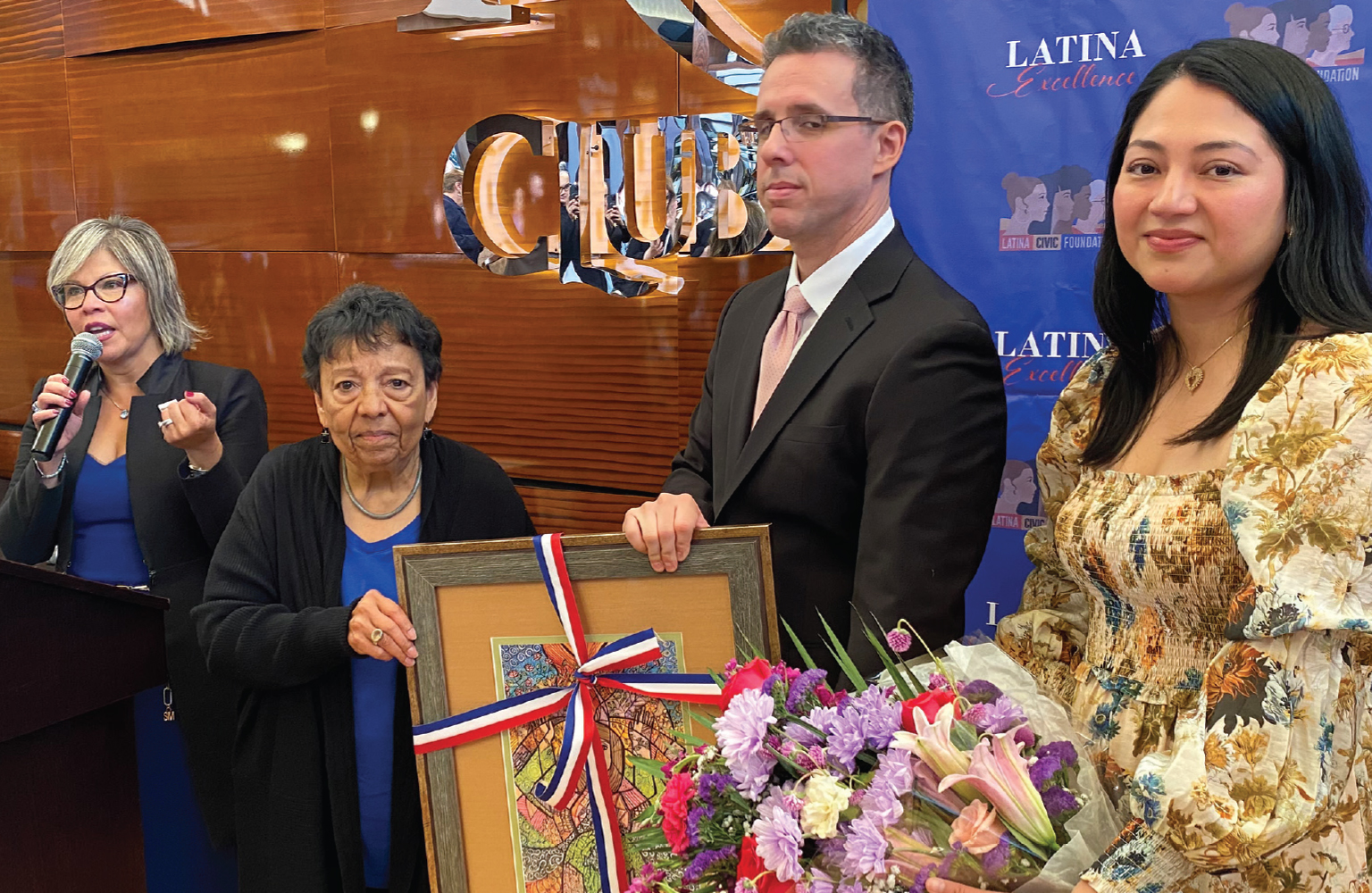
Assemblyman Gabe Rodriguez presented her with a resolution from the General Assembly.
“We will never be able to thank you enough for all that you have done for not only me and my family, but to so many people here in this room,” he said.
Farber’s advice to the room, the same room that had just given her a standing ovation, was about how she got there. Latinas have to build their own power, she said, but they can’t do it alone. Look for allies who share your beliefs, even if they don’t share your background.
“When there is no one that looks like you, you find somebody that feels like you,” she said.


