


Headquartered in Cherry Hill, Bestwork Industries for the Blind has spent more than four decades empowering people who are blind or visually impaired to achieve greater independence and meaningful employment. Founded in 1981, the nonprofit combines workforce development and employment opportunities with a range of professional services, including commercial sewing, military apparel production, custom kitting, light assembly, document scanning and digital imaging.
Through its work, Bestwork demonstrates the skills, capabilities and value that people with vision loss bring to the workplace while helping businesses and communities benefit from an inclusive workforce. Its mission extends beyond employment, however, to breaking down barriers, challenging misconceptions and creating opportunities for people who are blind or visually impaired to participate more fully in everyday life.
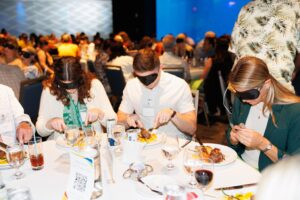
That mission took on a personal dimension at the Camden Aquarium, where Bestwork hosted its second Dining in the Dark experience. The immersive event invited guests to experience a small part of the challenges people with vision loss can encounter in everyday situations, using something most of us rarely think twice about: eating a meal.
The setting was unexpectedly serene. As guests arrived, fish and sharks glided through the aquarium’s enormous glass enclosure. Relaxing music filled the room, and servers circulated with hors d’oeuvres that were easy to reach and enjoy.
It was a welcoming beginning to an evening designed to challenge perceptions.
I was fortunate to share a table with Jon Katz, president and CEO, and Tom Black, senior vice president of operations. But the person who would make the most lasting impression on my experience was our table captain, Mike, a visually impaired man who guided us through the evening.
Slipping on the blindfold: The struggle of sightlessness
When the main course arrived, guests were instructed to put on their blindfolds. Suddenly, the familiar act of eating dinner became an exercise in patience, concentration and humility.
I slipped on my blindfold and waited for my plate. Mike patiently explained where everything was positioned, helping me orient myself before I picked up my fork and knife.
Then I began.
I searched for my filet, trying to locate it with my fork. Once I found it, cutting the meat into manageable pieces proved far more difficult than I had anticipated. I struggled to determine where to position my knife, how much pressure to apply and whether I had successfully cut a piece small enough to eat.
I tried to work methodically, using my fork and knife to navigate the plate from different directions. In my mind, I was being careful and strategic. I wanted to do a good job. I wanted to manage the meal independently and neatly.
But without sight, even the simplest tasks became surprisingly complicated.
I found myself asking Mike where the food was on my plate, whether I had cut a piece properly and whether I was doing a reasonable job. I became increasingly aware of my own voice, too. When I couldn’t see what I was doing, I seemed to speak louder as I tried to communicate my questions and get the guidance I needed.
There was another unexpected discovery: I felt full much sooner than I normally would. It wasn’t necessarily that I had eaten more. Rather, getting each bite from the plate to my mouth required so much effort and concentration that the meal became work.
When the blindfolds finally came off, I looked down at my plate.
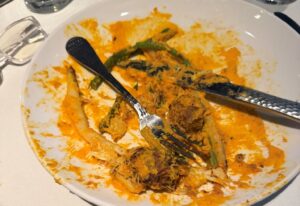
What I had imagined was a neat, organized approach to eating looked nothing like what I thought I had accomplished. I had struggled far more than I realized.
It was a humbling moment.
I had spent only a short time without sight, in a controlled environment, with food prepared for me and someone at my table ready to offer assistance. Yet I had experienced frustration, uncertainty and a loss of independence over something I had never given a second thought to before.
For people living with vision loss, these challenges do not end when dinner is over. They can be part of everyday routines, from preparing a meal and identifying items on a plate to navigating unfamiliar spaces and completing tasks others take for granted.
That realization was the real heart of Dining in the Dark.
The evening raised more than $93,000 from a silent auction to benefit Bestwork’s Blindness & Low Vision Services Center (BLVSC). But its impact extended beyond fundraising. The experience encouraged guests to recognize how much we rely on sight, how quickly our confidence can change when that sense is unavailable, and how important patience, thoughtful communication and understanding can be.
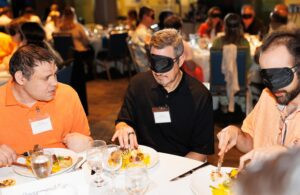
Mike’s role as our table captain was especially meaningful. He guided us through an experience that many of us found difficult, demonstrating the importance of support while allowing us to confront the challenges ourselves. His presence was a reminder that people who are visually impaired bring their own knowledge, skills and lived experiences to a world that is not always designed with them in mind.
The aquarium provided a beautiful backdrop, but it was the experience around the table that stayed with me. For a brief time, I was unable to rely on the visual cues I ordinarily take for granted. I had to slow down, ask questions and accept help.
And I left with a greater appreciation for how much effort can go into something as ordinary as sharing a meal.
Bestwork Industries for the Blind created an opportunity for guests to move beyond simply hearing about vision loss and to experience, however briefly, some of the challenges it can present. The event reflected the broader mission of an organization that works to expand opportunities for people who are blind or visually impaired, both in the workplace and in the community.
From its employment and manufacturing operations in Cherry Hill to its blindness and low vision services, Bestwork demonstrates that inclusion is about more than opening doors. It is about recognizing individual abilities, providing meaningful support and creating environments in which people can build independence, contribute their talents and participate fully in society.
Sometimes, seeing things differently requires us to close our eyes.
And sometimes, the most meaningful lessons come when we do.


