


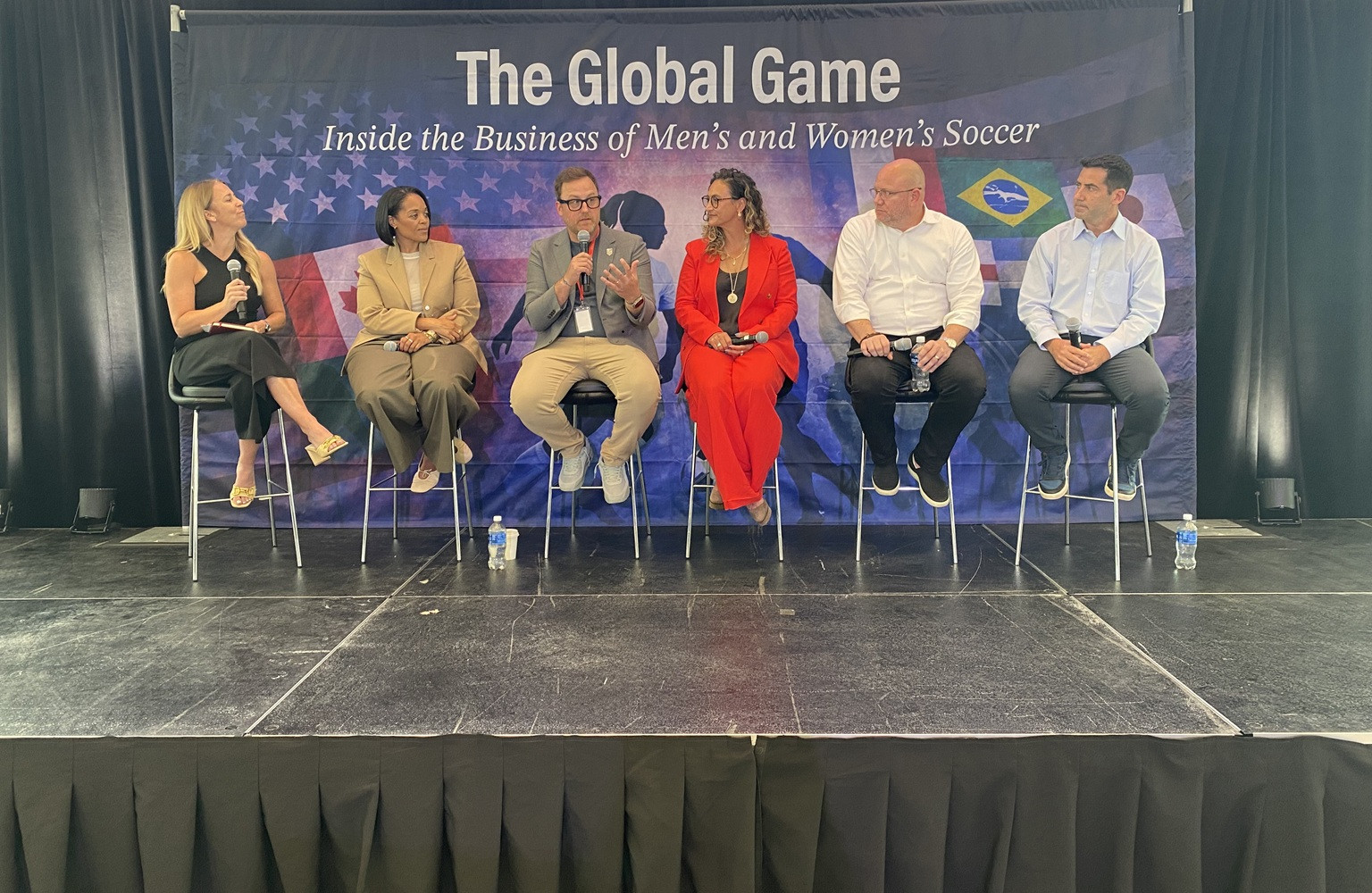
Eric Stover’s youngest daughter is 14. She loves soccer. Her favorite player is a household name. She knows all about his relationship with pop star Olivia Rodrigo. Stover, an executive with the Cosmos knows all this — but he’s not sure if she’s ever sat through a full 90 minutes of an actual match.
That anecdote closed out the “What’s Next for the Global Game” panel at the Global Game Summit last week at the Prudential Center. And it captured, perhaps better than any of the day’s data points, the gap the soccer industry is trying to close now that the World Cup has moved on from New Jersey.
The panel brought together Stover, Abe Geiger of the U.S. Soccer Federation, Danita Johnson of D.C. United, Evan Dabby of New Jersey Youth Soccer and the U.S. Club Soccer Association and Courtney Carter of the Seattle Sounders and Seattle Reign.
It was moderated by former U.S. women’s national team player and current broadcaster Kacey White.
They discussed how the sport can use the World Cup moment to increase an already growing soccer audience.
Here are five things the group said the sport needs to focus on now:
1. Bring down the cost of playing — without adding more money
Geiger’s argument wasn’t for bigger budgets. It was for cutting the redundancy already built into the system — excess travel, and what he called constant infighting over which players should go where and how early they should specialize.
“If we can align better and take some of the costs related to playing out of the game, then we’ll make the game more accessible and lower cost without adding any more dollars on top,” Geiger said.
He credited Dabby, whose organizations oversee youth and club soccer across New Jersey, with pushing the point earlier in the panel.
“I think what Evan’s talking about is really critical,” Geiger said, adding that without more alignment across youth soccer’s various organizations, the shared infrastructure needed to bring costs down collectively won’t materialize.
2. Get commercially in sync with the rest of the world
Carter, who works across both an MLS club and an NWSL club in Seattle, pointed to FIFA’s calendar realignment as a turning point for Major League Soccer.
For the first time, she said, the league’s on- and off-pitch storytelling can move in step with the rest of the global game rather than off-cycle from it. She also credited Apple TV with moving marquee soccer content out from behind its paywall, calling it a fix to what had been “a major hindrance to the growth of the game” for MLS.
The next step, she said, is telling American players’ stories continuously rather than once every four years — pointing to the HBO documentary “U.S. Against the World” as the model.
3. Meet fans where their attention already is
Carter framed the sport’s challenge as fundamentally a media one: “We are living in an attention economy,” she said, describing a shift toward micro-moments and creator-driven content that larger media networks are still trying to catch up to.
Her prescription was a data-driven approach to fan development — using what’s known about a fan to build a personalized path from casual interest toward a first game attended, a ball picked up, or money raised for youth soccer access.
4. Build one system that follows a fan through every role they play
Geiger extended the data point into federation-wide terms. U.S. Soccer touches coaching, refereeing, safeguarding, playing and fandom, he said — and the same person can move
through several of those roles over a lifetime: former player, parent, reluctant volunteer coach.
“We need to address people where they are, given the context that we can know about them if we can stitch together the data collectively and personalize the experience,” he said, adding that the opportunity to do that exists today in a way it didn’t even a few years ago — the challenge now is moving on it quickly.
5. Accept that fandom doesn’t look like it used to
Stover’s story about his daughter was the panel’s answer to its own question about retaining casual World Cup viewers once the tournament ends. She’s engaged — she follows highlights, players and soccer culture on social media — but not through the traditional 90-minute broadcast.
White, closing the panel, put it plainly: soccer, she said, needs to meet the speed of culture.


