


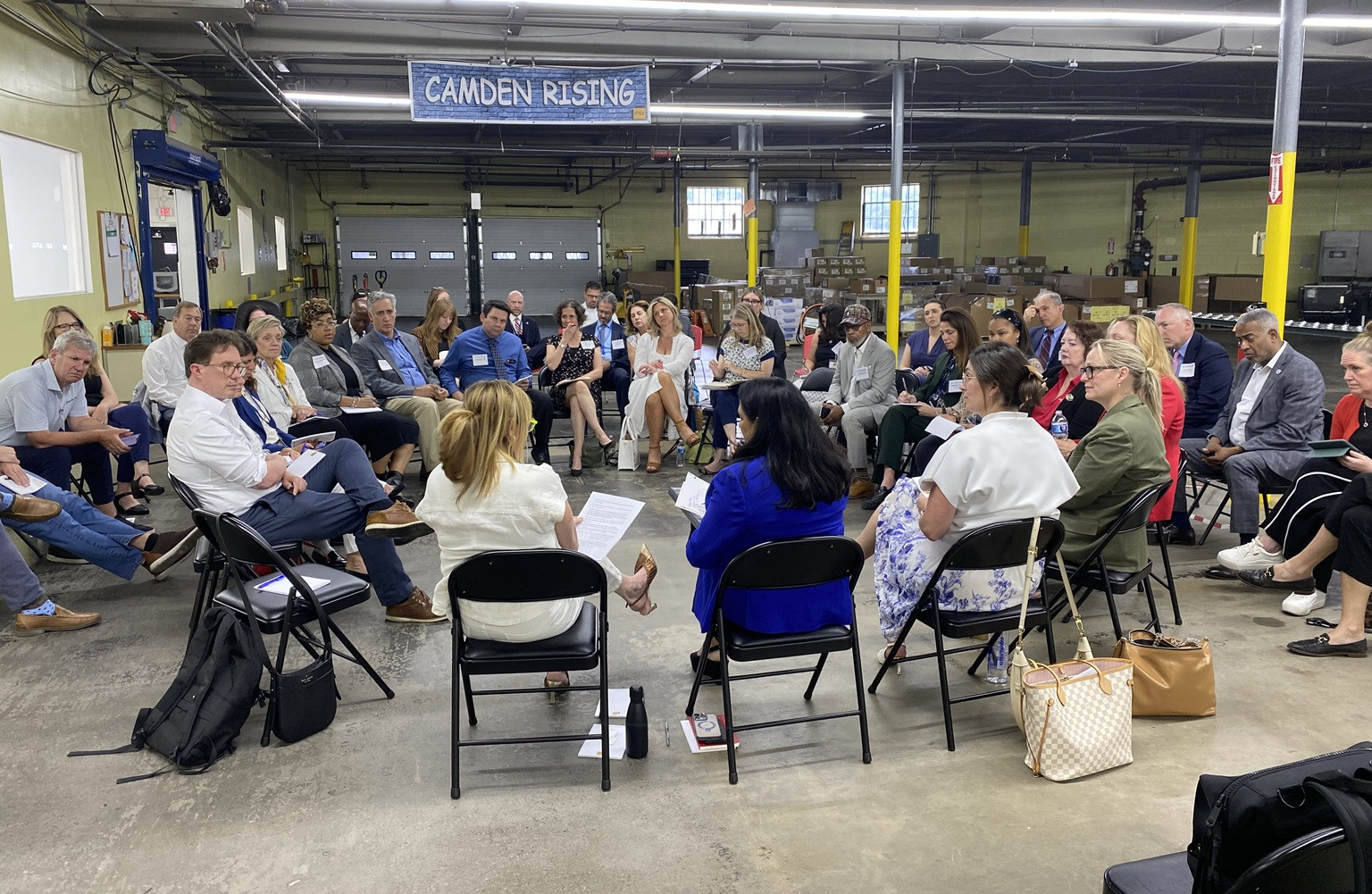

The chairs were arranged in a circle inside IPAK’s facility in Camden, and the message from the moment Kellie Doucette walked in was clear: This was not going to be a polite conversation.
A service provider with three decades in business, major projects completed and all the right certifications, talked about having to cross the bridge to Philadelphia to find work.
A marketing agency owner laid out, in precise detail, how the state’s procurement process was broken and why it was costing her 50 to 100 unbillable hours per bid.
A nonprofit leader described the maddening reality of putting staff through duplicative licensing requirements just to do the same job they did yesterday.
Doucette, New Jersey’s first-ever chief operating officer, didn’t flinch. She took notes. She asked follow-up questions. She told them to keep going.
“When I said be brutally honest, I really meant that,” she told BINJE afterward. “If people don’t feel like they can talk to us, and we don’t hear it, we can’t fix it.”
The Camden stop was the latest of Gov. Mikie Sherrill’s 21-county listening tour, a statewide effort to identify government inefficiencies, cut red tape and hear directly from the businesses and nonprofits trying to navigate a system that too often gets in their way.
The event was organized by Christina Renna, CEO of the Chamber of Commerce Southern New Jersey, and hosted by Karen Primak, CEO of IPAK, a Camden-based manufacturer and distributor of marketing and educational products serving highly regulated industries.
It drew an all-star list of elected officials and leaders of state agencies, including Mayor Vic Carstarphen of Camden, Camden County Commissioner Director Lou Capelli, Assemblyman Bill Spearman (D), Assemblywoman Melinda Kane (D), Amy Herbold, CEO of Choose New Jersey, and Sean Kennedy, Chief of Staff at the N.J. Economic Development Authority.
There was plenty to be heard.
***
For all the frustration in the room, something else was present — a feeling that hadn’t always been there when Trenton came calling to South Jersey.
People actually thought someone was listening.
Renna has been to enough of these events to know the difference between an administration that shows up and one that listens. She says this one does both — and that the region is noticing.
“South Jersey really appreciates the meetings they get from an administration,” she said. “They are getting more looks from this administration than they have from previous ones. And the more familiar they get with the governor and her team, the less shy they’re getting about sharing their concerns — which is exactly what’s going to help make government more efficient.”
She said the attention is noticeably different.
Renna ticked off examples: the governor coming to a bridge announcement in Upper Township, appearing on a radio show in Atlantic City, dispatching lieutenant governors and commissioners across the region rather than concentrating visits in a handful of urban centers.
“That is different,” Renna said.
Primak, whose building served as the backdrop for the day, put it in characteristically blunt South Jersey terms.
“We’re the ugly stepsister,” she said. “We’re the Eagles fans. We don’t exist. Now we feel seen and heard — and not lip service.”
She pointed back to a rainy pre-election event where Sherrill, not yet a candidate for governor, laid out what she planned to do for the region.
“This is part of what she said she was going to do,” Primak said. “It’s wonderful that they’re coming out and listening to us.”
***
The issues that came out of the circle of chairs were wide-ranging — and specific.
The CEO of a large manufacturer described waiting 11 months or more to receive tax credits his company had already been certified for, forcing him to borrow money at near-10-percent interest just to cover operating costs while the state processed the paperwork.
“Just give me my money,” he said, to laughter — and applause.
The leader of a restaurant said the state told her the sector wasn’t worth investing in. She feels New Jersey is missing out. And only needs to look across the river to see it.
She pointed to a study that found the city at less than one or two percent of the hospitality jobs it should have, leaving a workforce ready and able to fill those positions with nowhere local to go. Philadelphia, just across the bridge, is lapping Camden in its own backyard.
But the strongest line of the more-than-90-minute event came from the leader of a nonprofit.
She talked of how offended she was when the administration spoke of one-time late-added appropriations as “Christmas tree” gifts, as if they were presents. She said those appropriations were often the difference between a nonprofit surviving another year — or not.
***
The issues weren’t the same. But the frustration had a common thread — a government that means well but moves slowly. And processes that burden the smallest players the most.
Doucette said she gets it.
“The larger corporations have the resources to navigate processes,” she said. “For so many of the people around that table, sometimes the delays or roadblocks are the difference between opening a new site or even getting off the ground.”
Doucette outlined three work streams her office is focused on:
- Supercharging cross-agency coordination;
- Digging into the operational details of government — “the nerdy details,” she called them;
- Launching a strategic initiatives team focused on housing, energy and economic opportunity.
She highlighted one initiative: A real-time permitting dashboard that would let businesses track exactly where their applications stand with state agencies.
More than that, Doucette acknowledged that fixing systems calcified over decades won’t happen overnight.
“The more detail you can give us about the problem you’re facing, the easier it is for us to do the diagnostics,” she said. “These conversations really shaped the work we were doing when we were in the congressional office. And they’re shaping the work we’re doing now.”
As for the candor in the room, perhaps greater than she’s heard on other stops, Doucette said it’s exactly what the state needs to hear.
Renna said that much was easy to deliver.
“South Jersey isn’t shy,” she said.


