


Most people don’t think of loneliness as a psychiatric condition. They don’t think of the anxiety that creeps in as a spouse’s memory fades, or the quiet spiral that follows retirement, as a behavioral health crisis.
Christian Health CEO Steve Dumke does.
That insight — that aging and mental health are inseparable, and that the system has spent decades pretending otherwise — is at the core of what Christian Health, a nonprofit based in Bergen County, has been quietly building in North Jersey for more than a century.
“We’ve been doing things really quietly for a lot of years,” Dumke said. “But now we’re getting recognized in new and kind of fun ways.”
US News and Newsweek have recognized its facilities. The Hospital Association and other industry groups have honored its programs. What was once a small house where nurses cared for behavioral health patients in 1911 is now, Dumke said, becoming something much larger.
“All of a sudden, we’re becoming, frankly, a regional force,” he said.
There are good reasons why.
Christian Health serves more than 1,000 people daily across four campuses and multiple group homes, counseling locations and affordable housing sites spanning Bergen, Passaic, Morris, Sussex and Hudson counties.
It also operates a 58-bed psychiatric hospital, 304 long-term care beds and a growing portfolio of affordable housing. About 85% of the people it serves are seniors.
In the past five years, the organization has doubled in size.
***
What makes Christian Health unusual — and increasingly hard to categorize — is the deliberate overlap between its behavioral health expertise and its senior services.
Dumke is direct about why that combination matters. Dementia and Alzheimer’s don’t exist in isolation. They come with anxiety, combative behaviors, depression and other diagnoses that most long-term care facilities are not equipped to handle. Christian Health is.
The organization operates one of only five Special Care Nursing Facilities in New Jersey — a designation created by the state to serve patients who cannot be cared for in a traditional long-term care setting because of behavioral symptoms. It is a gap in the system that Christian Health is uniquely positioned to fill.
Its psychiatric in-patient hospital, Ramapo Ridge (which is part of the Christian Health’s Wyckoff campus) has developed two specialized programs that reflect the same philosophy:
Haven: It opened in the spring of 2024, is New Jersey’s first trauma-informed care center for women — “a unit where patients who have experienced trauma are cared for in a safe and secure wing for women only, with specialized groups and programming.”
It is believed to be the only in-patient program that only serves woman – to promote healing in a safe space, away from potential triggers.
The success of the Haven, led to the creation of a geriatric-only unit, which led to …
Harbor: It focuses on geriatric behavioral health, addressing the mental health needs of seniors that often go unrecognized until they become a crisis.
“What people don’t understand is, as you get older, you start to become more isolated, more lonely and also have other health needs that accompany the aging process,” Dumke said.
“You could be perfectly fine — in a sound mental state — and as you get older, all of a sudden you start experiencing increased anxiety and uncertainty, and it starts to spiral to a point in which you don’t even know how to handle it.”
***
The housing piece of Christian Health’s operation may be the most distinctive — and the least understood.
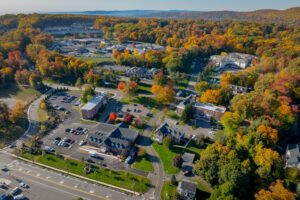
The organization currently operates three affordable housing sites, one with 250 beds, one with 163 and another with 40. It is redeveloping the former Little Sisters of the Poor building into 151 additional affordable units.
And in Pompton Lakes, a 64-unit affordable housing development for both seniors, veterans age 65 and older — being developed by Passaic County and managed by Christian Health — is on track to open this fall, with a wait list that already includes nearly 100 applicants for the 65 spots.
The philosophy behind all of it is straightforward. Christian Health treats people. Then it has to figure out where they go.
“We treat people, and then where do they go from there?” Dumke said. “Where do we discharge?”
Affordable housing is the answer — and increasingly, research supports the idea that it is also a health intervention. People living in social environments like affordable housing and independent living live far longer than those who don’t, Dumke said.
***
Dumke came to Christian Health from Ohio, where a chance job at a nursing home redirected a career that began in sports broadcasting. A family member’s description of Alzheimer’s as “insidious” stayed with him for more than 20 years. It still informs how he talks about the work.
He has been CEO for about a year. In that time, the organization has continued to grow its footprint with counseling services in Parsippany, Haskell, Sparta, Pompton Plains and Wycoff, facilities in Bergen, Passaic, Morris, Susssex and Hudson counties — and ambitions that extend across the entire northern region of the state.
There’s no reason to believe this growth will slow. In fact, Dumke sees the opposite happening.
“We have the perfect storm,” he said. “We have an aging population — the numbers of people who are over 65, over 75, over 85 are growing significantly — and we’re reaching an inflection point.
“Couple this with the fact that people are more and more isolated in our society and culture today, that caregivers are in shorter supply, and that caregivers are also facing challenges and increased pressure.
“I think we’re at a point where we’re going to see a continued increase in behavioral health needs and we need to figure out how to take care of them.”


