


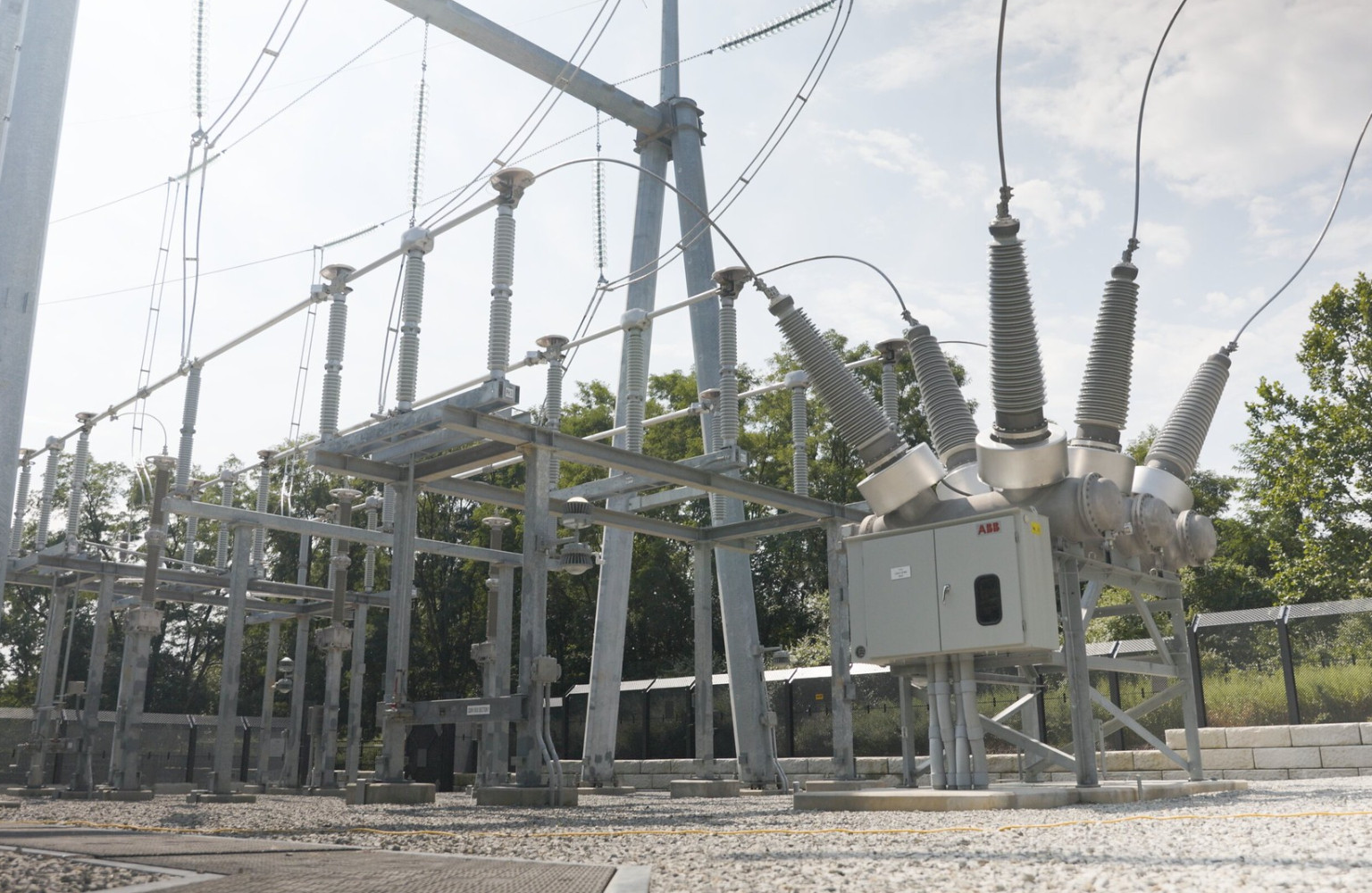
Drive past PSE&G‘s Livingston substation in Essex County and you’d never guess it’s the reason a chunk of the county kept its lights on during the last big storm.
Built in 2024 inside the utility’s existing right-of-way, it’s one piece of a decade-long, $30 billion bet that the boring stuff — poles, wires, substations — is what actually keeps the power on.
And it’s one reason why New Jersey is heading into the heart of hurricane season with roughly 22,000 fewer weak links in its power grid than it had three years ago. That’s how many utility poles PSE&G has quietly replaced since 2023 — and on the circuits that got the most attention, outages have dropped by half, Paul Toscarelli, PSE&G’s vice president of electric operations, said.
“At the end of every pole, wire and piece of equipment are customers who count on us to safely deliver the energy they need,” he said. “We take that responsibility seriously, and we will continue strengthening our systems to provide safe, reliable service today and prepare for customers’ changing energy needs.”
The timing isn’t an accident. PSE&G rolled out the numbers this week, right as the Atlantic hurricane season hits its peak stretch — the weeks when a downed line isn’t a hypothetical, it’s a Tuesday.
***
The pole-swapping is just one piece.
Thirty-two circuits upgraded through PSE&G’s Infrastructure Advancement Program are now 37% more resilient and 31% more reliable, with 22% fewer outages and 23% fewer customers affected when something does go wrong.
The company has also built six new high-capacity substations since 2023 to keep aging equipment from buckling under demand — including, increasingly, demand from home solar systems feeding power back into the grid.
Underground, the gas side of the business is getting the same treatment. PSE&G has replaced more than 1,655 miles of cast-iron and unprotected steel gas main since 2016, across more than 340 towns, and plans to swap out another 525 miles over the next three years.
“Reliability starts with the strength of the system and the dedicated workforce behind it,” Brian Clark, PSE&G’s senior vice president of gas operations, said. “By replacing aging infrastructure, we’re reducing the risk of leaks and strengthening the gas system that nearly two million customers depend on every day.”
PSE&G showed off the results Thursday at the Livingston substation itself, a facility that went live in 2024 and now feeds a more robust supply of power into a stretch of the state that had been running close to capacity. It’s the kind of project that draws no attention from the people it protects — until the next big storm rolls through and their power doesn’t go out.
That’s exactly the pitch state Sen. John McKeon made standing alongside utility executives. Representing the 27th Legislative District, McKeon said stronger, more modern infrastructure is no longer optional as severe weather grows more common — though he added that the cost of preparing for it shouldn’t fall entirely on ratepayers.
Bill Mullen, president of the New Jersey State Building & Construction Trades Council, framed the investment in more immediate terms: jobs. PSE&G, he said, remains one of the largest employers of the state’s union workforce, and every mile of pipe or pole replaced is also an apprenticeship, a paycheck, a career.
Zoom out, and the numbers get bigger still.
Over the past decade, PSE&G has poured $30 billion into its electric and gas systems, nearly three-quarters of it aimed squarely at reliability and resiliency — money that’s gone toward raising 42 substations above Superstorm Sandy flood levels and installing more than 1,500 smart switching devices that let crews reroute power around trouble spots before customers even notice.


