


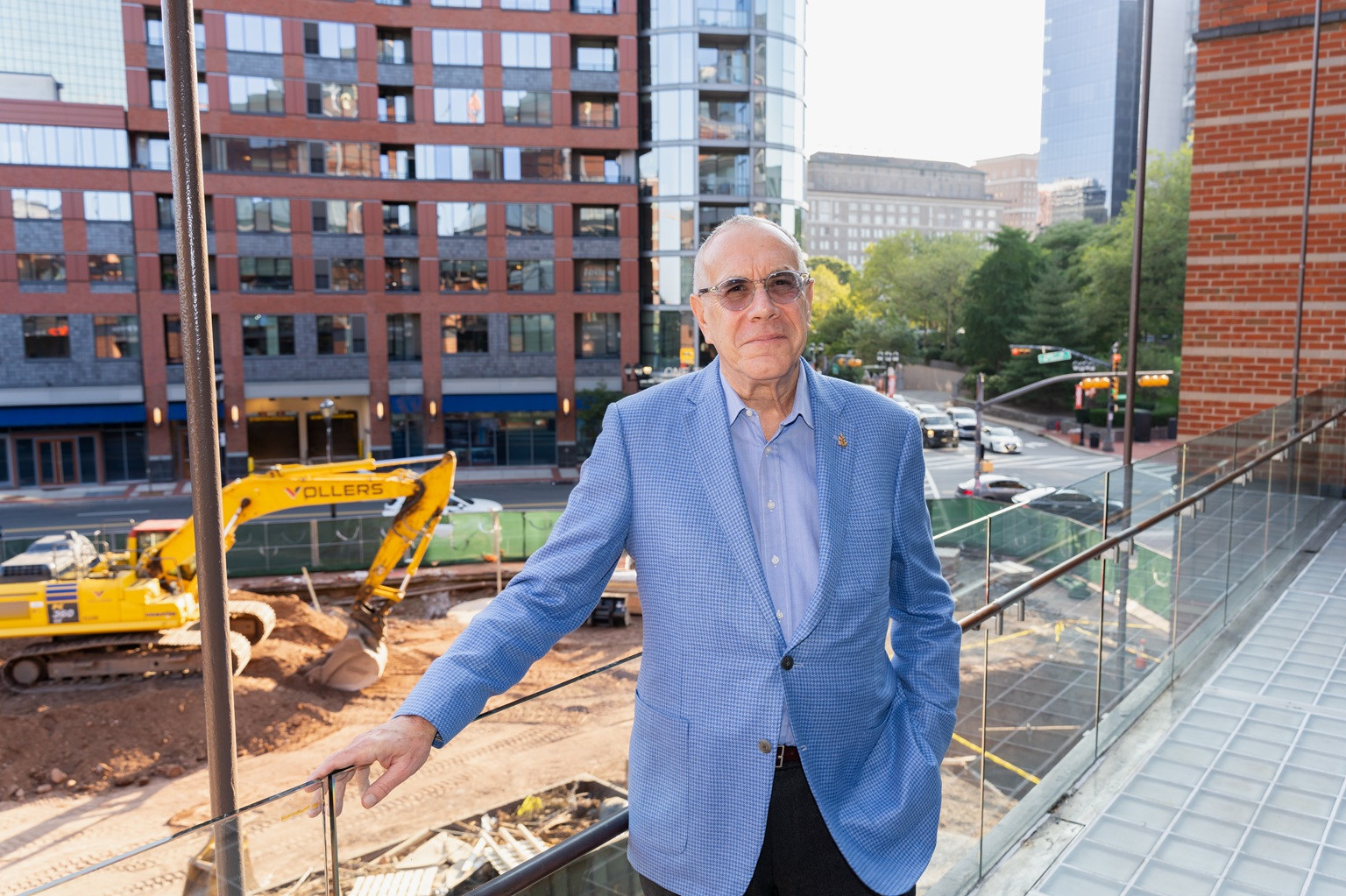
John Schreiber is retiring from the N.J. Performing Arts Center on July 1, 2027, after 15 years as its president and CEO.
His accomplishments (detailed here) are many, but if you ask him, Schreiber will tell you he’s one short of being complete.
NJPAC has launched a $100 million endowment campaign called the John Schreiber Social Impact Fund, meant to permanently fund the arts center’s community work — arts education, community engagement and arts-and-wellbeing programming — regardless of ticket sales, the economy or who’s running NJPAC next.
More on NJPAC
- A look at a legacy: 15 years of Schreiber as CEO
- Social impact effort: Why it matters at NJPAC
- Seed money: A the generous $50M gift from the Coopermans
The campaign, seeded by a $50 million gift from Leon and Toby Cooperman last September, has raised more than $70 million so far. It will take center stage at NJPAC’s Spotlight Gala on Oct. 3, where Schreiber will also be honored with the gala’s Founders Award.
BINJE spoke with Schreiber about the fund, the building it’s tied to, and why he’s using his own exit to make the case for giving. The conversation has been edited for length and clarity.
BINJE: Let’s start with the basics. What is the John Schreiber Social Impact Fund?
A: It’s an endowment — a permanent pool of money — meant to fund NJPAC’s work in the community forever, no matter what happens to the arts center’s other revenue in any given year, Schreiber said.
“As we know in cities and states, when there’s a budget deficit, the first thing to go is the arts,” he said. “I wanted to solve for that. And the way to solve for that is to endow this work in social impact, so it is perpetual — whether sunshine or rain.”
BINJE: Why now? Why not just keep raising money year to year, the way NJPAC always has?
A: Schreiber said the idea has been on his mind for a few years — well before his own retirement was set. The concern was always the same: what happens to programs like arts education and community engagement if NJPAC has a bad year at the box office, or worse.
“It could be a recession. It could be a slow season. It could be a pandemic,” he said, referencing NJPAC’s own experience during COVID-19, which was the only year in his tenure the arts center didn’t post a small surplus.
BINJE: How much has been raised, and how much is the goal?
A: The fund’s target is $100 million. Leon and Toby Cooperman kicked it off with a $50 million gift in September, and NJPAC has since raised the total past $70 million — leaving a little more than $25 million to go, with roughly a year left before Schreiber’s departure.
BINJE: What does the money actually pay for?
A: The most visible piece is the Cooperman Family Arts Education and Community Center, a new building opening on NJPAC’s Newark campus around the same time Schreiber leaves, in June or July of 2027.
The center will include a reading room for young children, 12 classrooms, a black box theater with a full technical grid for teaching lighting and stagecraft, and professional-grade rehearsal studios upstairs — space NJPAC plans to give free to local artists and occasionally rent to touring Broadway productions to help cover costs.
The building itself cost $77 million, up from an original pre-pandemic estimate of $40 million. It’s part of a larger $336 million campus expansion that also includes new rental housing and a renovation of NJPAC’s original building — financing Schreiber credits largely to Tim Lizura, NJPAC’s executive vice president of real estate and capital projects.
But Schreiber is careful to note the building and the fund are two different things.
“A building doesn’t run itself,” he said, in essence. The center can open on schedule and still see its programming shrink in a lean year — unless there’s an endowment behind it. That’s what the fund is for.
BINJE: Was a community center always the plan?
A: Not exactly, Schreiber said. A few years ago, NJPAC spent about a year looking into something arts centers don’t usually consider: opening a K-8 public school where the arts were built into every subject rather than offered as an elective.
The idea didn’t survive the research. NJPAC found that the kind of curriculum it would need essentially didn’t exist yet, and running a school — accreditation, logistics, all of it — sat outside anything the organization actually knew how to do.
“That was not for us,” Schreiber said.
Instead, NJPAC landed on a community center open to “mothers and babies to older adults,” in Schreiber’s words, offering free classes, training and cultural programming to anyone in Newark and beyond. When NJPAC master-planned its campus expansion, that center became the anchor of the whole project.
BINJE: Has raising money for this kind of work gotten harder given the current political climate around programs described as “DEI” or “social impact”?
A: Schreiber doesn’t dodge the question. Federal arts funding has been under pressure, he said, and programs like NJPAC’s have increasingly become targets for critics who treat words like “diversity” or “underserved” as red flags.
But he said it hasn’t cost NJPAC a single donor.
“No one walked away from us,” Schreiber said. “Everyone said, without exception, we believe in the work. We haven’t cowered — and I think that’s given our donor community, our corporate community, confidence that we’re not going anywhere, and we’re not changing the definition of our service. In fact, we’re expanding it.”
He also credited New Jersey’s political environment directly.
“It certainly helps that we are in a state that is sympathetic to this work,” he said. “If we were in Florida, that may not be the case.”
BINJE: What role will the Oct. 3 Spotlight Gala play in all this?
A: A big one, Schreiber said. NJPAC’s Spotlight Gala typically raises around $2 million a year on its own. This year’s gala will double as the public unveiling of the fund’s full ask — with Schreiber being honored with the Founders Award the same night.
He’s well aware of the optics, and he’s leaning into them.
“The team is cleverly using my departure as a catalyst to ask folks to give more,” Schreiber said. “And I hope they do — because most of the money we raise goes right back into the work we do in social impact. This is a good bet. I believe it’s a good bet, and I’m happy to beat the bushes in support of it.”
BINJE: Most importantly: How can people give?
A: Those interested in contributing to the John Schreiber Social Impact Fund can do so through NJPAC’s website, or by attending the Founders Award — and, by his own admission, make one more ask on his way out the door.


