


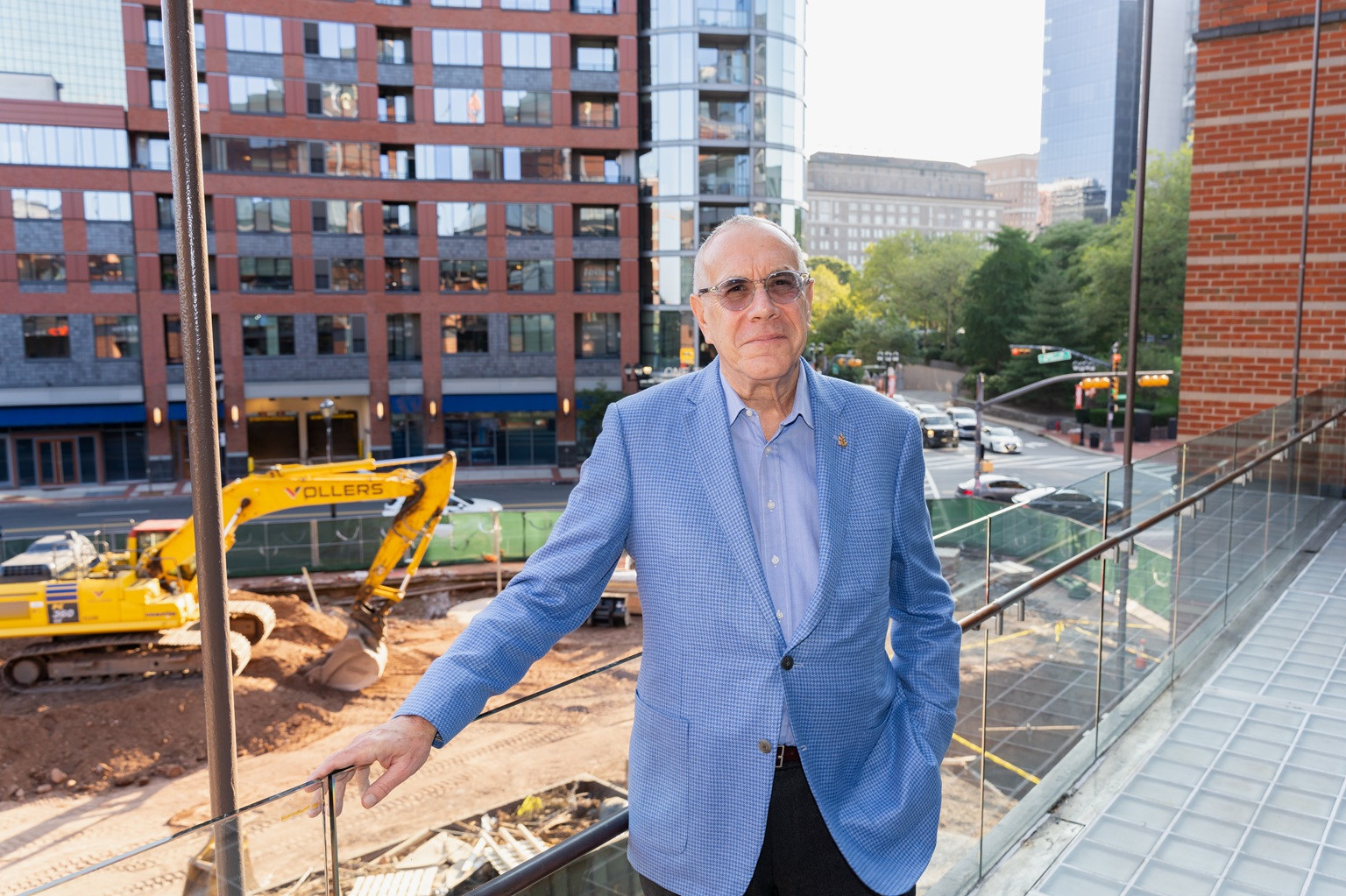
In 2027, the N.J. Performing Arts Center aims to open the Cooperman Family Arts Education and Community Center, complete a $336 million campus expansion and see Lionsgate Newark begin operations — a wave of projects that will redefine both NJPAC and its role in the city.
And like any great entertainer, John Schreiber is choosing to leave on a high note. After 15 years running NJPAC, Schreiber will step down as CEO on July 1, 2027.
How to help
To buy tickets to the NJPAC Spotlight Gala on Oct. 3 or make a contribution to the John Schreiber Social Impact Fund, click here.
Schreiber will be honored with the Founders Award at the Oct. 3 Spotlight Gala, a night that will continue a public push to fully endow the $100 million John Schreiber Social Impact Fund, an effort to permanently fund the arts center’s community work — arts education, community engagement and arts-and-wellbeing programming
The timing of his departure wasn’t necessarily planned, but it couldn’t be more fitting: everything he spent those years building is scheduled to open just as he takes his final bow.
“The fact that the timing dovetails the way it does — it’s a tremendous coincidence, and a happy coincidence for me,” he said. “I would have felt uncomfortable leaving this undone.”
***
It’s hard to overstate how much “this” is.
When Schreiber arrived in 2011, NJPAC was a single performing arts hall running a structural deficit of about $3 million on a $20 million budget — not catastrophic, but not sustainable. He spent his first seasons making uncomfortable calls to donors in June, asking for help to close the budget gap.
“That’s a terrible ask,” he said. “Nobody wants to give you money to solve a deficit.”
Once NJPAC stabilized — posting small surpluses nearly every year since, save for the pandemic — the conversation changed. The asks became about growth, not patchwork. About community, not crisis. And that shift became the foundation for everything that followed.
That shift started with one conversation.
Schreiber said Nancy Cantor, then chancellor of Rutgers University–Newark, told him cultural institutions could be community anchors, just like hospitals and universities. That idea, he said, reshaped his entire approach. It gave NJPAC permission to think bigger, to act bigger, to see itself as a civic engine rather than a venue.
It also changed how the arts center programmed its stages. Schreiber credits David Rodriguez, hired six months into his tenure, with transforming NJPAC into one of the most diverse performing arts centers in the country — in its audiences and its artists.
“When we became intentional about it, our business got better,” Schreiber said. “Our engagement became more authentic.”
***
The anchor philosophy eventually led NJPAC into a business few arts nonprofits touch: real estate.
The instinct wasn’t new — Gov. Thomas Kean had set aside land around NJPAC in the 1980s, hoping the arts center would shape its neighborhood the way Lincoln Center shaped Manhattan. But by the time Schreiber arrived, the first residential tower planned across the street was teetering.
“Nobody believed that building market-rate residential in downtown Newark would pay off,” he said.
It took until 2018 for One Theater Square to open. Schreiber moved in himself, living on the top floor. The building rented fast, proving the market and setting off a wave of development that now includes the 350-unit ArtSide building, the Cooperman Center and hundreds of millions more still to come.
If real estate was an unexpected pivot, a movie studio might seem stranger still. But for Schreiber, it traces back to his own career in California.
Early in his tenure, he pitched Newark to Doug Steiner of Steiner Studios. Steiner passed — no tax credit program, no incentive. Years later, when Gov. Phil Murphy revived the film tax credit, the math changed. A call from Newark leaders about the long-abandoned Seth Boyden housing site changed it further.
NJPAC offered to serve as redeveloper and find a studio partner. That effort eventually brought in Robert Halmi and Lionsgate, which signed a 10-year lease and broke ground in December.
The deal was built around jobs: 70% of full-time positions reserved for Newark residents, a community benefits agreement worth more than $1 million, and a planned media-focused high school next door.
“Everyone doesn’t have to go to college,” Schreiber said. “A kid can intern at our studio, or apprentice there, and if they get a union card, they can have a job that pays $80,000, $90,000 a year, to start.”
***
Schreiber’s exit isn’t open-ended. He’s a member of the search committee for his successor, aiming to name someone by April 2027 and stay on as an adviser for six months.
Whoever takes the job will inherit an organization with a $145 million endowment, a sustainable business model and a campus about to triple its footprint. But Schreiber is quick to note that none of that guarantees the future.
“Past success does not predict future results,” he said. “Nobody can take their foot off the pedal.”
The job, he said, requires someone who can run what is now a $70 million operation, genuinely enjoys fundraising, wants to be present in the community and brings real curiosity about the world outside their office.
“Being present in community is really an indispensable part of the gig,” he said.
It’s a gig that has transformed since Schreiber came aboard 15 years ago.
“I couldn’t ever have imagined it,” he said. “And now, as I’m heading for the exits, people are saying such nice things, and I honestly can’t believe it.”
He credits what he calls a “collaborative coalition of the willing” — a board, elected officials and funders who bought into the idea that NJPAC’s work was never just about the arts center.
“It was really at heart all about improving outcomes for community,” he said. “Who wouldn’t want to be a part of that?”
***
Schreiber, always ready with the perfect line, describes his career at NJPAC in the same way he might describe one of his first jobs, when he served as a jazz festival producer.
“What do jazz musicians do? They improvise,” he said. “We’ve had the opportunity, with a supportive board and smart, generous funders, to come up with initiatives, some of which have really been transformative.
“So, I’ll take credit as the orchestra leader. But the 100 people in the band make the music.”
He paused, still uncomfortable with the praise.
“I don’t get it,” he said. “I’m grateful for it, and I’ve learned how to say thank you. But it ain’t me. We did it. And that’s the kind of leader we need going forward — one who really understands and advances collaboration.”


