


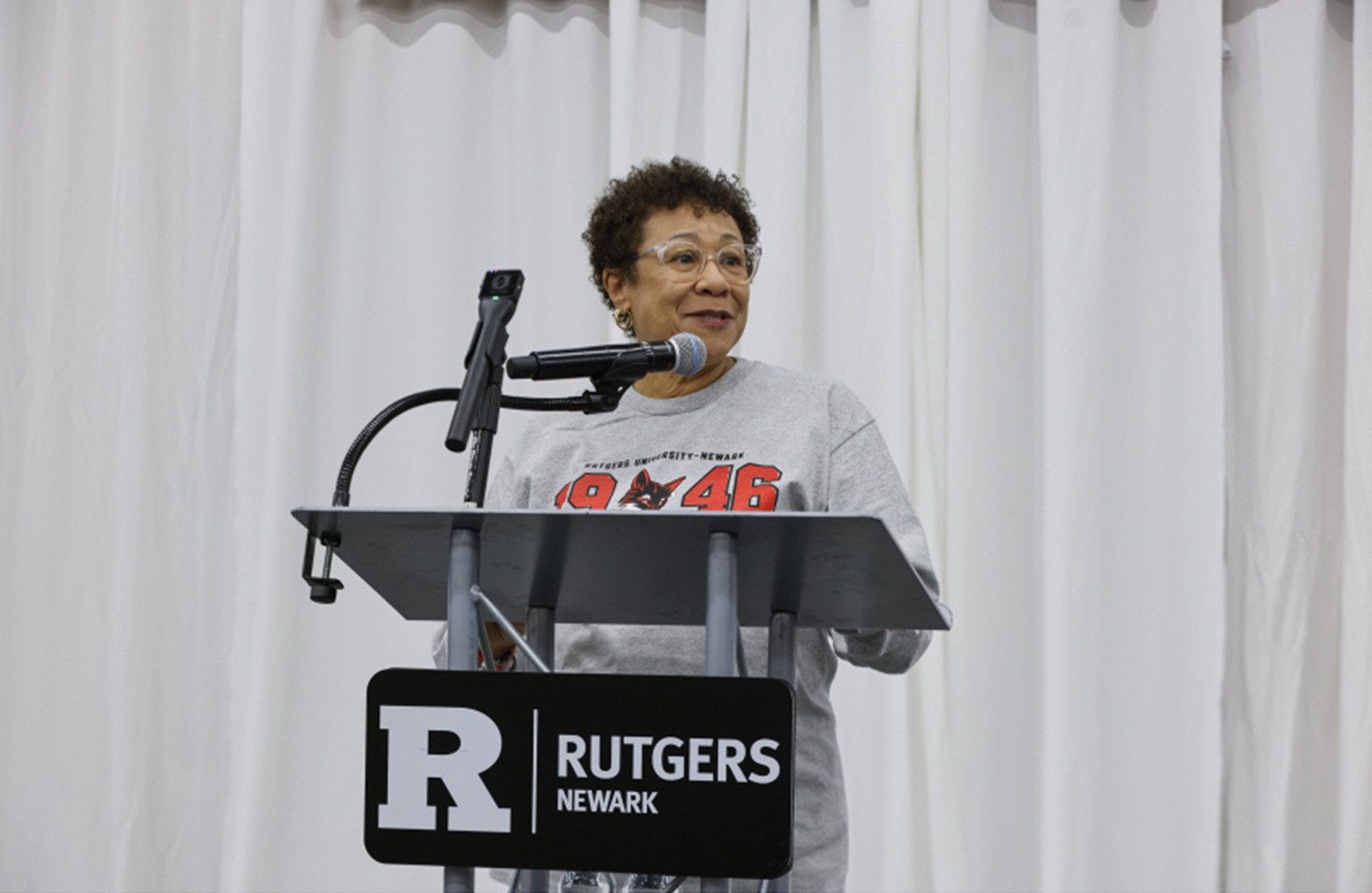
Tonya Smith-Jackson knows exactly how long she has been chancellor of Rutgers-Newark.
“Today is Day 449,” she said last Friday.
Each day, she said, has been all she had hoped for. Her reasons come down to three things.
The first is the university itself. Smith-Jackson did a lot of reading about Rutgers-Newark before she arrived. She said it still undersold the place.
“An urban serving, minority serving, Hispanic serving anchor institution that’s also research … doing anchor empowered community engaged research,” she said. “That’s a gold mine. It’s a gold mine.”
The second is what she keeps finding. She still learns something new nearly every day.
“I’ll talk to faculty, I’ll talk to staff and students. I’m like, ‘What? We’re doing what in the community? And what are we doing in the law clinics? Are you kidding?’” she said. “This place is awesome. It’s just that we’re not telling the story of our awesomeness.”
The third is the city.
“I’m telling you, this is a loving community,” she said. “We’re in Newark. We’re of Newark.”
Her takeaway from those 449 days is that the work is there; the telling isn’t.
“Every day, as I learn something new, I keep saying to myself, ‘We have got to get this story right,’” she said.
Part of that story is history. Rutgers-Newark marked its 80th anniversary in April, eight decades after a 1946 gubernatorial decree merged the University of Newark with Rutgers. In the early years, many of its students were Newark industrial workers hoping to move into law or business. In 1969, student activists took over Conklin Hall to demand a more diverse campus.
Today, Rutgers-Newark is one of the most diverse universities in the country.
The federal government recognizes it as a Hispanic-Serving Institution, a Minority-Serving Institution and an Asian American and Native American Pacific Islander-Serving Institution. Nearly nine in 10 students come from New Jersey, and U.S. News & World Report ranks it among the top 100 universities nationally and in the top 10 for social mobility.
The tie to the city runs deep, too.
Alum Richard Roper, who helped found the Black Organization of Students in the 1960s, has credited former Chancellor Nancy Cantor with making the university part of Newark, not just a school located in it. Smith-Jackson has picked up where Cantor left off. She calls Newark overlooked and underestimated, and she counts Mayor Ras Baraka and companies such as Prudential, Audible and Panasonic among the university’s strongest partners.
Smith-Jackson loves working with others. But she also loves that not every day is “work.”
Take homecoming, a weeklong celebration that wrapped up last Saturday. On Thursday night, the night before Day 449, Smith-Jackson turned up at a student talent show as “DJ 80 Cents.”
The name is a nod to the university’s 80th anniversary and to the rapper 50 Cent, whose real name is Curtis Jackson. Just like her husband.
Smith-Jackson said she had a great time.
“Homecoming Week enabled us to bring everyone together and have a great time,” she said.


