


When Angelina Melendi arrived at Seton Hall University as a freshman, she was skipping meals.
Not to save money. To save food.
Melendi said the supply her family got from local food pantries was limited. Holding back on her share meant there was more for the other seven people in her household, including her three younger siblings, a disabled uncle and an elderly godmother.
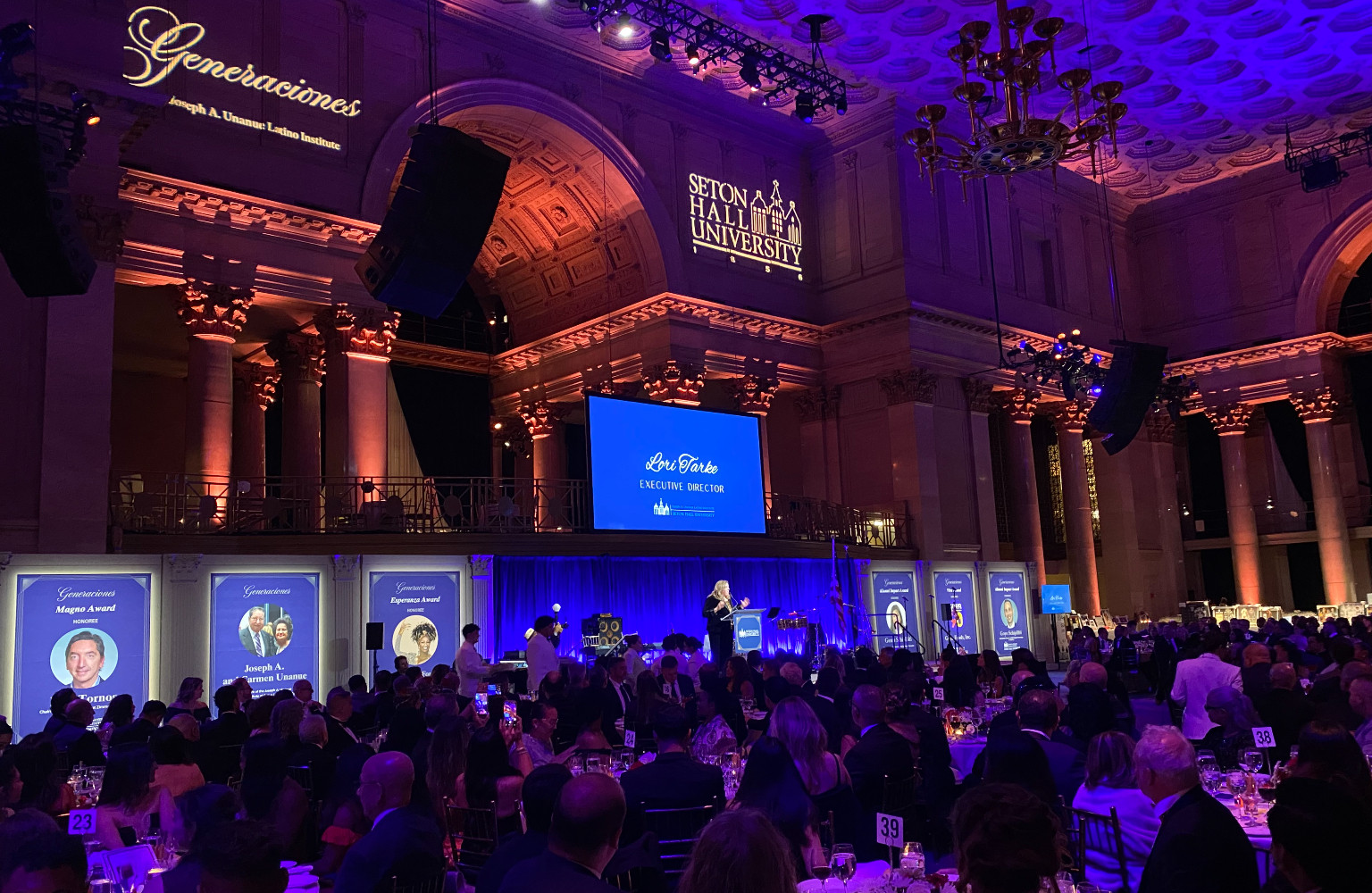
Speaking at the Generaciones Gala last Friday night in New York City — the annual fundraiser for the Joseph A. Unanue Latino Institute at Seton Hall — Melendi explained how her mother works several jobs to keep them afloat.
For her part, Melendi said she would track down campus events with free food. But when that didn’t cover it, Melendi said the hunger caught up with her.
“Hunger doesn’t just make you angry; it drains your focus, sparks extreme mood swings, and can derail your health,” she said.
A professor noticed before she was ready to admit it. Eventually Melendi found her way to Lori Tarke, the executive director of the institute. When sat in her office, she was shaking, afraid of being judged.
Tarke did the opposite. She opened a freezer stocked with Goya food. And she told Melendi something she said she’ll carry forever.
“Your story is another person’s salvation,” Melendi recalled her saying. “You have a 3.74 GPA. Stand tall.”
Melendi did just that in front of a packed room at Cipriani Wall Street.
“I am not a charity case,” she said. “I’m a survivor.”
She is a living example of the mission and the vision of the institute.
***
The theme of this year’s gala was 250 years of Latino impact on American history. Tarke built the room around it.
About six months ago, she said, she was watching TV coverage of the nation’s 250th anniversary and noticed who was being talked about — and who wasn’t.
Tarke didn’t complain. She simply corrected the omission, creating 30 posters of 30 Latinos who shaped American history. They were displayed around the room, everyone from Celia Cruz to Desi Arnaz.
Here was a twist: Some of the people on the posters were in the room.
That included Col. Marisol Chalas, the first Latina National Guard Black Hawk pilot, and Deb Visconi, CEO of Bergen New Bridge Medical Center and the first Latina chair of the New Jersey Hospital Association. Don Miguel Rodriguez, known as “Don Mike of Newark,” who fought for Latino rights in the 1970s, made it to the gala in his 90s. So did descendants of Joseph A. Unanue, who built Goya Foods into the nation’s largest Hispanic-owned company.
Tarke compared it to ‘The Night at the Museum.’
***
The evening’s honorees included DailyPay’s Goyo Schipilliti and his wife, Gema, a vice president at The Campbell’s Company, as well as Zimmer Biomet CEO Ivan Tornos.
Goya Foods, celebrating its 90th anniversary, received the Viva Award, accepted by Danielle Norris, a granddaughter of Joseph A. Unanue.
“It is especially meaningful for me to receive this award from an institution that carries the name and legacy of my grandfather, Joseph A. Unanue,” she said.
Seton Hall President Monsignor Joseph Reilly called the room “a living legacy of 250 years in the making.”
Reilly announced that the university will close its historic fundraising campaign this year with more than $225 million raised. But he saved his greatest praise for Tarke and the work she does at the institute.
Reilly said the spirit of the institute would not be possible “were it not for Lori.”
Speaker after speaker went out of their way to credit her, too. Tornos admitted there was only one reason he was there: Tarke.
“It’s you, your compassion and your leadership that got me on this stage, and it’s you that is going to keep me in this project for as long as I’m alive,” he said.
Tarke’s reach goes past the honorees. The centerpieces were made by adults with autism at the Allegro School. The roses came from a new Hispanic- and woman-owned florist. Small businesses from New York and New Jersey supplied the swag.
“We don’t just open doors for students; we open doors for communities so that people can achieve the American dream,” Tarke said.
“We used to be this tiny little institute that nobody knew about, but I think it’s safe to say that we’re a national force to be reckoned with at this point.”
***
Tarke, of course, would be the first to say the night wasn’t about her or even the institute. It was about the students.
Melendi’s story isn’t unique. That was Tarke’s point.
When she asked the institute’s scholars to stand, about 50 rose. Among them, Tarke said, are students facing homelessness, students who are food insecure and students who left countries that didn’t let them spread their wings. Some are dealing with a parent’s illness.
“We don’t simply give scholarships; we support the whole person, and in some cases, we support their families too,” she said.
Lucas Brasil knows. He lost his mother to cancer in 2020, when he was 15. At Seton Hall, he used internship pay to help his father with rent and bills. When the institute asked scholarship recipients over the holidays whether their families needed anything, he answered for his dad.
Tarke called. She wanted to know what Brasil needed. He finally admitted it: a suit, since he had outgrown his high school one, and a decent pair of shoes. He had been wearing the same pair since high school.
The institute’s community took care of it. Brasil is now starting his career at Ernst & Young.
Then there’s Candela Gutierrez, who came from Cuba not long ago and wants to be a pediatric surgeon. Her mother told Tarke at another gala that Gutierrez can’t stop crying about what the institute has done for her. Friday night, Gutierrez sat next to Tornos, whose company makes the robots she may one day use in surgery.
The institute awards about 45 scholarships a year and reports a 97% graduation rate.
Melendi said she now has the chance to change her family’s path.
“With my education and this foundation behind me, I now have the power to break a cycle of generational poverty for my family,” she said. “I am not defined by the situation I was born into.”
Her story, as Tarke told her, is another person’s salvation.


