


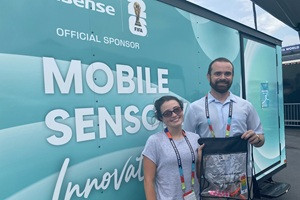
Sean Culkin has spent the summer bouncing between World Cup cities — Boston, Toronto, wherever the phone call sends him next — making sure a quiet room is ready at every stadium gate. On Sunday, when the World Cup final fills MetLife Stadium with its loudest crowd of the tournament, that room will be waiting again, tucked away from the noise.
Culkin is the training manager for KultureCity, the nonprofit that has provided a sensory room and sensory bags at all seven of MetLife’s World Cup matches — and will be back for the final.
Ready to serve anyone and everyone.
Culkin is autistic himself, but he’s quick to point out the work isn’t only for people on the autism spectrum. He said KultureCity serves anyone with what the organization calls invisible disabilities — autism, ADHD, PTSD, traumatic brain injury, even conditions like Down syndrome that carry invisible aspects.
“We want to make sure that people have the tools that they need to succeed,” he said.
The goal, Culkin said, isn’t to diagnose or categorize anyone walking through the gates — it’s to hand them options and let them decide what they need.
“We’re not telling people who they are, not telling people what they need,” he said. “We’re providing the tools so that people can put together what they need to enjoy everything today at the World Cup.”
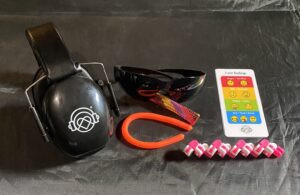
Those tools include:
Noise-reducing headphones: Not noise-canceling — Culkin is careful about the distinction. They cut down on stadium noise without blocking out the game entirely, so fans can still follow the action and talk to people next to them without raising their voices.
Fidget tools: Not toys, Culkin is quick to note — “I call them fidget tools, not fidget toys, because all ages.” Three different types are available, designed for fans of any age looking for a way to stay grounded during sensory overload.
Strobe-resistant glasses: Aimed at fans sensitive to bright, flashing lights — including people with epilepsy.
Communication cards: A “feeling thermometer” sits on the front, helping fans indicate how they’re doing. The back has simple icon cues: fidget, headphones, glasses, move, exit — a quick way to signal what’s needed without having to explain it to a stranger.
Everything is free. FIFA covers the cost.
***
Culkin spoke from KultureCity’s setup at the edge of FanFest, just outside the stadium — an air-conditioned room with indirect lighting, beanbag chairs and varied wall textures, wheelchair accessible.
It’s the base the organization operates from at every MetLife match.
“Whatever helps bring them to center, they can do so with all the tools they need in a private setting and return to wherever they need to,” Culkin said.
To be clear, the program isn’t new to sports — it’s just new to soccer at this scale.
KultureCity is active in nearly 10,000 locations worldwide and has built more than 700 sensory rooms, with existing partnerships across MLB, the NHL, the NFL and the NBA. Locally, that includes the Red Bulls, the Devils, Barclays Center and Madison Square Garden, along with New York’s zoos, aquariums, museums and Broadway theaters.
When the World Cup came to the U.S., Culkin said, most of the venues involved were already KultureCity partners.
“It just made sense to have this partnership,” he said.
That groundwork helped make the World Cup the first tournament to earn KultureCity’s Sensory Inclusive designation. KultureCity Executive Director Uma Srivastava called it a milestone for the sport.
“The FIFA World Cup 2026 achieving the first-ever KultureCity Sensory Inclusive Tournament recognition is a historic milestone for accessibility in global sports,” she said. “We are creating spaces where individuals with sensory needs and their families can fully participate with comfort, dignity and inclusion at the forefront.”
The designation was built in partnership with Hisense, a longtime FIFA commercial partner that sponsors the sensory rooms at all 16 World Cup venues.
“At Hisense, we believe every innovation should enrich every life,” Hisense Group Vice President Catherine Fang said. “True innovation means turning technology into access — and ensuring no one is left on the sidelines.”
***
FIFA World Cup 2026 Chief Operating Officer Heimo Schirgi framed the initiative as part of a broader mission.
“Football unites the world, and it is our goal to help everyone take part in the sport — whether as a player or as a fan,” he said. “We are proud that the FIFA World Cup 2026 is the first-ever tournament to receive the Sensory Inclusive designation.”
For a stadium about to host the loudest, most crowded event of the tournament, that distinction comes with a finer point: nobody has to explain themselves to feel comfortable.
This push for accessibility and inclusion at this World Cup extends beyond sensory support: live sign language interpretation for every match, haptic boards for blind and low-vision fans at select stadiums, and audio-descriptive commentary tournament-wide.
That infrastructure has been there for every match at MetLife this summer.
On Sunday, as the World Cup crowns its champion in front of the tournament’s biggest crowd, it’ll be there one more time — a quiet room, built for anyone who needs to step away from the loudest game in the world and come back to it.


