


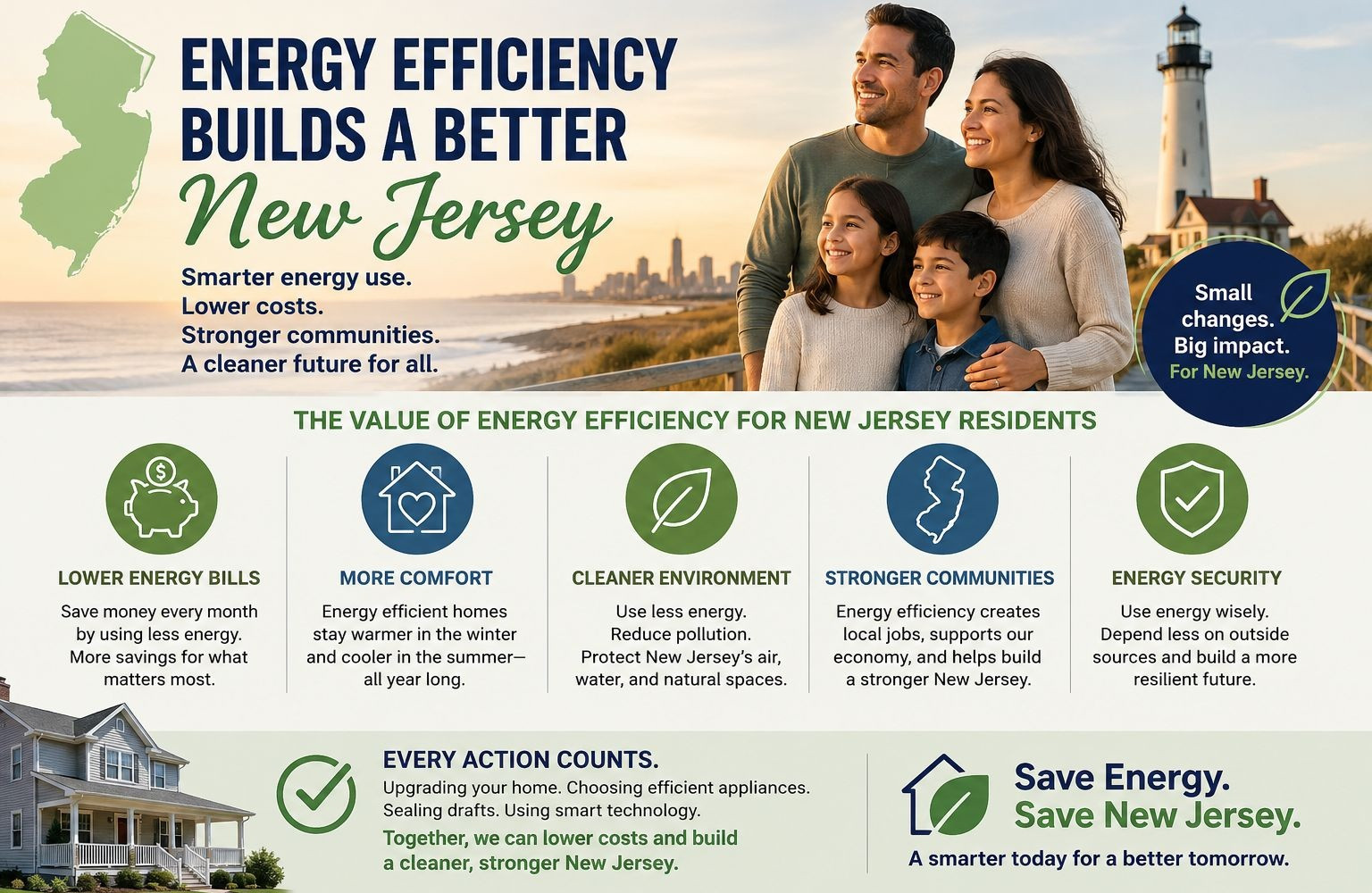
New Jersey is facing a real energy challenge. Electricity prices are rising, demand is growing from AI, data centers, electrification, and population growth, and the region continues to face concerns around reliability and supply constraints. In moments like this, the conversation should not be centered on whether we should expand energy efficiency programs — it should be focused on one question: how fast can we deploy energy efficiency to every home, business, school, hospital, and public building in the state?
Energy efficiency is often called the “first fuel” because the cheapest megawatt is the one you never have to use. Every kilowatt-hour saved reduces strain on the electric grid, lowers monthly bills, and helps avoid expensive infrastructure upgrades. In a state like New Jersey, where affordability and reliability are top concerns, energy efficiency is not a luxury — it is essential infrastructure.
New Jersey has become one of the nation’s leaders in this space. According to the 2025 American Council for an Energy-Efficient Economy (ACEEE) State Energy Efficiency Scorecard, New Jersey is ranked 8th nationally in energy efficiency policy and programs and is considered one of the most improved states in the country.
That progress matters because the results are measurable.
Since utility-led programs accelerated following implementation of the Clean Energy Act, millions of megawatt-hours of electricity have already been saved. PSE&G alone reports approximately 3.3 million megawatt-hours (MWh) in annual electric savings and more than 83 million therms of natural gas savings through its energy efficiency efforts.
To put that into perspective, 3.3 million MWh equals roughly 3.3 billion kilowatt-hours (kWh) of electricity savings annually — enough to power hundreds of thousands of homes across the region. These are not theoretical savings on paper. These are real reductions in demand that lower stress on the grid during periods of peak usage and help moderate costs for everyone.
And the benefits extend far beyond energy savings.
Energy efficiency creates jobs — thousands of them. Electricians, HVAC technicians, engineers, insulation installers, auditors, energy managers, pipefitters, software specialists, construction workers, and manufacturing employees all benefit from this growing sector. These are local jobs that cannot be outsourced. Every retrofit project, building upgrade, lighting replacement, smart thermostat installation, and HVAC modernization creates economic activity in New Jersey communities.
One of the greatest strengths of New Jersey’s model is the partnership between utilities and third-party implementers. Utilities provide scale, customer access, technical expertise, and long-term planning, while private contractors and energy companies provide innovation, workforce deployment, and project execution. Together, they create an ecosystem capable of delivering efficiency programs quickly and effectively across residential, commercial, industrial, and government sectors.
This collaborative structure has also become a major workforce development engine.
As New Jersey works to grow its skilled labor force, energy efficiency programs are helping train the next generation of workers. Educational institutions like Rutgers University and The College of New Jersey (TCNJ) have embraced energy efficiency initiatives to reduce operational costs while also creating opportunities for students to learn about modern building systems, energy management, HVAC optimization, controls, and sustainable infrastructure.
These institutions understand something important: reducing energy waste lowers operating costs and frees up resources that can be reinvested into education, research, facilities, and student services. Energy efficiency is not simply about conservation — it is about competitiveness.
In fact, many public institutions, businesses, and municipalities across New Jersey have used energy efficiency projects to stabilize budgets. From lighting upgrades and building automation systems to high-efficiency heating and cooling systems, these investments continue paying dividends year after year. If the current programs are tweaked in any way that negatively impacts the ability to implement them, New Jersey will see direct negative impacts to energy bills.
The reality is simple: while New Jersey’s new energy resources, like nuclear and natural gas power plants, are built, it will take an all-of-the-above energy resources approach. That approach must include energy efficiency. We absolutely need new power generation, grid modernization, transmission investment, and long-term planning. But energy efficiency is one of the fastest ways to make a dent in high energy bills and must remain a central part of the strategy because it delivers immediate results.
Every kilowatt-hour saved matters.
As electricity demand continues to rise, and it will for the foreseeable future, New Jersey should be accelerating energy efficiency deployment, not slowing it down. The focus should be on expanding access, streamlining programs, increasing participation, training more workers, and ensuring every resident and business understands the tools available to reduce costs.
Energy efficiency strengthens reliability. It lowers bills. It supports jobs. It develops the workforce. It reduces pressure on the grid. And it helps New Jersey remain economically competitive in an increasingly energy-intensive future.
In an energy-constrained world, energy efficiency is not a side conversation. It is one of the smartest investments New Jersey can make right now to lower energy usage and help lower energy costs.
Erick Ford is the president of the New Jersey Energy Policy Coalition.


