


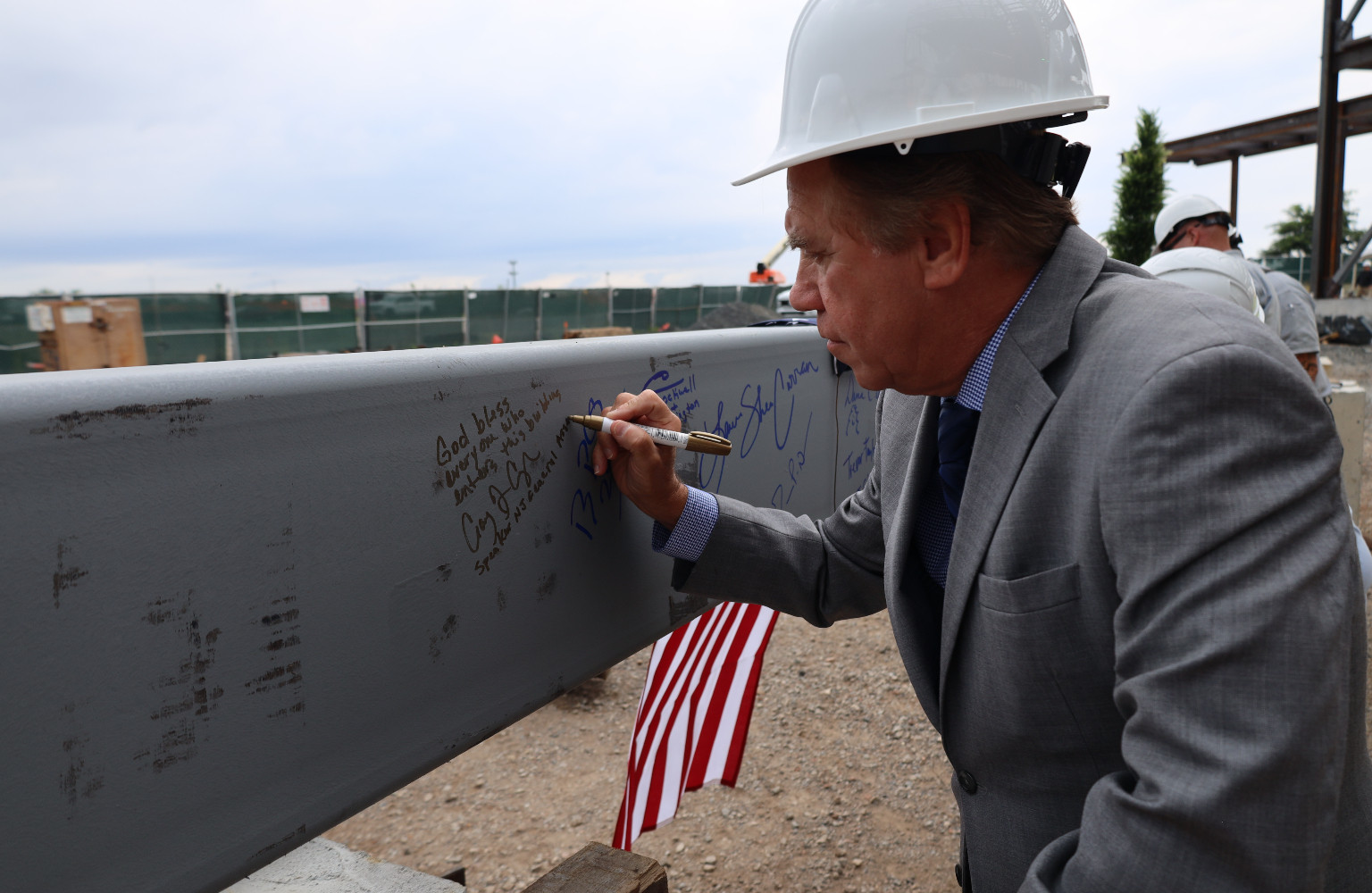
The ceremonial topping off beam at the Multimodal Ferry Terminal in Carteret went up on a Wednesday afternoon. The moment, however, had been in the making for 24 years.
That’s why, when Mayor Daniel Reiman watched workers bolt the final piece of steel into place at the borough’s new ferry terminal, he wasn’t thinking about girders — he was thinking about the Army Corps of Engineers the Coast Guard, and every federal acronym that had stood between this waterfront and this exact afternoon.
“Twenty-four years to fight through the bureaucracy of the Army Corps of Engineers, the Coast Guard, the FTA, the USDOT, the alphabet soup of acronyms that make up the federal, state and regional agencies,” Reiman told a crowd gathered for the occasion.
It was, in his telling, less a construction milestone than a small act of vindication.
The $50 million Multimodal Ferry Terminal is now about halfway built. Its exterior is set to be finished by the end of the year, with interior work to follow through the winter — putting a grand opening roughly a year away. But for a project that traces back to 2002, one more year barely registers.
Reiman was joined by Assembly Speaker Craig Coughlin, Freeholder Director Ronald Rios, borough council members and a crowd of union workers, department heads and representatives of the state’s congressional delegation for the beam signing, held at the new Pier Pavilion on Veteran’s Pier — its first public event. Contractor Brockwell and Carrington of Towaco installed the beam.
The mayor credited the project’s momentum to more than $100 million in federal and state grants secured with help from Coughlin and the borough’s congressional delegation, including Rep. Frank Pallone and Sens. Cory Booker and Andy Kim.
Coughlin, who said his family has roots in Carteret, framed the milestone as proof of what sustained local pressure can accomplish.
“There’s been an enormous amount of investment — $35 million from the state alone,” he said. “But what really is at the essence of this is vision, determination and the relentlessness that makes sure something gets done. Every roadblock that was put in the way of getting this project done has been overcome, and that doesn’t just happen. It happens because you have true leadership.”
Days before the beam signing, the Federal Transit Administration awarded NJ Transit a $9.6 million ferry grant to build an electric ferry boat in partnership with the borough. Carteret already has funding secured for other vessels; one, the Theodore Roosevelt, is docked at the Carteret Municipal Marina awaiting one of four planned ferry slips, while another is under construction in New Orleans. Reiman said ferry service and the terminal will open well before the electric boat is completed, which isn’t expected until 2030.
“I’m just delighted to hear that another boat is on the way,” Coughlin said. “These things are not cheap, but this is an example of what we can do when we’re all rowing in the same direction, when we all have same sense of priorities, when we all come together to make sure things get done.”
The ferry project traces its roots to a 1990s Port Authority of New York and New Jersey study that identified Carteret as the best site for its next regional ferry stop. The terminal is part of a broader remake of a waterfront that Reiman describes as having gone from “a toxic nightmare abandoned by industry” to a destination with much more redevelopment still ahead, including a 5-mile boardwalk, a $1.5 billion movie studio and hotel, and a helicopter pad.
“I’ve seen the renaissance that is Carteret,” Coughlin said. “It really is a special place. Time and time again, it gets better and better with the performing arts center, the downtown, and now here on the waterfront. You’re going to have restaurants and shops and more places to go.”
Since taking office in 2002, Reiman has overseen the transformation of Carteret’s waterfront into Waterfront Park, Veteran’s Pier, a mini golf course and the 185-slip Carteret Municipal Marina, with the Pier Pavilion and a mobile kitchen set to open soon. The mayor also thanked the U.S. Department of Transportation, the state Department of Transportation, the New Jersey Infrastructure Bank, the FTA and the state Department of Environmental Protection for their support of the project.


