


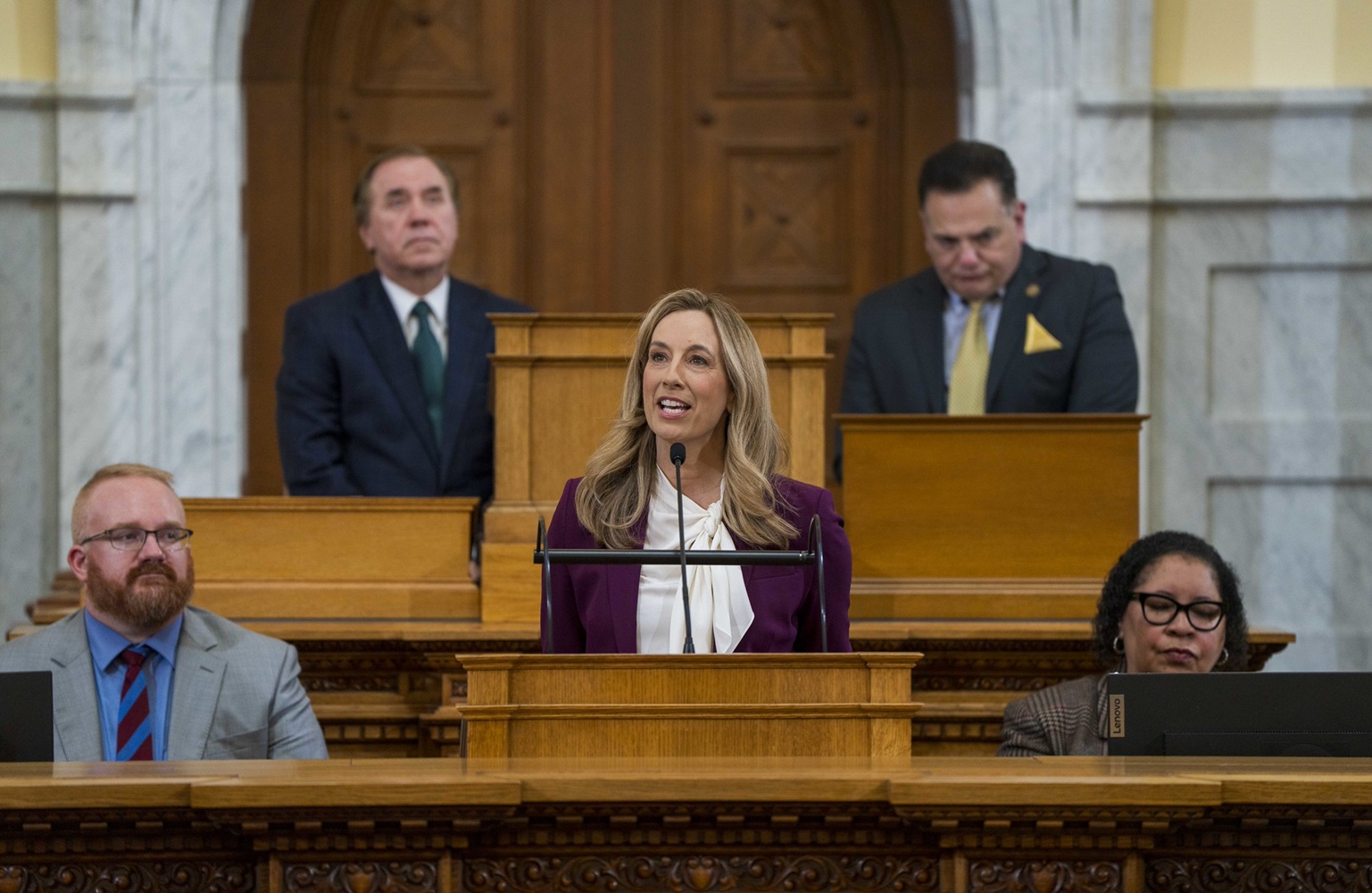
Business groups around the state loved hearing that Gov. Mikie Sherrill was focused on streamlining the permitting process, bringing more transparency and accountability to the budgeting process, increasing government efficiencies and promising to end the last-minute pet-project appropriations that crush the budget in the name of delivering for constituents.
The promise to strengthen the Business Action Center, Main Street programs and to cut more than $2 billion in spending — including a slice out of budget-busting STAY NJ program — sounded good, too. As did a pledge to attack pharmacy benefit managers.
Sherrill’s Budget for New Jersey 2026
- Business groups applaud Sherrill’s cuts — voice concerns over new taxes
- Health care’s huge hidden cost: Sherrill to take aim at PBMs
- Seven things we learned from Sherrill’s first budget
But you can be sure that business group leaders also didn’t miss this line in her first budget address: “It does NOT raise taxes on individual New Jerseyans.”
It should be noted that it was the governor’s team that put ‘NOT’ in all caps. Businesses may have capitalized “INDIVIDUAL” as it was clear from the sentence that the no-tax pledge does not apply to them.
How and where taxes will be raised on businesses and corporations will be determined in the coming negotiations. Sherrill gave the first hints during her 46-minute speech Tuesday.
A proposed per-employee fee on businesses with more than 50 employees on Medicaid got the most attention.
Chris Emigholz, the chief government affairs officer at the N.J. Business & Industry Association, summed it up this way:
“This is perhaps the most troubling part of the budget proposal for the business community,” he said.
Emigholz said it establishes a situation where employers can be penalized even if they offer health coverage for their workers, which is already one of the largest expenses they absorb every year.
“The impact of the tax is difficult to calculate,” he said. “Many employers don’t know how many of their employees are enrolled in Medicaid. There are industries with high turnover rates. Some employees actually choose not to work more hours so they can keep certain government benefits. And it creates a disincentive for businesses to employ part-time and seasonal workers.”
Christina Renna of the Chamber of Commerce of Southern New Jersey, after saying the budget address contained reasons for encouragement (commitment to energy diversity, permitting reform and housing affordability), noted the proposed employer Medicaid mandate, too, saying it will require “serious scrutiny.”
Tony Russo of the Commerce and Industry Association of New Jersey was less specific. He said his group is “concerned” with the proposed elimination of certain corporate tax deductions and what impacts they will have.
At least Russo used the term ‘deductions.’
The idea that laws passed in the Legislature and signed by the governor were called ‘Loopholes’ was a bit concerning, too.
All this being said, the governor’s budget address is just the first part of a long-negotiated process.
Business groups said they were overall optimistic about much of what they heard. They are trying to remain hopeful that all involved will get to the same place.
Emigholz said is much when talking about Sherrill’s plans to limit the Alternate Business Calculation deduction.
“While it may be well intentioned to better focus this tax program on smaller businesses, NJBIA is worried that the proposed threshold is too low because it excludes businesses with $1 million in gross revenue and could discourage entrepreneurial investment,” he said.
Tom Bracken of the State Chamber repeated his mantra: You cannot cut your way to prosperity.
“Expense reductions must be paired with aggressive growth initiatives that generate sustainable, organic revenue from business expansion,” he said. “We hope that as budget deliberations continue in the coming months, these high-impact initiatives will be added to the proposal.
“The foundation for strong economic and fiscal growth can only be achieved by combining continued expense austerity with significant revenue growth.”
Michele Siekerka of the NJBIA agreed.
Businesses understand the state’s fiscal situation as well as anyone. They want to help, she said — not be used to fix problems they did not create.
Siekerka said she heard some of that on Tuesday.
“We appreciate that the budgetary challenges facing New Jersey are not exclusively being thrust upon our already beleaguered business community, which was too often the case in recent years,” she said. “Rather, there is a better balance between spending cuts and the business tax changes being proposed.”


