


Public education is built on a simple promise: every child deserves equal opportunity. But delivering on that promise looks very different depending on a student’s needs. For children with disabilities, it often means intensive, individualized programs involving specialized staff, therapies and environments that make it possible for them to learn in ways most of us take for granted. In the case of a child with disabilities, these supports are not optional; they are what make learning possible. And they come at a cost beyond what any single district can reasonably absorb.
About NJASEPS
The N.J. Association of Special Education Partner Schools, formerly known as ASAH, is a nonprofit organization representing New Jersey’s private special education schools that provide highly specialized services to more than 10,000 infants, children, and young adults with disabilities. Since 1974, NJASEPS has worked in partnership with public school districts, state agencies, and communities to promote excellence, equity, and collaboration in special education across the state.
Extraordinary Special Education Aid was created to close that gap. When it falls short, the cost does not disappear — it shifts. The burden ripples outward onto local schools, taxpayers and ultimately, the students the system is meant to serve. A system that promises individualized education — but fails to fund it – is a broken system.
What happens when funding falls short
Extraordinary Special Education Aid was established under the School Funding Reform Act to protect districts from the volatility of high-cost, low-incidence placements. The law requires that the state reimburse school districts for 90% of in-district costs over $40,000 and 75% of out-of-district private placement costs over $55,000. But in reality, the state doesn’t put in enough funding each year to meet those promises.
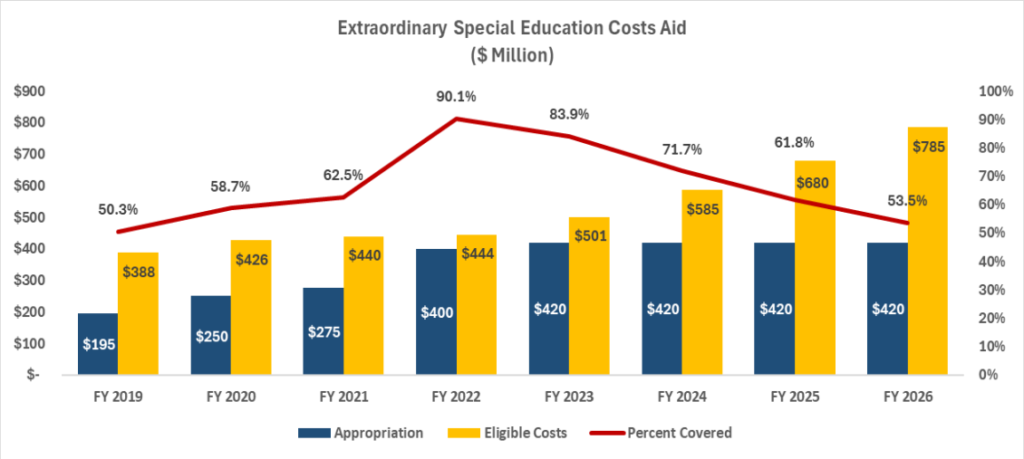 This fiscal year, New Jersey is only covering 51.7% of eligible Extraordinary Special Education Aid costs, and coverage is estimated to drop to 40% next year. The result is instability — especially for small and geographically remote districts — and a system that is less efficient, less equitable and more costly over time.
During recent testimony before the Senate and Assembly Budget Committees, I shared research that affirms fully funding this Aid would stabilize local and state budgets, reduce litigation and administrative burdens and restore much-needed predictability. Most importantly, it would ensure that students are supported based on their needs — not limited by shortfall.
A promise we can’t break
The N.J. Association of Special Education Partner Schools, known as NJASEPS, represents nearly 10,000 students that rely on Extraordinary Special Education Aid. For their families navigating underfunded programs, this is not about policy — it is their child’s entire educational experience at stake. And for families whose children do not require special education services, the impact is still real: districts forced to absorb these costs must make difficult decisions that affect all students.
Fully funding Extraordinary Special Education Aid is how the state keeps its promise. For families, this is not a line item, it is their child’s chance to learn, grow and be included. That is not something we can cut short.
John Mulholand, Jr. Is the executive director of the New Jersey Association of Special Education Partner Schools.


