


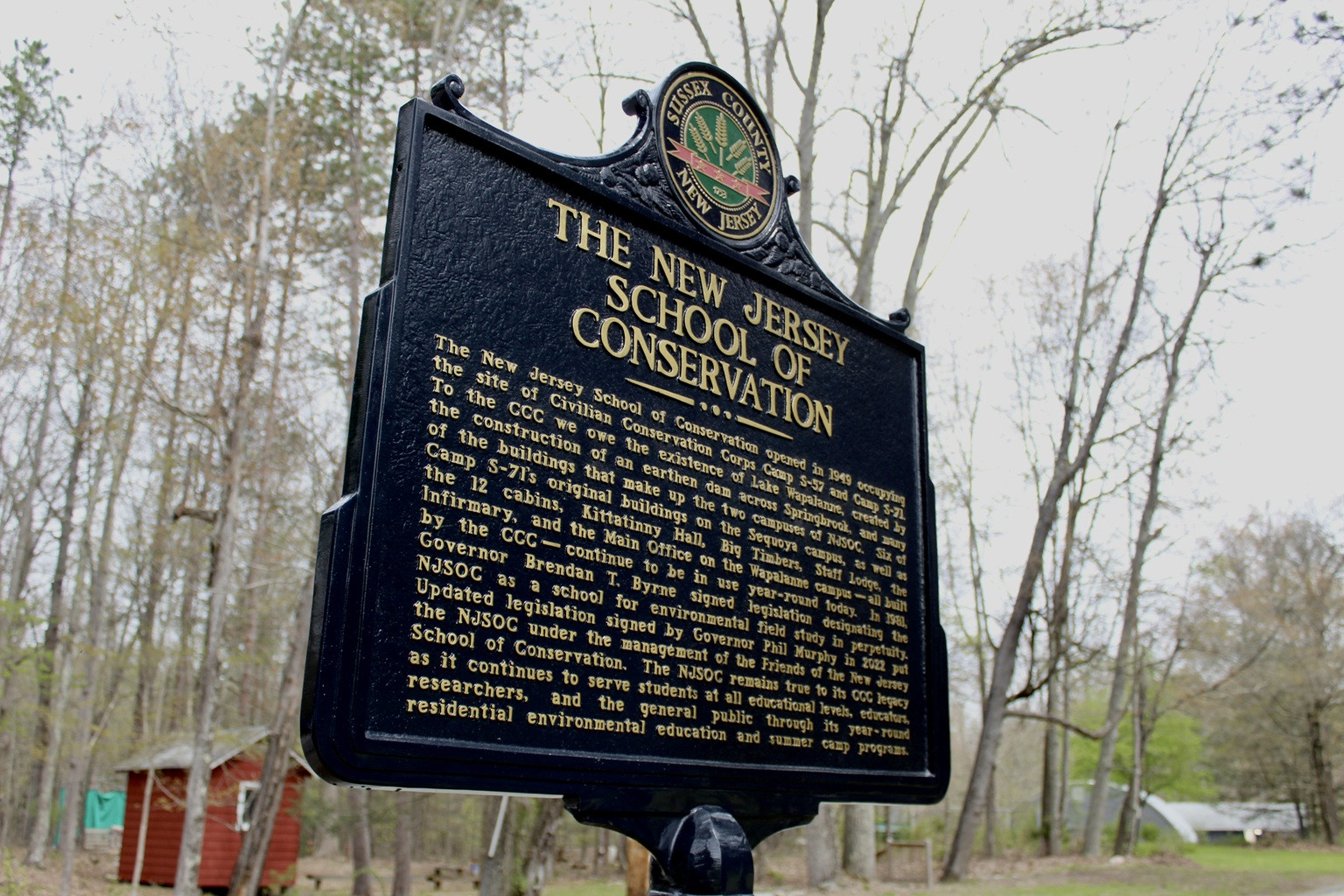
In the 1930s, young men from the Civilian Conservation Corps built a cluster of cabins in the woods of Sussex County. They were part of a New Deal program designed to put idle hands to work and give the country something to hold onto during hard times. Nearly 90 years later, those same buildings are still doing what they were built to do — giving young people a place to learn, explore and grow.
Now, for the first time in 76 years, the state that owns them may walk away.
The New Jersey School of Conservation — the nation’s oldest year-round residential outdoor education center, located on a 240-acre campus in Stokes State Forest — has been zeroed out of New Jersey’s proposed FY27 budget for the first time in its history.
More on the NJ School of Conservation:
- State’s famed School of Conservation may be lost in budget battle
- A few days in the woods. A lifetime of impact. Kids are why the School of Conservation is worth saving.
- 10 things to know about the NJ School of Conservation — and why it’s worth fighting for
It is one of a number of programs cut from the spending plan currently being negotiated in Trenton, with a June 30 deadline.
“It doesn’t make any sense economically, or from a policy position, or from just a doing the right thing stance to shut the school down,” said Jen Coffey, board chair of the Friends of NJSOC.
Then there’s this: The cost to the state to keep up the property, which it will be required to do, may be more than what the School is asking for in the budget.
Two budget resolutions — Senate Resolution 302 and Assembly Resolution 990 — would restore $3 million for the school before the June 30 deadline.
Those who want to help can contact their legislators or visit njsoc.org. In the meantime, here are 10 more things to know about the New Jersey School of Conservation, taken from conversations with Executive Director Kerry Kirk Pflugh, board chair Jen Coffey, NAIOP New Jersey CEO Dan Kennedy and environmental attorney Dennis Toft.
10. It started with a bipartisan idea — in 1949
The school was the brainchild of a Republican governor and a Republican state senator who worked with the education community to establish it in 1949. In 1981, Democratic Governor Brendan Byrne signed legislation designating the school in perpetuity as a center for environmental field study. In 2022, Governor Phil Murphy transferred management to the Friends of NJSOC with unanimous bipartisan support. It has outlasted every political era New Jersey has produced — and has never been a partisan issue.
9. The buildings are nearly 90 years old — and still standing
The campus consists of 63 buildings, most of them constructed by the Civilian Conservation Corps in the 1930s. When the Friends of NJSOC took over management in 2022, many of the buildings were in poor repair. The organization has spent the past three years restoring them. About half the buildings on the campus are still offline. Getting the remaining structures up to code is a central part of the $3 million ask.
8. The campus is 240 acres in one of New Jersey’s most beautiful state forests
The school sits within Stokes State Forest in Sussex County — 240 acres of fields, forests, lakes and trails that serve as both classroom and laboratory. The campus includes a lake, a dam, a solar array and a wastewater treatment plant that discharges to one of the cleanest streams in New Jersey.
7. The curriculum covers four areas — and all of it is tied to state standards
Students can choose from 23 classes spanning science, social studies, humanities and recreation. Water ecology. Metal smithing. Blacksmithing. Archery. Discovery hikes. Ropes courses. Team-building activities. Every class is correlated to New Jersey’s core curriculum standards. The goal, Executive Director Kerry Kirk Pflugh said, is not to teach students what to think — it is to teach them how to think.
6. The students range from fourth grade to college — and demand is growing
The school’s primary audience has traditionally been fourth through sixth graders, but the growth of STEM and STEAM programs at the high school level has brought older students to the campus for capstone projects and field research. Nine academic institutions have formally signed on as research partners. Demand, Pflugh said, is growing faster than the school can accommodate — it is already turning groups away due to capacity constraints.
5. Half the students come from Title One overburdened communities
About 50% of the students who participate in the school’s programs come from Title One communities — schools and districts where resources are limited and outdoor experiences are rare. For many of them, the trip to Sussex County is their first time sleeping away from home, their first time in a forest, and their first time experiencing the kind of hands-on learning the school provides. NAIOP New Jersey made a direct contribution to subsidize a trip for the Paterson school district. Dan Kennedy, its CEO, said any business in New Jersey could do the same.
4. A commercial real estate CEO and an environmental commissions director are on the same side
Kennedy, CEO of NAIOP, and Coffey, executive director of the Association of New Jersey Environmental Commissions, don’t agree on much. On the School of Conservation, they are completely aligned. Kennedy’s argument is workforce development — the engineers, architects and contractors who work on New Jersey projects need a workforce grounded in how the natural world works. Coffey’s is broader: getting kids outside is the antidote to the mental health crisis driven by screen time and social isolation.
3. One of New Jersey’s top environmental attorneys traces his career back to a fifth-grade pond ecology class there
Dennis Toft, co-chair of the environmental law group at Chiesa Shahinian & Giantomasi, was an 11-year-old from Lawrence Township when he took the Stokes trip in 1968. He remembers wading around a lake, looking at plants and species he had never seen in his neighborhood near Trenton. The experience sparked an interest in the environment that never left him. By the time he reached law school, environmental law was the obvious path. “It all started back in fifth grade,” Toft said.
2. Closing the school may cost the state more than keeping it open
If the Friends of NJSOC lose their funding and can no longer manage the site, the property reverts to the New Jersey Department of Environmental Protection. DEP then inherits 240 acres, 63 aging buildings, a wastewater treatment plant, a solar array, a lake and a dam — along with everything that comes with a hard Sussex County winter. “It’s going to cost government a whole lot more than $3 million just to manage that site,” Coffey said, “let alone hold the programs the way that we are.”
1. The deadline is June 30 — and there is something you can do
Two budget resolutions — Senate Resolution 302 and Assembly Resolution 990 — would restore $3 million for the school before the state budget must be signed. The school is asking residents, former students, teachers, businesses and anyone who values outdoor education to contact their legislators and make the case. The school’s website at njsoc.org has a direct link to take action. The CCC built those cabins to last. The question now is whether New Jersey will let them keep doing what they were built to do.


