


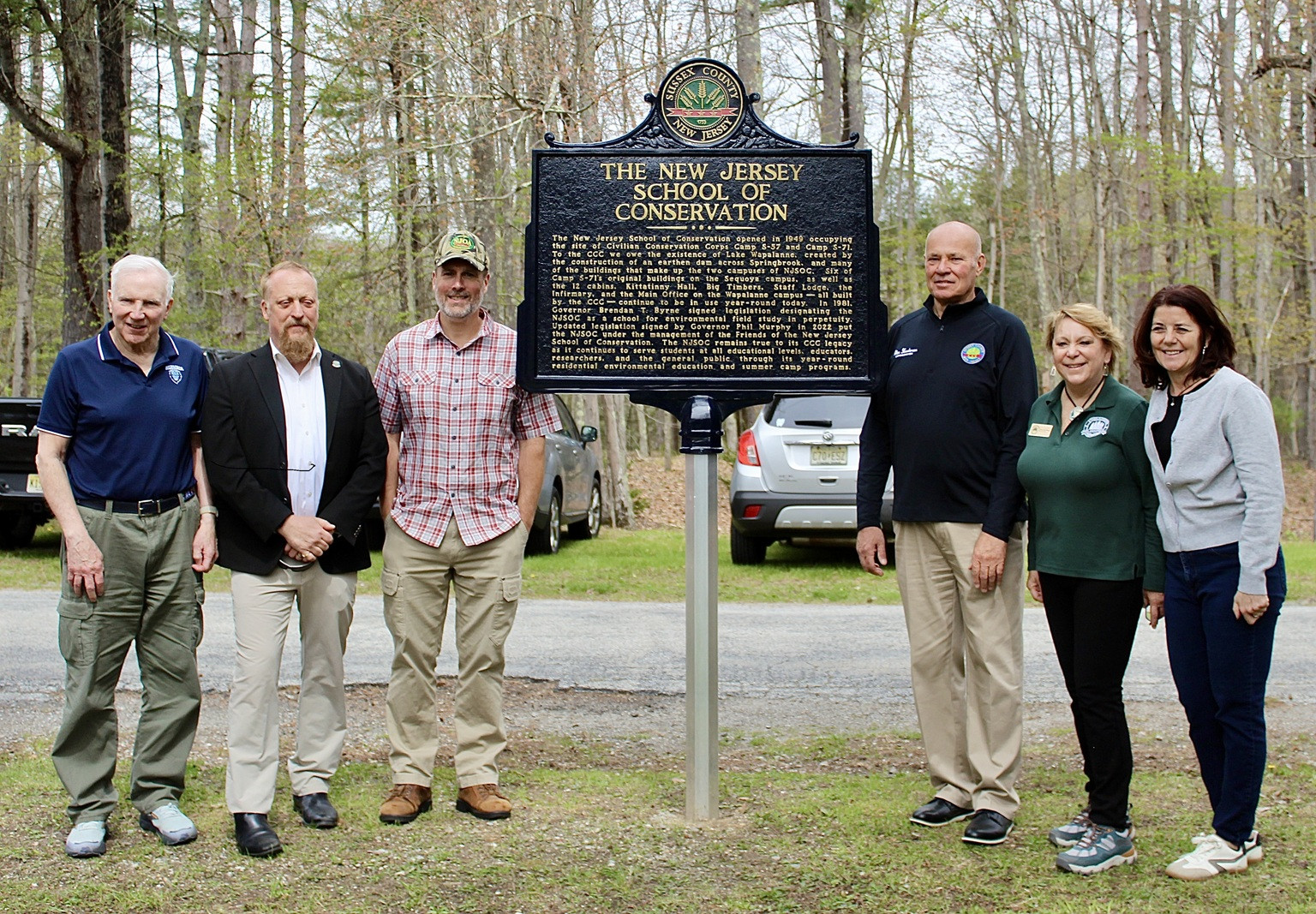
Every year, thousands of New Jersey kids arrive at a 240-acre campus in Sussex County and spend a day or two doing something increasingly rare: putting their phones down and paying attention to the world around them. They wade through ponds, identify species, learn to build with hand tools and sleep away from home — some of them for the first time.
The New Jersey School of Conservation has been making that happen since 1949. It has survived a pandemic, a near-abandonment by the university that managed it for 40 years, and decades of aging buildings held together by a small nonprofit and sheer determination.
What it has never survived before — and what it is fighting right now — is being zeroed out of the state budget, a move the school could not overcome.
More on the NJ School of Conservation:
- State’s famed School of Conservation may be lost in budget battle
- A few days in the woods. A lifetime of impact. Kids are why the School of Conservation is worth saving.
- 10 things to know about the NJ School of Conservation — and why it’s worth fighting for
To be sure, the school is not alone. New Jersey’s proposed FY27 budget has cut or eliminated funding for a number of programs, and the School of Conservation is one of many fighting to get back in before the June 30 deadline. Two budget resolutions — Senate Resolution 302 and Assembly Resolution 990 — would restore $3 million for the school.
It is a familiar story in budget season: programs get zeroed out, advocates mobilize, Trenton decides. But the School of Conservation comes with an unusual twist that its supporters have been pressing hard in those conversations.
Closing the school may cost the state more than keeping it open.
“We’re in the 11th hour,” Executive Director Kerry Kirk Pflugh said. “We’re doing a very aggressive campaign to try to save the school.”
***
If the Friends of NJSOC — the nonprofit that has managed the site since 2022 — loses its funding and can no longer operate, the property reverts to the state Department of Environmental Protection. DEP then inherits 240 acres, 63 buildings, a wastewater treatment plant that discharges to one of New Jersey’s cleanest streams, a solar array, a lake, a dam and everything that comes with a hard Sussex County winter.
Jen Coffey, president of the Friends of NJSOC and executive director of the Association of New Jersey Environmental Commissions, put it plainly.
“It’s going to cost government a whole lot more than $3 million just to manage that site,” she said, “let alone hold the programs the way that we are.”
The school’s annual budget last year was $2.5 million — $1.6 million from the state, roughly $500,000 raised through grants and fundraising, and carry-over from the prior year. Three million dollars would cover operations and the capital improvements needed to bring the aging campus up to code. After that, Pflugh said, the annual operating ask drops to $1.6 million — a number the school can sustain alongside its own fundraising.
What the school does with that money is harder to quantify than a line item.
The curriculum spans science, social studies, humanities and hands-on outdoor education — water ecology, metal smithing, archery, discovery hikes and ropes courses, among other activities. All of it is tied to New Jersey’s core curriculum standards.
The goal, Pflugh said, is not to teach kids what to think. It is to teach them how to think.
“We’re teaching how to problem solve, how to be aware of our ecosystems, how to identify problems, do the research, and come up with solutions,” she said. “How to get along collaboratively, working as teams.”
Then there’s this: The school served nearly 4,000 students from 19 counties (and three states last year – with nearly have of them coming from Title One overburdened communities. Kids Coffey said would otherwise never have this experience at all.
***
The school’s supporters span a spectrum that is unusual even by New Jersey standards.
Dennis Toft, one of New Jersey’s top environmental attorneys, has been instrumental in connecting the school to the business and legal communities. He was himself a fifth-grade student who made the trip to Stokes State Forest — a pond ecology class in 1968 that he credits with setting him on the path to environmental law.
Dan Kennedy, CEO of NAIOP New Jersey — the commercial real estate industry’s trade association — is a VP on the Friends board and has been one of its most vocal advocates. His argument is straightforward: the engineers, environmental attorneys, architects and contractors who work on New Jersey’s development projects need a workforce that understands how the natural world works. NAIOP made a direct contribution to subsidize a trip to the school for the Paterson school district.
“Getting kids off their phones and into the woods, learning about the world and how it works is really important for society as a whole,” Kennedy said.
Standing alongside Kennedy is Coffey — whose organization and Kennedy’s don’t typically agree on much.
“Dennis and Dan and I disagree on absolutely everything except for the School of Conservation,” she said. “This is a way for business partners to say, ‘Hey, yeah, we support kids getting out there and being able to run around in nature and learn and explore.’”
That kind of alignment — environmentalists and commercial real estate advocates pushing the same cause — is the argument the school is taking to Trenton.
***
The school was founded in 1949 under a Republican governor and a Republican state senator. It was designated in perpetuity by Democratic Gov. Brendan Byrne in 1981. Gov. Phil Murphy transferred management to the Friends in 2022 with unanimous bipartisan support. It has outlasted every political era New Jersey has produced.
It is believed to be the last remaining operational Civilian Conservation Corps site in the country.
Pflugh came to the job the way most people come to their life’s work — it found her. Her father, John Kirk, ran the school for 37 years. She grew up on the campus, spent 35 years at the DEP, and when Montclair walked away in 2020, she helped save it. Now she runs it.
Pflugh is a product of this place. So are the 500,000 students who have passed through it. So, in a way, is Dennis Toft — the fifth grader who waded through a pond in 1968 and eventually became one of the state’s leading environmental lawyers. The school has a way of doing that to people.
The budget deadline is June 30. Senate Resolution 302 and Assembly Resolution 990 would restore the funding. Those who want to help can contact their legislators or visit njsoc.org.
“I see these young people who come, and the teachers who come, and the experiences they have are profound,” Pflugh said. “That is worth fighting for.”


