


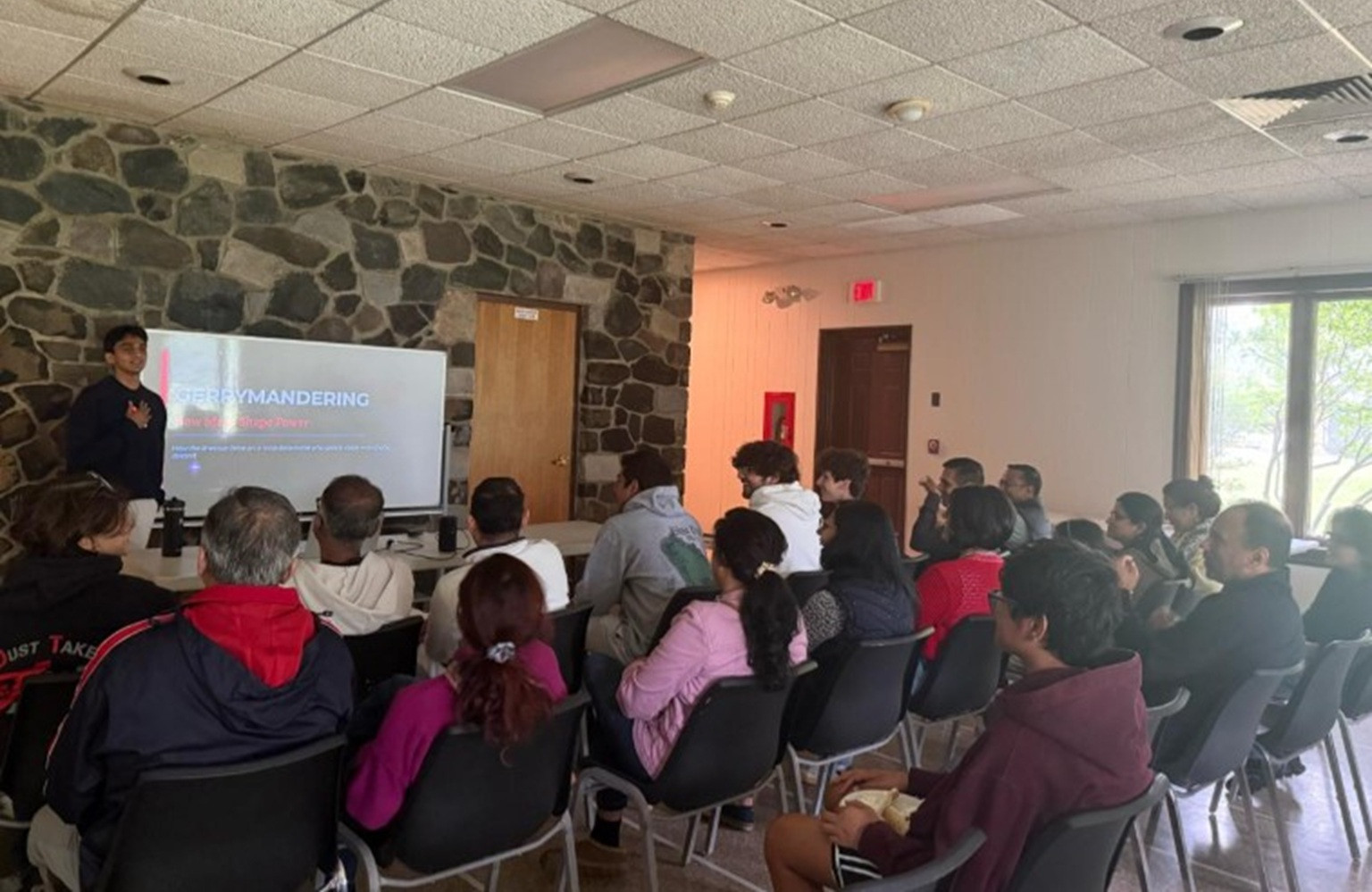
On a Saturday morning in May, in a room at the Millburn Bauer Center, people of all ages came to hear a presentation on something that dramatically impacts all of them — but that they know little about: How their congressional districts are drawn.
And how that districting — often done with a technique called gerrymandering — rarely is done with the good of the voters in mind.
The speaker explained how gerrymandering, a term that traces back to 1812, is a way in which voters are placed in districts that defy a geographic shape or community identity to best ensure a desired outcome.
To be clear, gerrymandering has been used equally and unabashedly by every political party. And normally, it’s a behind-the-scenes part of the political process. But an effort by Republican state leaders, strongly encouraged by the Trump administration, to redraw districts ahead of midterm elections this fall, has brought redistricting (and the use of gerrymandering in the process) into the light.
That’s why four or five dozen people, everyone from seniors to those too young to even vote, came to hear the presentation.
That’s why an event that was supposed to last an hour went far longer.
And maybe that’s why no one seemed to care that the speaker was not a political science professor, talking-head journalist or government official — but Raghav Sampath, a rising senior at Montclair Kimberley Academy.
***
Sampath’s timing wasn’t an accident.
Redistricting has become one of the hotter fights in national politics ahead of this fall’s midterms, after the U.S. Supreme Court struck down Louisiana’s congressional map as unconstitutional this spring, prompting Republican-led states to consider redrawing their own lines to pick up seats.
Gov. Mikie Sherrill has said she’s open to the idea of New Jersey doing the same thing in response — creating what she called a counterbalance if other states redraw maps to benefit Republicans.
New Jersey, unlike many states, doesn’t leave redistricting to whoever controls the Legislature. Then again, the process is not completely nonpartisan.
New Jersey uses a 13-member commission to draw the state’s congressional map, with a nonpartisan tiebreaker casting the deciding vote when the two sides can’t agree. In the current cycle, that tiebreaker was former state Supreme Court Justice John Wallace, whose vote produced the map now in effect through 2032 — a 9-3 split favoring Democrats.
As of now, New Jersey hasn’t changed anything. Redrawing the state’s map to further benefit either party would require a constitutional amendment and a voter referendum, a process state lawmakers haven’t set in motion.
The Louisiana ruling, which said the state could not set up districts to favor a particular race — in this case, ensuring that Black communities had a representation — was one of the moments from Sampath’s presentation that generated the most discussion.
Sampath said he walked the room through the tension between racial and partisan gerrymandering — a distinction that gets murky in states where race and party affiliation overlap heavily.
“I talked about why it was decided the way it was — and how do you decide if it’s a racial gerrymander versus a partisan gerrymander?” he said. “In Louisiana, Alabama, Mississippi, Georgia, 90% of white voters are Republicans, and 90% of black voters are Democrats. So, is there really a difference between racial and partisan gerrymandering in these states?
“That was one of the most interesting ideas we sort of spoke about as a group.”
***
Anyone can identify a problem. Solving it, is a greater task.
During the presentation, Sampath spent real time on the question of what a fairer map might look like — and pointed to Michigan as the model he trusts most.
Michigan’s redistricting commission isn’t run by neutral outsiders with no stake in the outcome, he explained; it’s four Democrats, four Republicans and five independents, structured so that neither party can win without appealing to the middle.
“So, at the end of the day, the Democrats can have their ideas, the Republicans can have their ideas, but you need to appeal to the independents,” he explained. “You need to appeal to the middle that often gets left out of partisan politics. That is the key to Michigan’s success.
“They had the most balanced map Michigan has ever seen. It’s really, I believe, one of the best maps in the country.”
Sampath said this is what voters want.
“We’ve seen voters overwhelmingly, whenever they’re given the opportunity under fair circumstances, they overwhelmingly reject partisan gerrymander,” he said. “It’s one of the only issues in the country where Republican voters and Democratic voters agree.”
Still …
“Because of the way our politics are right now, incumbent representatives have an incentive to lobby their states or whomever to keep their own district that they win,” he said. “So, what happens, is that instead of the voters choosing the representative, which is democracy and what you’d like to see, the representative is often picking their own voters.
“That is the tension. That’s the phrase I use in my town hall to explain why gerrymandering is so bad.”
***
Sampath’s interest in the subject didn’t just start with a school assignment.
“I’ve been interested in gerrymandering since 2021, when the redistricting cycle was in full swing,” he said. “It was an issue I was passionate about. I was obsessed with it. I remember during COVID we had online classes. I would be looking at maps when I wasn’t supposed to.”
That interest has since hardened into something closer to expertise. He placed second nationally in the Political Science Bee in 2025, reached the semifinals of the U.S. History Bee and International History Bee in multiple years, and was accepted into Yale Young Global Scholars, one of the more selective pre-college programs in the country.
He’s also spent his high school years testing his interest in politics directly — volunteering on multiple New Jersey campaigns, including Andy Kim’s U.S. Senate run and Tom Malinowski’s congressional campaign, and interning in the offices of state Sen. John McKeon and Congressman Josh Gottheimer.
At Montclair Kimberley, he was elected to the Spirit Committee and will serve as incoming president of both the school’s debate team and its Model UN club.
He’s already planning his next presentations, a version aimed at his own classmates ahead of the midterms this fall, and a townhall event about the upcoming midterm elections and the trend he sees in the national and New Jersey districts.
***
At the Bauer Center, Sampath said he made a point of staying out of the partisan fray entirely.
“I was very careful not to do that,” he said. “Gerrymandering as an institution is extremely old. It goes back literally to the 1800s, with the Democratic Republicans and Federalists, parties that don’t even exist. To blame gerrymandering on one party wouldn’t necessarily be fair.”
That was a theme of his presentation.
“I just explained how it was,” he said. “I explained which states were gerrymandered. I put a map up that showed the most gerrymandered states, and I let people draw their own conclusions. I wasn’t making a partisan statement. I was just trying to do civic education.”
It’s a lesson many people — including elected officials — might be interested in hearing.


