


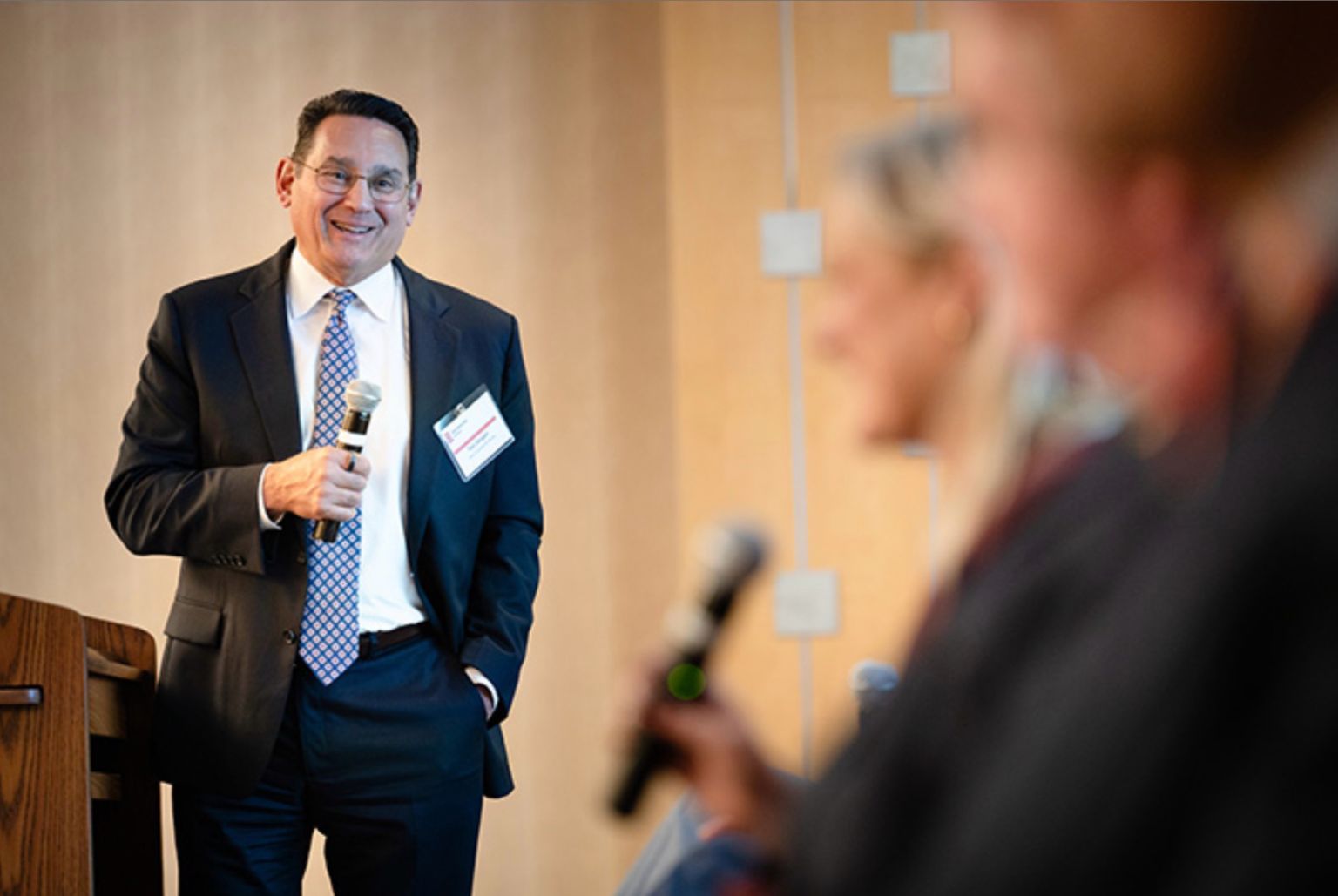
Ted Zangari said he was thrilled the third annual Rutgers Center for Real Estate Symposium held at the Heldrich in New Brunswick last week provided spirited conversations about the state’s supply-and-demand issues — and everything else that has made New Jersey so unfavorable to site selectors.
That’s why he wants the talk to continue.
You can learn a lot by simply asking: What do corporate site selectors need from a state? And how do they see New Jersey?
“Once you raise those two questions, you’re hitting on the buyer side, which is ultimately what’s important,” he told BINJE.
Zangari, the Sills Cummis & Gross attorney who is one of the key leaders behind the annual Rutgers Center for Real Estate Symposium, said this year’s symposium was an honest effort to understand why the state lags in so many external economic development assessments.
“We turned the mirror on ourselves and did a self-examination of New Jersey, and a way forward,” he said.
***
The program went challenge by challenge: constrained water, constrained energy, jammed roadways, permitting, etc.
- Developer Gene Diaz pressed state officials on delays;
- The Highlands Council’s Ben Spinelli warned that no one knows how much growth the state’s water supply can handle;
- Woodbridge Mayor John McCormac showed how one town gets projects approved in minutes, not years;
- And a panel Zangari moderated looked at how rankings and reputation are costing New Jersey corporate moves.
The final panel turned from the buildings to the businesses and people who fill them. That’s where Zangari wants the conversation to go next.
To hear Zangari tell it, New Jersey’s real estate problem is really two problems, and they point in opposite directions.
On housing, demand isn’t the issue. The state can’t build multifamily fast enough. Office is a different story.
Zangari pointed to Jersey City, where residential towers keep rising. He doubts all those residents work from home, and he doubts they all commute out of town. It’s a blend. But if more of them worked in town, he said, the waterfront wouldn’t have office vacancy rates in the 20% range.
“So clearly, we have a demand problem,” he said.
Industrial is the reverse. Before New Jersey can chase manufacturers, it needs somewhere to put them.
“We actually have a supply problem before we could even generate a demand problem, and that’s that we’re out of industrial land of any meaningful size in the port district,” he said.
That district is measured 25 miles from the crown of the Statue of Liberty. Within it, Zangari said, there are no assembled, cleaned-up sites where a business could put up a manufacturing plant of any size tomorrow.
Fixing that takes a public-private partnership. Zangari said the private sector alone doesn’t have the time, patience or appetite for risk to spend years piecing sites together. The state would need to help vacate streets, take over dormant rail yards and clean up contaminated land.
“And voila, suddenly you have a 40-acre site,” he said. “We have to create supply before we can even gin up demand.”
***
Zangari is in a good spot to work both sides.
Besides directing the symposium, he is one of the founders of the Rutgers Center for Real Estate and serves on its executive committee. He also is on the executive board of the State Chamber of Commerce, where he gives the board a quarterly update on economic development.
“I have one foot in real estate development, and one foot in economic development, representing the tenants or end users,” he said. “You need both. This is a supply and a demand problem.”
The plan is to use both platforms. The Rutgers Center for Real Estate will lead on supply, meaning real estate development. The State Chamber will lead on demand, meaning the companies that fill the buildings.
And while there are plans for more public forums, Zangari said a part of the work needs to happen behind closed doors.
He said some of the toughest advice needs to come privately, from the private-sector people who work with site selectors every day. In those sessions, the usual roles flip. Public officials and their staffs make up the audience, and business leaders do the talking.
Those conversations won’t be as flashy as Diaz’s on-stage frustration with permitting, which Zangari called “a visceral frustration, years in the making,” among developers and businesses alike.
“At first blush, anyway, this is a blander topic,” he said. “But I guarantee you, as these issues are teased out, there will be spirited conversations behind closed doors with public officials when they hear from private sector officials about the challenges that they encounter in trying to recruit and retain companies.”
Taxes will be part of that, but Zangari said there’s no quick fix.
“This governor inherited a real set of challenges, and there’s no magic bullet,” he said. “There’s no way a governor could just wave a wand and reduce all our taxes to the levels that exist in the neighboring states all around us.
“But there could be a plan, an aspirational plan for over time reducing our overall corporate tax structure. That’s not sexy, but it’s necessary.”


