


Brielle Freda Seminerio took over her family’s manufacturing company at 29. She knew what her employees were wondering.
They had worked for her father for years. Now, she recalled, here was his daughter.
“Is she going to flop or is she going to rise to the occasion?” she was certain they were thinking.
She rose.
Three years later, Seminerio is President of Brewster Washers, a fifth-generation company that turns 108 in March. She credits mentors with getting her through it.
“I’ve leaned on my mentors to help me develop the skills that I need, and make sure my team also trusts me as a young leader,” she said.
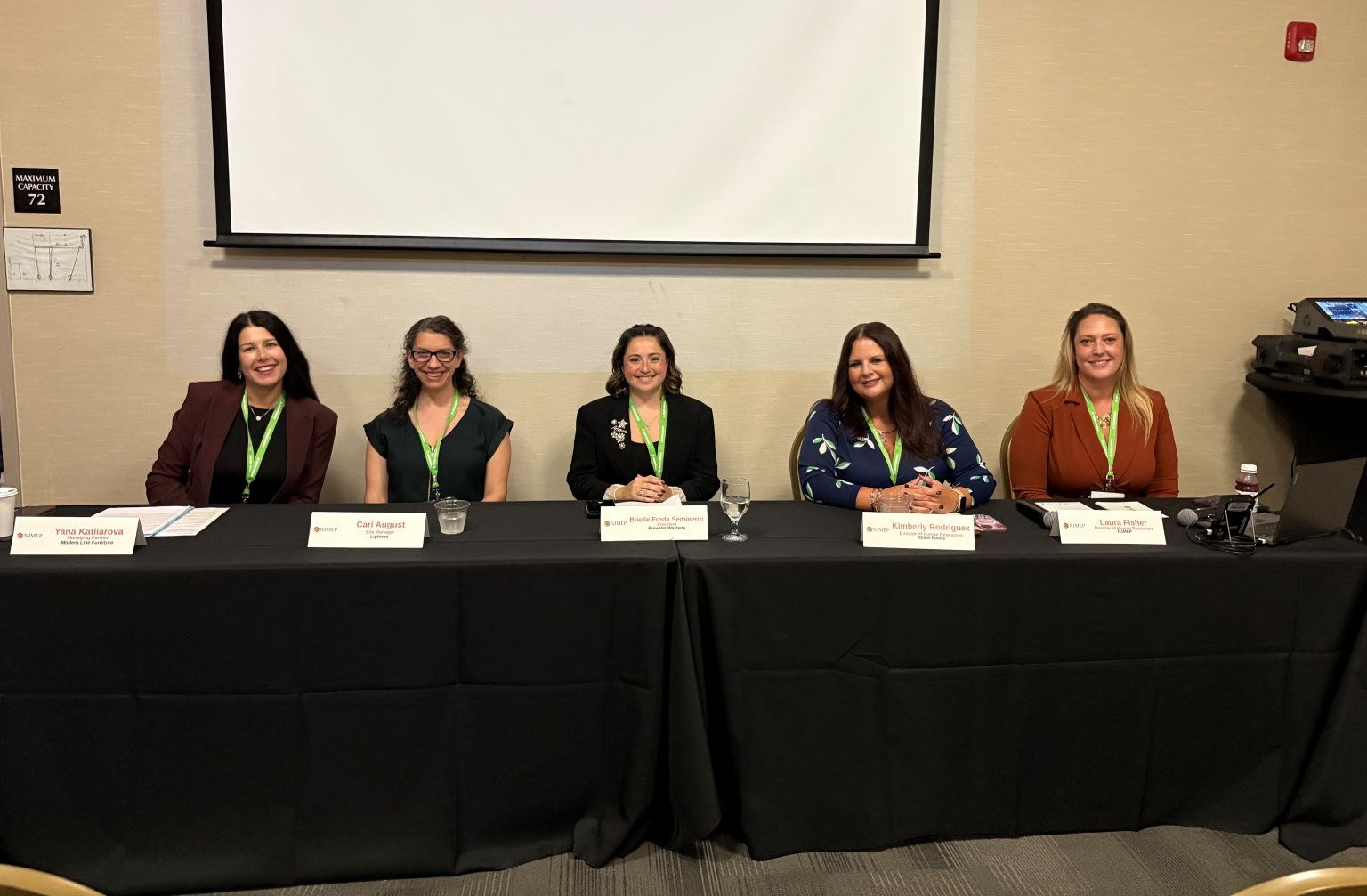
It’s good advice. And just one of the many points of guidance Seminerio and three other panelists gave last week on a women in manufacturing panel during the Made in NJ Manufacturing Day.
Seminerio was joined by:
- Yana Katliarova, Managing Partner of Modern Line Furniture;
- Cari August, Site Manager at Lightera;
- Kimberly Rodriguez, Director of Human Resources at REMA Foods;
- Laura Fisher, Director of Human Resources at NJMEP, moderated.
Here are 10 key items from the panel:
10. Tribal knowledge is a risk. Treat it like one
Brewster Washers’ longtime tool and die maker retired after 60 years. Only one employee, there 20 years, now knows how to build the dies for the company’s manual punch presses. Seminerio said the AS9100 aerospace quality standard specifically calls out tribal knowledge as a threat.
She learned the lesson the hard way. When her father got sick, she sat with him in the hospital in the mornings, learning how he priced jobs, because no one had ever asked.
“No one ever picked his brain because Dad just had it under control,” she said.
Now she makes time, even on a single shift, for her foreman to teach the next generation, including her brother.
9. Get out on the floor
Katliarova works on the sales side, not the factory floor. But at least once a day, she said, she and her office team walk out to the factory to talk through custom projects with the workers who will build them. They get feedback on the best way to do the job, then relay it to the customer.
“It’s very important to listen to your workers and understand their perspective,” she said.
8. Take the shot
Rodriguez didn’t start in HR. She was 37, with a toddler and no college degree, when a big company kept turning her down. She went back to school, got her undergraduate degree in her 40s and just finished her master’s in June. She calls it “a lattice career, not just a career ladder.”
“Don’t wait for the fear to disappear because it probably won’t. Take the shot,” she said. “Your career is an inside job.”
Fisher had a line of her own, one she and her NJMEP colleague Stephanie Casano share: “If you’re scared, do it scared.”
7. Put the generations together
Katliarova saw a 3D printer at an NJMEP event and thought it could speed up prototyping new furniture designs. Her senior R&D employee liked the idea but admitted he didn’t know the technology.
Then a young hire on the logistics team, fresh out of college, mentioned that he printed 3D figurines at home for fun. He took over the project, helped order an industrial printer and now runs it with R&D. Experienced workers know why processes exist, Katliarova said. Younger ones like to experiment. The company is better when both listen.
6. Mentorship isn’t a perk; it’s strategy
Seminerio said mentorship is how a company develops skilled people, keeps them and passes their knowledge down. Leaning on her own mentors, she said, helped her earn the
trust of a team that had known only her father, and showed her commitment to them. Now she’s giving her team mentors of their own.
5. You don’t need a formal program to find a mentor
August asked the room for a show of hands. Most had been mentored, and nearly as many had mentored someone else. Far fewer worked at a company with a formal mentoring program.
Her advice: reach out to people at events like this one, and connect on LinkedIn.
“A mentor-mentee relationship doesn’t have to be some highly time-invested, long-term thing,” she said.
4. Don’t complain about role models, bring some
August recalled a LinkedIn post from a manager who was dismayed that middle schoolers named athletes and musicians as their role models.
“Who did you put in front of them to look up to?” she said.
She once brought a group of early-career female engineers to a United Way STEM program at a bilingual preschool, where they talked to the children about their work in Spanish. On the ride home, she said, she could see the engineers starting to see themselves as role models.
3. Show students the whole factory
When Katliarova talks to students through NJMEP’s Makers and Creators program, she leads with projects for NASCAR and Coachella. Most kids, she said, picture furniture manufacturing as someone putting plywood together by hand. They don’t see the designers, marketers, salespeople and CNC machinists.
Seminerio has seen it work. Her father once hosted a tour for Passaic County Tech students, spotted one asking good questions and hired him. The student learned to make tools and dies, worked there through high school and college, and now works in quality at one of the company’s customers. Seminerio is bringing Passaic County Tech students back for a tour this month.
2. Buy local, and watch what happens
When COVID cut off parts from overseas, Katliarova said, Modern Line started sourcing from small local shops instead. One of them was a welder working out of his garage. Since Modern Line became a customer, she said, he has rented a warehouse and picked up six more customers.
1. Take the day
Seminerio tells her employees that if they’re having a bad day, they should go home. Brewster Washers makes critical parts, she said, and workers need a clear head.
“You walk through those doors, you leave all the other crap out the door and you come and you focus, because what we’re manufacturing are very important parts, and we can’t get it wrong,” she said.
August’s company uses PTO, not separate sick and vacation days, and she doesn’t ask why someone takes a day off.
“It’s not my business,” she said.


