



Susanne Angarano knows the challenges of working in a college town.
Angarano, a principal at Syracuse, New York-based Ashley McGraw Architects, has spent years designing higher-education projects that exist at the often-awkward intersection of campus and community.
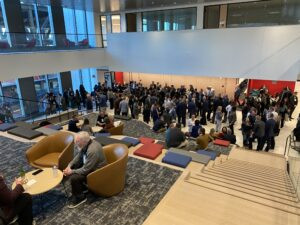
So, when she found herself inside H-1 of the HELIX in New Brunswick on Monday night, listening to DEVCO President Chris Paladino explain how the ambitious public-private partnership came together, she was more than just intrigued. She was impressed.
“This is incredible,” Angarano said during the networking portion of the event. “It’s inspiring to see the community-campus connection. It’s inspiring to see industry innovation and medical innovation all in one space.
“And it’s really impressive to see how the vision was executed. A lot of cities struggle to do something like this. They’ll have the idea, but they can’t get it done — or it takes years and years of jumping through hoops to get there.”
Angarano was among the attendees at an event that capped the opening day of the 2026 Mid-Atlantic Regional Conference of the Society for College and University Planning. It marked the first public event held at the HELIX, which has yet to host its formal ribbon-cutting.

H-1 serves as the HELIX’s academic and research engine, housing Rutgers’ medical school, translational research programs and the New Jersey Innovation Hub. The building is supported by more than 1,200 labs, startup and corporate R&D spaces, and a ground-floor food hall and public plaza designed to make the innovation district a destination for the broader community.
Portal Innovations will lead much of the startup activity, while Clydz’s — the well-known New Brunswick eatery — will relocate its flagship restaurant to the project and oversee the entirety of the food program.
Paladino, always eager to highlight the work of his team, offered a broad overview of DEVCO’s decades-long efforts to transform New Brunswick and strengthen its relationship with Rutgers University. Many in attendance had not previously been familiar with either DEVCO or the HELIX project — and left clearly impressed.
Jay Pence, director of facility operations for the McIntire School of Commerce at the University of Virginia, said he was struck by how much the development managed to fit within a relatively compact footprint.
“To be able to pack so much into a small footprint in a denser environment like this is really impressive,” he said. “This isn’t a single-purpose building. You’re going to have different uses layered on top of each other, and you’re able to do everything you need to do within about a block and a half.”
That kind of density — and connectivity — was central to Paladino’s vision.
Once completed, the HELIX will include a new headquarters for Nokia Bell Labs as well as the tallest mixed-use tower in New Jersey, with additional research facilities and 265 residential units.
“He’s bridging the gap in a town-and-gown environment,” Pence said. “Integrating the university into the community can be a pretty hard thing to do, and it seems like this is being done in a way that benefits everybody.”
Paladino has long said he hoped to create an innovation district that could rival those found in Boston or North Carolina’s Research Triangle. For David Liberatore, a learning and planning principal with Raleigh-based architecture firm Hanbury, the comparison holds weight.
The scope of DEVCO’s work in New Brunswick, he said, was striking.
“I haven’t seen public-private partnerships to this extent anywhere,” Liberatore said. “The takeaway is the rejuvenation of the university and the revitalization of the town, which is exactly what universities need right now.”
Liberatore was cautious about direct comparisons to the Research Triangle, citing the sheer scale and land availability in North Carolina. But Boston, he said, is another story.
“I think it’s going to be comparable to Kendall Square,” he said.
For Angarano, who was raised in New Jersey before moving to upstate New York for school more than two decades ago, the HELIX represented both hometown pride and a professional case study.
She was particularly struck by the way DEVCO structured its funding and partnerships.
“The funding structures he showed were really helpful,” she said. “It’s something tangible I can take back and say, ‘This is how you bring different partners together to execute a plan’ — because that’s often the biggest hurdle.
“It’s all just so very impressive.”


