


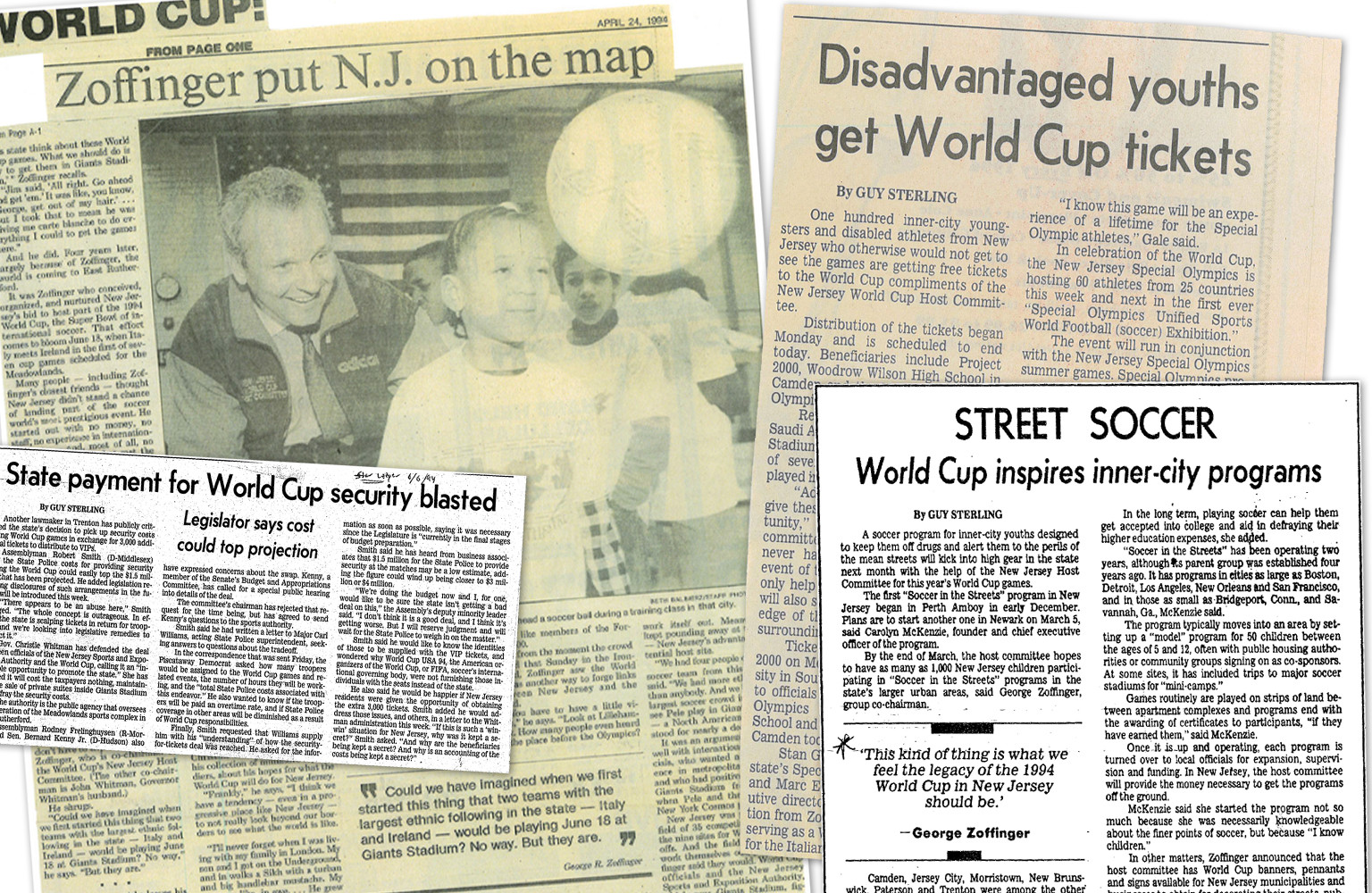
Chris Paladino remembers walking into U.S. Soccer Headquarters in Century City, California, with Johnny Clark. It was the spring of 1994. They were there to pick up the World Cup Host Committee’s tickets for matches scheduled for the old Giants Stadium. Thousands of them. And since this was 1994, there were actual tickets that had to be picked up.
“Where are your armed guards?” they were asked.
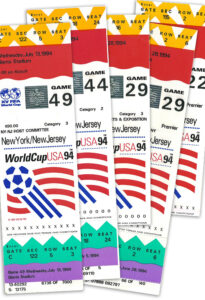 They laughed. Then they realized the representatives from FIFA weren’t joking. They were told that when other delegations came for tickets, they came with security. People with guns.
They learned the World Cup — something they had been asked to work on, voluntarily, with a limited team — was even bigger than they realized.
“It was crazy,” Paladino recalled. “We needed to get the tickets, so we flew out to L.A. to pick them up. We never once thought about bringing security.”
Incredibly, this is not the best story Paladino will tell you about those tickets. Not even close.
But it’s just one of many stories Paladino and George Zoffinger, who led the Host Committee, have when looking back at the World Cup the last time it was played in New Jersey.
***
Paladino is now synonymous with DEVCO. Then, he was in his first months there, fresh off stints in the governor’s office and at the N.J. Economic Development Authority — roles that landed him a spot with the Host Committee.
Paladino remembers 1994 being a much simpler time — one where access to the players and those around them was easy and expected.
The U.S. team — which included a number of young kids from New Jersey — did whatever the Host Committee asked during the lead up, Paladino said.
“They were just so glad someone cared about soccer,” he said.
When Italy’s national team came through for promotional press events before the tournament started, it was just as casual.
A meal at Panico’s in New Brunswick became a staple.
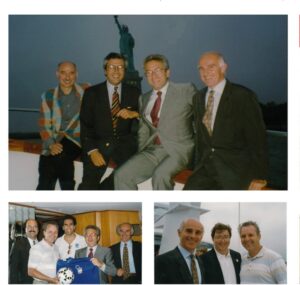
Roberto Baggio, Italy’s best player and one of the biggest stars in the sport, would be there. So would the team’s manager, Arrigo Sacchi. And Antonio Matarrese, president of the Italian Soccer Federation and a member of the Italian Parliament — known, fittingly, as the country’s “soccer czar.”
Before the tournament began, Paladino remembers taking the Italian team out on a yacht for a trip around the Statue of Liberty. He remembers the Italian team practicing at Pingry, and partying at their hotel, the Somerset Hills Hotel.
“The stories coming out of there were crazy,” Paladino said.
The national team of Bulgaria, which stayed in Central Jersey, apparently thought so too — and began making demands of their own. Demands, Paladino said, that aren’t printable.
He just says he solved them the way things were done back then — with free beer.
***
Paladino’s strongest memory of the 1994 World Cup in New Jersey is this: It doesn’t happen without Zoffinger.
Zoffinger, the Commerce Commissioner at the start of Gov. Jim Florio’s term, had lived in London during the 1990 World Cup in Italy. He came home convinced the state needed to make a play for matches at the Meadowlands.
For Zoffinger, the passion traces back to a single moment: watching a soccer match on television in a bar in Newark’s Ironbound section with newly elected Gov. Jim Florio.
Florio, watching the crowd’s energy in the place, was amazed by the passion.
“This is what I’ve been telling you about,” Zoffinger said he told him. “This is why we ought to go and make a bid for this.”
New Jersey was hesitant to do so. There was a fear that soccer meant unruly fans, not passion.
Paladino remembers it taking a series of meetings in Newark to seal the deal — gatherings that included Florio, then Sen. Frank Lautenberg, current CSG Law partner Frank Giantomasi, then-Newark Sheriff Armando Fontoura and a few other Newark-area power brokers.
It was the kind of informal, small-room meeting where state business used to get done. By the time it was over, Florio was convinced — and helped bring the matches to Giants Stadium, which stunningly was competing for the right to host them with the Yale Bowl in Connecticut.
The entire operation that followed ran on a Host Committee budget of $300,000, with a staff Paladino describes as small — a handful of people, including interns, doing most of the heavy lifting.
“We paid people with pizza and beer,” Paladino said.
Zoffinger tells it the same way. Neither he, Paladino, nor Clark ever took a salary for the work. The committee’s entire intern budget, he recalled, was around $15,000 — and every dollar of it, along with everything else, was raised privately.
“We did it with nothing,” Zoffinger said. “This year, it’s all about the money. We did so much with nothing.”
***
Giants Stadium eventually was awarded seven matches for the event. And although it got a semifinal, its first match may have topped that for excitement.
It was the ultimate New Jersey matchup: Italy vs. Ireland.
“I remember the place was going crazy,” Paladino said.
Zoffinger remembers being surprised by the crowd. For a different reason.
“We expected that the crowd would be mainly Italian,” he said. “It turned out to be mainly Irish.”
After the match, it got even crazier.
The Host Committee had secured the use of Pegasus, the upscale restaurant at the Big M, what the Meadowlands Racetrack was known as when the racetrack was known as the place to be.
The plan was to hold parties there after each match. It was intended to be an alternative to sitting in traffic for those parked at Giants Stadium (which was allowed back then). They even invited the delegations of the teams playing to join them, not knowing if they would.
Representatives of Ireland, after a surprising 1-0 victory, showed up. And celebrated. Perhaps a little too much.
“I had to go over and basically ask them to leave,” Zoffinger said. “If I didn’t, they would have been drinking beer the whole night.”
***
Paladino marvels at the memories.
“It was just different then,” he said.
The biggest difference was the cost of tickets, which are almost impossible to believe.
Tickets were as low as $25. Only premium seats — and premium rounds — went into three digits. And then, not by much.
There wasn’t much of a secondary market to speak of, either. Not because scalpers didn’t exist, but because the technology to run such a market at scale didn’t exist.
Remember: No cell phones. No laptops. If you wanted a ticket, you needed a person, a phone line, or a line to stand in.
Which brings us back to the quest for tickets in Los Angeles.
Zoffinger was determined to make the World Cup a New Jersey affair. He arranged for the Host Committee to get 11,000 tickets, which they distributed — at face value — to soccer clubs and youth organizations across the state, often at community events like pizza parties.
They just had to go get them.
***
After the awkward security questions, Paladino and Clark were allowed into the room and got the thousands of tickets they had come for. Now, they had to get them back to New Jersey. This is where the good part comes in.
They put the tickets in some oversized legal bags. Not wanting to check them, they carried them onto the plane. And carried them through the terminal in Dallas, where they had a connecting flight home.
With time to kill between flights, Paladino stopped for a slice of pizza, then a shoeshine. He made his way to the gate — tickets in hand, or so he thought.
Just before boarding, he realized one of the bags wasn’t with him. He’d left it at the shoeshine stand.
“I had thousands of tickets in there,” Paladino said. “They might have been worth a million dollars on the streets of Milan or Rio.”
He ran back through the terminal only to find the bag was … exactly where he’d left it. Untouched, just sitting out in the open at a shoeshine stand.
“I came back, and the guy was there,” Paladino said. “I was like, ‘Oh man, thanks.'”
He knew what a close call this was. In an era of paper tickets, losing that bag would have been a disaster.
So, it only makes sense that when he returned to New Jersey, he told … everyone.
“I love telling stories about when I do something dumb,” he said.
***
Zoffinger appreciates the legacy of the 1994 World Cup.
“That was really the beginning of soccer in America; MLS was formed right after that,” he said. “It’s really great to see the way that the sport has evolved into something that’s so great for the U.S.”
Zoffinger feels the 1994 Host Committee played a small part in that, thanks to its “Soccer in the Streets” program, which went into towns across the state to introduce the game to a new generation of players.
He marvels at how big the event has become — but bristles at the corporate nature of it. And the prices.
“Pay $3,000 for a ticket? That’s crazy,” he said.
Zoffinger hasn’t been to a match. But he has helped a new generation of New Jerseyans enjoy it.
DEVCO, which Zoffinger remains chair of, has held successful watch parties at the Yard throughout the 2026 FIFA World Cup.
Paladino, who oversees the events at the Yard, has grown to love them. They’re simple — a few hundred people, mostly families, having a good time and enjoying a free night out. But far from crazy.
It’s part of the reason he hasn’t been to a single match at MetLife Stadium this time around. Why he’s turned down invitations more than once. Why he won’t be at the final on Sunday.
“I want my memories of the World Cup to be from ’94,” he said.
He’s certainly got plenty of them.


