


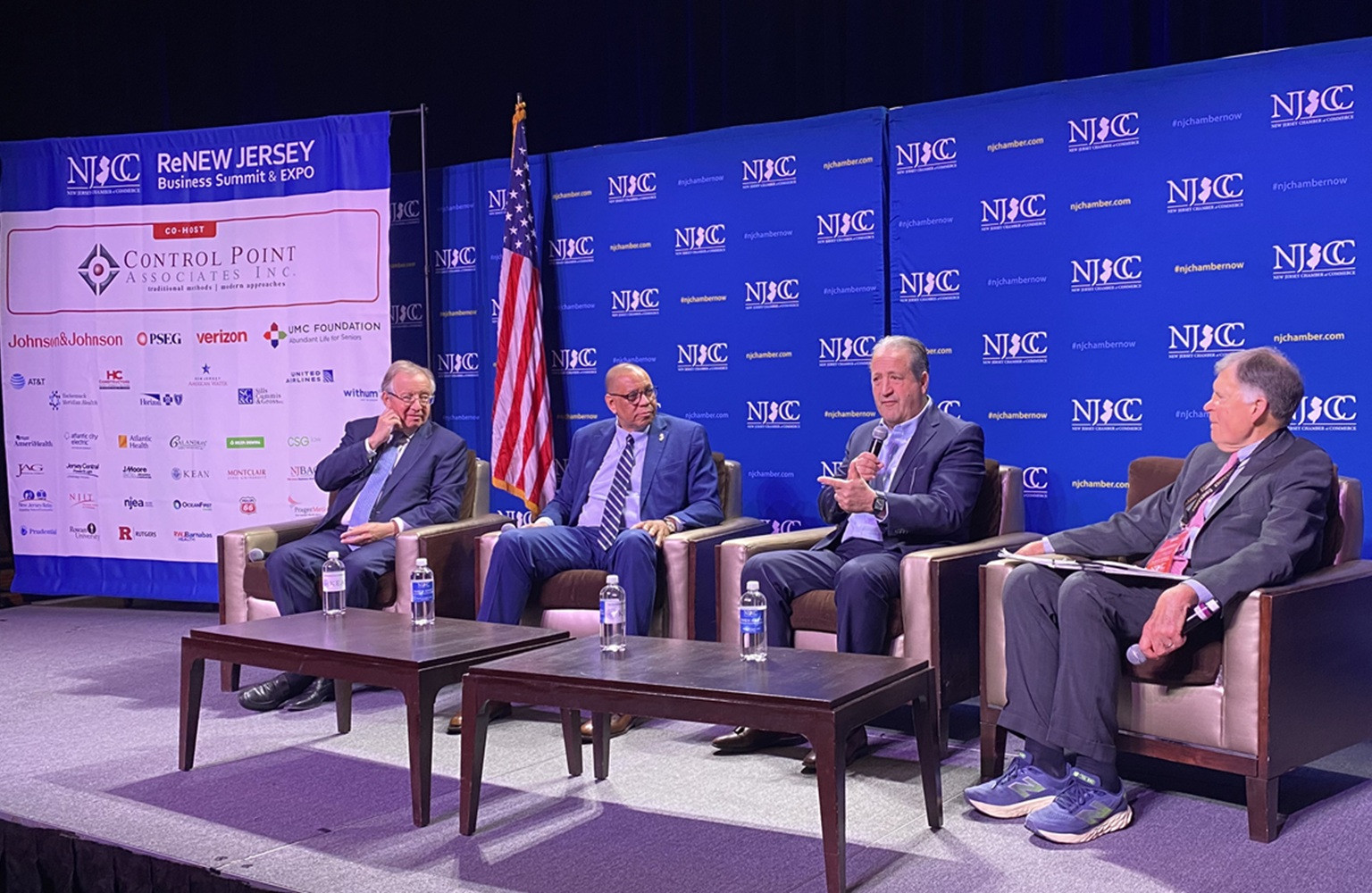
Sitting on a stage in Atlantic City on a panel with some of the key drivers of economic development in the state over the past generation, PSEG Chair and CEO Ralph LaRossa brought up a project in Texas to make a point.
What could become the largest data center in the country recently received approval for an 8,000‑acre campus in Pecos County.
LaRossa wasn’t necessarily upset that Texas landed the project instead of New Jersey. He was concerned that a project of that magnitude simply got an answer — and got it quickly — from state and local officials.
BINJE coverage of ReNew Jersey Summit 2026
- BINJE Poll: Affordable housing, health care top wish list of state’s business leaders
- A new audience for advocacy: Why Autism New Jersey attended the ReNew Jersey Summit
- Some like it hot: How Withum booth stole the show at ReNew event in A.C.
- United CEO Kirby: I think Newark is the Crown Jewel for United Airlines
- Host Committee unveils ‘Welcome World Rewards Program’ to support small business in region
- LaRossa: State needs to get to ‘Yes’ or ‘No’ – quickly
- Results over rhetoric: Caldwell tells business crowd it’s all about getting things done
- Mobility matters: Why getting Gateway done matters to the region
- From bust to buy‑in: Guardian on why Atlantic City is now ready for competition
- Left out … left behind? Kim says CHIPS Act failure is warning sign for state
“It’s okay to say, ‘No,’ and it’s okay to say, ‘Yes,’ but get to ‘No’ or get to ‘Yes’ fast, and then start moving in that direction,” he said. “The more we talk about stuff, the more other states are going to beat us.”
LaRossa, speaking on a panel with Lt. Gov. Dale Caldwell and Amtrak Chair and Gateway Development Commission Vice Chair Tony Coscia during the ReNew Jersey Business Summit & Expo in Atlantic City, said the state is significantly hampered by the speed of its decision‑making.
LaRossa’s central complaint is that too many projects, after being green‑lit in Trenton, get bogged down at the municipal level. Policy is decided at the state level; then it is effectively vetoed town by town because a local official doesn’t like it.
Or, more often, because a local official is bound by an outdated rule or regulation that prevents approval of the project.
This needs to stop, LaRossa said.
“I don’t know who’s right or who’s wrong. I just know that somebody, from a policy standpoint, made a decision to put that pipe in the ground and put that wire there — so, let’s go,” he said.
That’s where the contrast with other states comes into focus.
“We can disagree; we can argue, but at some point, we’ve got to move in a direction that policymakers are leading us to,” LaRossa said. “It’s not even party affiliation, it’s local rule. When you have over 500 different municipalities that can make a decision to second‑guess what happens at the top, that’s very problematic.
“So, let’s eliminate a lot of those layers of decision‑making.”
His most vivid example of the issue came with offshore wind, which he described less as an ideological debate and more as a case study in how slow, fractured decision‑making carries real economic and reliability costs.
In this case, the cost of inaction meant a loss of energy.
“We got in and got out because the people that were in charge of that project didn’t realize the local rule was going to come into play here,” he said. “I don’t know what was right or wrong, but what I do know is we’re missing over 11,000 megawatts of power in this state right now.”
LaRossa’s message was simple: Streamline the state’s permitting process or risk missing out.
To get there, New Jersey doesn’t need a new maze of agencies, he said. It needs to sharpen and accelerate the ones it already has — the Business Action Center, the N.J. Economic Development Authority and Choose New Jersey.
To LaRossa, that’s the core competitive question: Can New Jersey make clear decisions at the speed of its rivals — or not?
“Let’s support each other; let’s move in the same direction,” he said. “If we do that, we’re a very powerful and very smart and very capable state to continue to move businesses forward.”


