


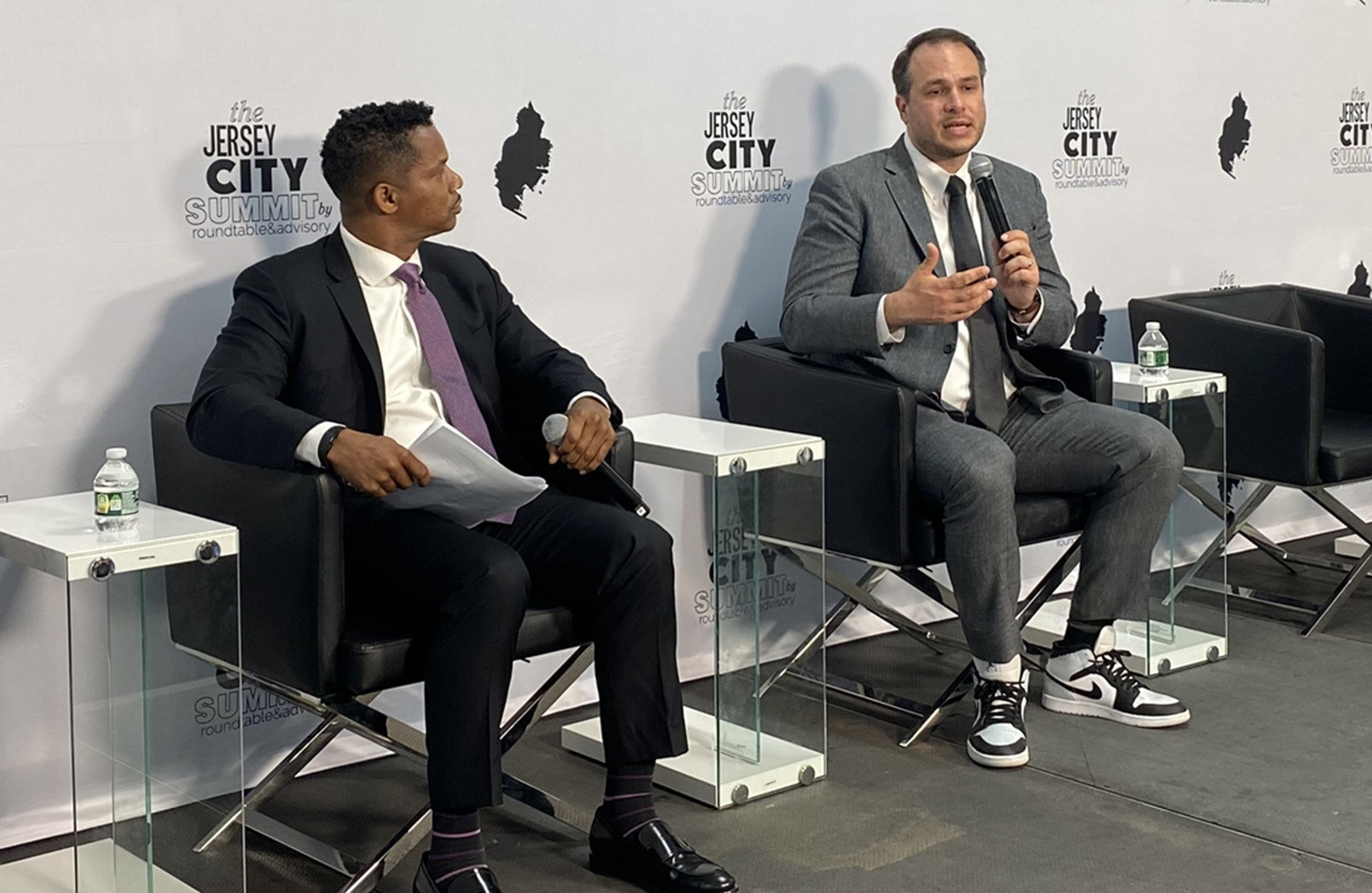
James Solomon has a message for the people who build Jersey City: Keep building. Just make sure it works for everybody.
The mayor made that case Thursday before a gathering of commercial real estate developers, financiers, and dealmakers at the Jersey City Summit for Real Estate, Economic Development & Innovation, the region’s premier CRE forum.
For Solomon, who was sworn in Jan. 15 after eight years on the City Council, the message wasn’t a campaign theme as much as it was a reality check. He said it’s the only math that works.
“Jersey City continuing to grow and be a regional center of growth is extraordinarily important,” he said. “It’s important for us as we address fiscal realities in the city. It’s important for us as we welcome residents. It’s important for us as we address our regional housing supply crisis.”
But growth alone, Solomon made clear, is no longer the whole answer.
“I think it’s really important that we demonstrate to residents all across the city that the development of Jersey City is having tangible improvements on their lives and the lives of their families and friends and communities,” he said. “Building more affordable homes is crucial to that.”
***
Solomon spent 30 minutes in conversation with N.J. Community Capital CEO Bernel Hall, touching on PILOTs, permitting, state partnerships, city services and his five-point vision for Jersey City’s future.
He detailed a philosophy he’s been building for years, that a well-run city — one that delivers affordable housing, fiscal stability and basic services — is itself an economic development strategy.
He pointed to a long-stalled redevelopment project — dormant for more than two decades — as a working example of the approach. It finally moved when the city and all parties involved got in the same room and worked it out.
“It was a real partnership in the best sense of the words,” he said.
The result: eight acres of open space, affordable units that weren’t in the original plans, a new field for the Roberto Clemente League and new market-rate housing.
“That approach that we took on that project is the approach we want to take on all projects,” he said. “Affordable housing is always going to be the first thing that I want to be talking about with any project that’s coming in.”
***
His thoughts on PILOT agreements — payment in lieu of taxes, a central and sometimes contentious tool of Jersey City’s development boom — were telling.
Solomon announced Thursday that his administration is advancing Canal Crossing before the City Council, a project that checks every box on his criteria: 20% affordable housing at AMI levels below what state law requires, a project labor agreement, prevailing wage for service workers, and a park delivered in phase one, not promised for later.
“For us, it met all our criteria, so we’re advancing it now,” he said.
But Solomon was equally direct about what won’t qualify.
“We are not going to do any pilots that are parts of luxury-only projects,” he said. “There has to be affordable housing for us to even start a conversation around it.”
He pointed to the Pompidou museum project — which received a pilot with no affordable housing component — as the model his administration will not follow.
“That for us would just be off the table,” he said.
The city’s debt — and the fact its credit rating has been downgraded five times in three years — is a bigger issue.
Solomon said his administration has been making the case in Trenton that Jersey City’s fiscal health and New Jersey’s broader ambitions are inseparable.
“Jersey City’s economic growth is really New Jersey’s economic growth,” he said. “New Jersey cannot meet its goals, and particularly Governor Sherrill cannot meet her goals, without Jersey City continuing to be an economic partner.”
He said the city has a plan that requires significant state support — and he is optimistic about getting it. The budget deadline is June 30.
***
When Hall asked Solomon to describe Jersey City five to 10 years from now, the mayor offered five benchmarks he wants to be judged on.
- Development that benefits the entire city — not just the waterfront;
- Fiscal stability and a rising credit rating;
- Noticeably improved city services across every neighborhood;
- Investment in young people, starting with a goal of 1,000 summer jobs annually;
- And a city government that residents actually trust.
“The real vision is across Jersey City, people say the city government cares, it works hard, it’s honest, and it’s transparent, and we as a city and us as individuals are benefiting from its growth and development,” he said.


