


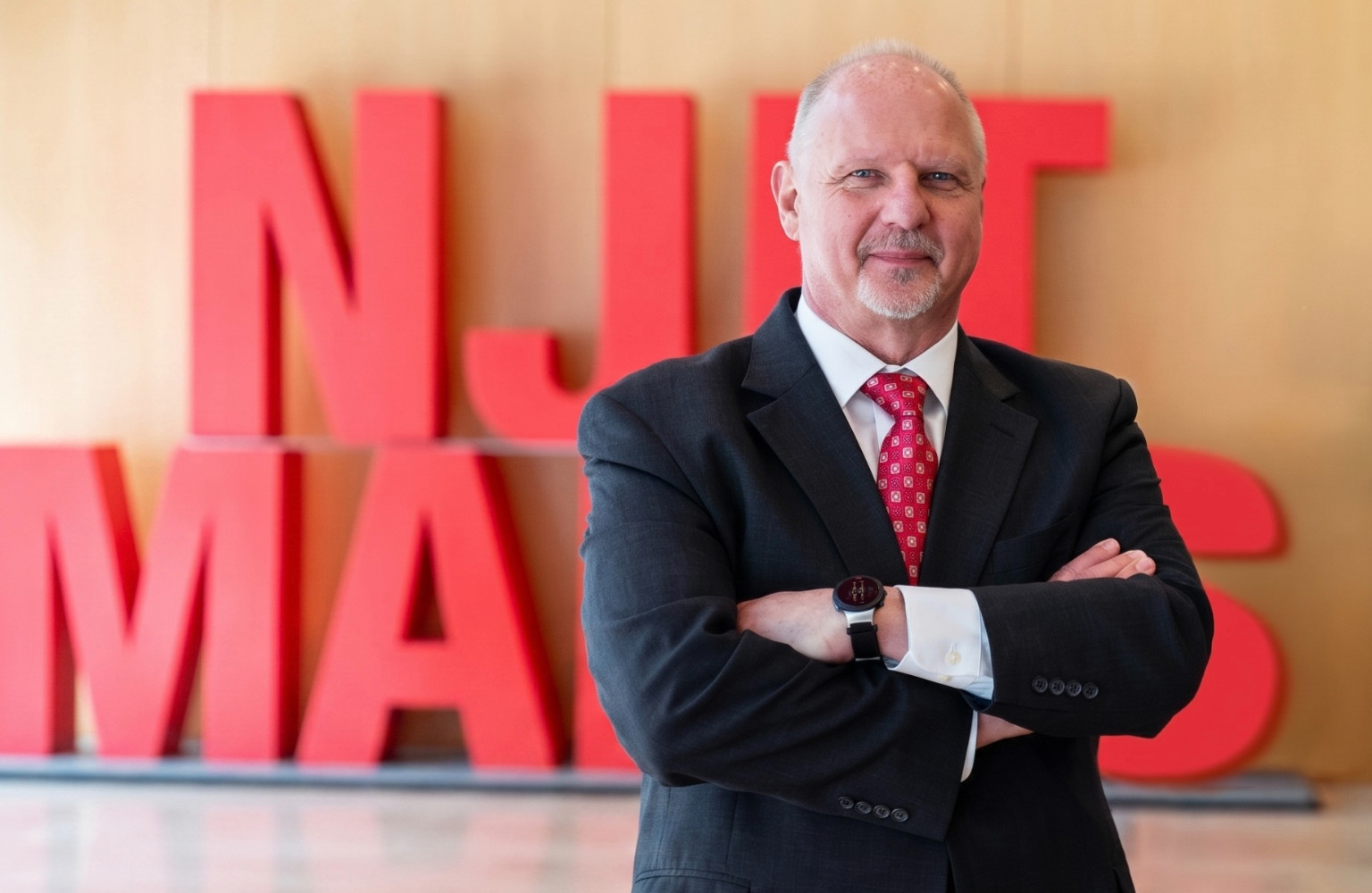
John Pelesko was never expecting to be the interim president of NJIT — a role thrust upon him this summer after the somewhat unexpected retirement of Teik Lim. But now that he’s in the job, he’s not looking back. Pelesko is looking forward. And the 29-year veteran of higher education sees a challenge ahead that is far greater than simply running a university.
“Higher education is in crisis in this country, and I’m very much walking into that situation,” he said. “I really think the bigger story here is what we’re facing as a sector, what we’re facing as an industry, what we’re facing here in New Jersey in particular, and what NJIT is facing.”
Pelesko, a mathematician who earned his Ph.D. at NJIT in 1997, spent 21 years at the University of Delaware — with 12 of those years in leadership positions, including as dean of its largest college — before NJIT named him provost and executive vice president for academic affairs following a nationwide search in the summer of 2023.
This spring, he got the word that his role might be changing.
“I knew (Lim’s retirement) was coming for a little bit before it was announced,” he said. “But it wasn’t like I knew it was coming a year ago.”
When Pelesko was named interim president a few days later, it was another milestone moment in a journey he never expected to take.
“I never had the goal to be in an academic administration, ever,” he said. “I wanted to be a faculty member. I wanted to do research. I wanted to teach.”
What changed his calculus years ago, he said, was realizing the scale of impact possible in leadership roles compared with research alone.
“Is this next role something where I think I can contribute, where I have the right skills, the right background, the right perspective — where it’s the right time for me to make the biggest possible difference?” he said.
That question, Pelesko said, is what pulled him back to NJIT a few years back.
“It’s a polytech education; it’s first-gen students — I’m almost a first-gen student myself; It’s many students from challenging financial circumstances,” he said. “I said to myself, ‘Oh my God, I can make a huge impact here.'”
That impact could be even greater in his role as interim president.
Pelesko, in his first extensive interview since assuming the role on Aug. 4, talked with BINJE about the challenges reshaping higher education nationally, and how he believes NJIT is positioned to address them.
The conversation has been edited slightly for length and clarity.
BINJE: You mentioned a sector-wide crisis in higher education. What does that actually look like from where you sit?
A: Pelesko pointed to four forces converging at once: a demographic cliff in college-age students that peaked nationally in 2025, a drop in public perception of the value of higher education that has contributed to a steady decline in the percentage of high school graduates choosing to attend college, a collapse in international student enrollment, and the arrival of artificial intelligence reshaping what the workforce needs from graduates.
“We know the peak was in 2025,” he said of the demographic decline. “I know that for the rest of my career, the demographics are going to go that way.
“The Northeast will be hit particularly hard. The decline is also steepest among young men (a population typically overrepresented in the STEM disciplines). That’s one reason that NJIT keeps working to broaden who sees themselves in a technical education.”
BINJE: Let’s move to the international collapse — how severe has that actually been?
A: Severe, and fast, Pelesko said.
NJIT’s international master’s applications have fallen by roughly a factor of 10 in three years — from about 20,000 to under 2,500 — driven in part by broader political dynamics affecting how the U.S. is perceived abroad, he said.
“That doesn’t turn around overnight,” he said. “Even if we have a new president in two years, even if they’re more welcoming, it’s a decade to undo that kind of damage.”
BINJE: How is NJIT adjusting to that loss, if the switch can’t just be flipped back on?
A: Pelesko pointed to NJIT’s undergraduate numbers as a counterweight — applications have climbed from roughly 7,000 to 18,000 in recent years, even as graduate international enrollment has cratered. He credited that resilience partly to awareness of NJIT’s return-on-investment to families weighing whether college is worth the cost at all, and partly to student population that is about 60% commuters, keeping NJIT’s model distinct from peer schools that only offer a residential-campus experience.
BINJE: You’ve talked about AI reshaping the workforce. What does that mean for how NJIT teaches?
A: Pelesko said AI is undermining a long-standing, mostly unspoken assumption in higher education: that employers will spend two to four years training new graduates before they’re fully productive.
“With the exception of very few fields, we train somebody, they go get a job, and then industry spends two, three, sometimes four years before they’re producing value — because they’re really training them for a specific role that aligns with their business model,” he said.
Pelesko noted that dynamic doesn’t hold in fields like nursing or physical therapy, where practicums are already built into the training itself.
“But in engineering, in computer science, all of these places, it’s true,” he said.
That gap, Pelesko said, is exactly what AI is closing off.
BINJE: How?
A: “AI is coming in, making it possible for companies to say, ‘I don’t really need those first-year people that much anymore,'” Pelesko said.
In response, Pelesko said NJIT has pushed for three years to guarantee every student some form of experiential learning before graduation — a co-op, internship or industry capstone project — so graduates can “add value from day one” rather than needing years of on-the-job training.
“It doesn’t fully leapfrog, but it puts them a step up,” he said. “We’ve got to keep pushing like that.”
BINJE: Is that push toward experiential, hands-on learning connected to NJIT’s reputation for entrepreneurship?
A: Directly, Pelesko said. NJIT’s entrepreneurial track record — anchored for years by NJII, the university’s innovation and research-commercialization arm — is one of the school’s clearest differentiators at a moment when nearly every college claims to be “entrepreneurial.”
That arm is in transition. Michael Johnson, who has led NJII, is departing at the end of October, and Pelesko said he’s still working through what that transition looks like.
“NJII is absolutely a differentiator for us,” Pelesko said.
To broaden that work beyond faculty research and graduate-level projects, NJIT launched a Center for Student Entrepreneurship roughly a year or two ago, now run by Kathy Naasz, executive director of student entrepreneurship and a research professor in NJIT’s Martin Tuchman School of Management.
“NJII is great, and it’s really great in helping us with translating faculty research and grad student engagement, and to a certain extent undergrads,” Pelesko said. “But we wanted to even broaden that” — extending entrepreneurial opportunity to more of the undergraduate population, not just researchers and graduate students.
BINJE: Let’s do the view-from-10,000-feet question: New Jersey has a lot of colleges and universities. Do we have too many?
A: Pelesko didn’t dodge the question.
“There absolutely has to be a reckoning,” he said, pointing to Pennsylvania’s consolidation of its state university system as a national precedent. He stopped short of endorsing a formal, coordinated university system for New Jersey, saying he wasn’t sure that was the right structural fix — but argued strongly for more cross-institution coordination, citing NJIT’s course-sharing arrangement with Rutgers-Newark as a working example.
BINJE: Now, the money question: Where does the tuition conversation fit into all of this?
A: Pelesko addressed it briefly and directly, calling it “part of” the larger picture facing NJIT and the sector — but not, in his view, the central story. He steered the conversation instead toward the structural pressures he described above, which he sees as the more consequential story for NJIT’s future.
BINJE: And finally: What’s the biggest opportunity in all of this, if there is one?
A: Pelesko circled back to AI — not as a threat alone, but as a chance for higher education to serve people well beyond the traditional 18-year-old freshman. He pointed to a recent NJIT forum with civil engineering firms as a telling example: employers unsure whether to hire engineers or computer scientists, and needing help retraining either.
“That’s not something you can rely on community colleges to do alone,” Pelesko said. “You need the rest of higher education to play in that world as well.”


