


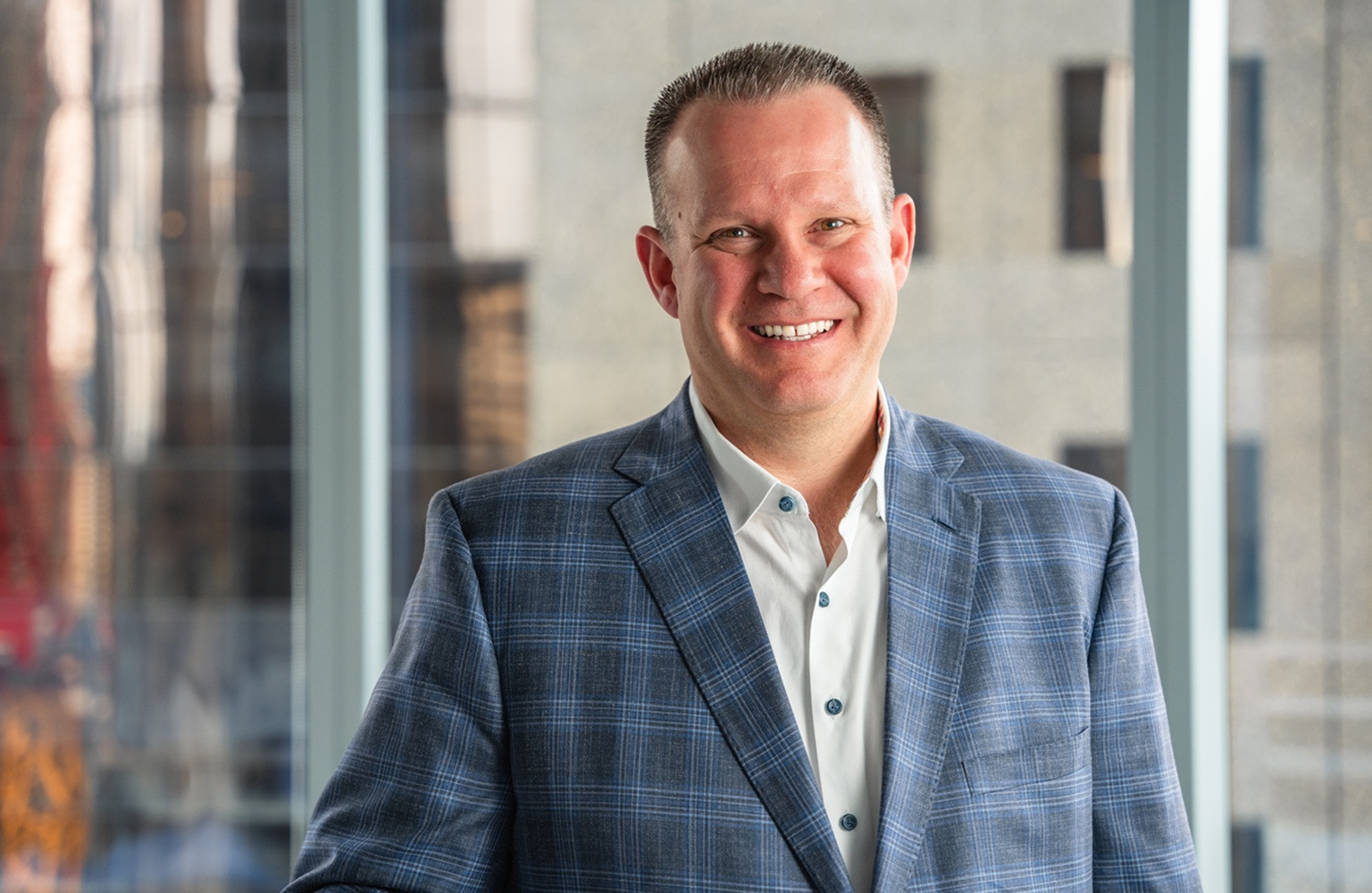
“Blue” Jenkins drives past 7,000 acres of blueberry fields to get to SJI’s headquarters in Folsom. The next day, he might head up the Parkway to get to Linden, where the company is building what is projected to be the largest food waste-to-energy project in North America.
He loves both trips.
Jenkins said that range of opportunities drew him to New Jersey. South Jersey Industries runs two gas utilities with 750,000 customers, but it also captures methane from landfills, runs fuel cells and solar arrays and has a small hydrogen facility.
“The innovation side of this business is super impressive,” he said. “It really attracted me here.”
Jenkins became CEO on Aug. 3, succeeding Michael Renna, who retired after nearly 30 years with the company. He brings nearly 30 years of experience in energy of his own.
(Read more here: 12 things to know about Jenkins)
Jenkins started as a CPA and moved to the unregulated side of a small Northwest utility, which BP bought 18 months later. He then spent 13 years at BP, where he worked the commodity trading desk and rose to Senior Vice President, North America Gas and Power. Next came eight years at EQT in Pittsburgh, where he was Chief Commercial Officer, and seven years leading Washington Gas.
“I’ve been blessed to work in this industry for 30 years,” he said. “I got into it a little bit by happenstance.”
He said he found something at SJI that not every company has.
“It’s a blessing to show up and have a team that likes each other,” he said. “They’re passionate about what they do.”
BINJE talked with Jenkins recently about SJI, the energy debate in New Jersey and his first months in the state. Here’s more of the conversation, edited for length and clarity.
BINJE: SJI does a lot more than deliver gas. What’s in the portfolio?
Blue Jenkins: We’ve got a great utility business. Two different utilities. South Jersey Gas covers all of South Jersey, and we’ve got Elizabethtown Gas up north, which covers Union and that Northwest New Jersey area. We’ve got 750,000 customers in that utility, and we spend a lot of time thinking about safe, reliable, affordable energy.
Then we spend a lot of time on innovation, greener types of energy. We had a long history in solar. Most of the facilities SJI owns have some sort of solar capacity. We’ve done fuel cells, and we continue to use that technology to create energy behind the meter: on site, lower emissions.
We’ve also got several projects across New Jersey and the eastern half of the country in renewable natural gas. And there are a couple of landfills here in New Jersey where we capture that naturally venting methane that would go to the atmosphere if something wasn’t done. We capture it, we clean it up and we put it in the pipeline. And we’ve got a small hydrogen facility to prove that technology, and that’s working well.
BINJE: Then there’s Linden. Talk about this transformative effort?
Blue Jenkins: Perhaps the big flagship project is going right now in Linden. It’s our food waste project. When it comes online in ’27, it’ll be the largest food waste project in North America, and the team’s super proud about that. It’ll take 1,500 tons a day at full capacity from that Northern New Jersey region. When you do the math, that’s 3 million pounds of food waste a day that won’t go in landfills.
BINJE: How will you reuse the food?
Blue Jenkins: It’ll turn into potentially three products. One is renewable natural gas, pipeline quality, that can be injected right into our Elizabethtown Gas system. The second is what I’ll call a nutrient rich additive that can be mixed with soil. Finally, we are looking at beneficial reuse of the biogenic CO2 that is a natural by-product of our process. So, you’re solving a regional problem, taking food waste out of landfills, turning it into low-carbon energy and creating other products out of it.
BINJE: With that many lanes, how do you keep it all organized?
Blue Jenkins: I’m blessed to have a great team. So much of what we do is the quality of the people who work here. We’ve got 1,200 employees across this business who take immense pride and passion in the work they do. I get lots of feedback from customers in the communities we serve: “Hey, I met Sally, and she was so nice,” or “I met Steve while he was fixing something, and he was very professional.” I love that.
I’ve got dedicated business lines, with a leader in each one. We spend time as a leadership team talking about what the opportunity set is, what the challenges are and how we get focused. I distill that down into three things.
BINJE: What are they?
Blue Jenkins: First, the businesses and families we serve. How do we keep it safe, reliable and affordable? You turn your thermostat on, you expect the house to get warm. If you have a gas stove and you flip the switch, you expect a blue flame to show up. We’ve got 1,200 people who do that with pride every day.
Second, we’ve got to tell the story more clearly about the work we do and how New Jersey is pulling together to solve not only affordability but also reducing emissions and diversifying its energy mix.
And all of those things help lower emissions. As we modernize the system, it lowers emissions. As we solve this food waste problem, it lowers emissions. As we bring more landfills online, that lowers emissions and provides diversity of supply.
I try to get out and visit all of our sites. I’m in Folsom today. I’ll be in Linden tomorrow. I’ll be at one of our operating sites on Wednesday. That’s just what we do.
BINJE: Utilities get blamed for things they can’t control and get little credit for what they can. Fair?
Blue Jenkins: There’s some truth in that. We do this for a living, so we know the intricacies of what’s required. For a lot of folks, they simply turn on the light switch and expect it to work. Then the bill shows up, and they want to know why it costs that much. So, we have to do a better job of telling the story.
In a previous life, I exported a lot of LPGs, liquid petroleum gases: propane, butane, the things you might think about for your grill. Lots of portions of the world heat and cook on that, and that was a serious upgrade from gathering fuel to cook on. We’re blessed here. Cheap, reliable energy is supposed to be a right, and sometimes we lose sight of that. It’s expensive to maintain.
I’m not aware of any utility executive I cross paths with, and I cross paths with most of them across the U.S., who doesn’t take seriously their obligation to provide energy that’s reliable and affordable. It’s a challenging time to do that.
BINJE: Utilities in New Jersey can’t build their own generation. Is that unusual?
Blue Jenkins: It’s not unique to New Jersey. Some states allow companies to own both generation and distribution. Some say no, we need to separate it. I think somebody had a view a decade ago and expected a particular outcome, and maybe they didn’t think through what the policy impacts really were. Limiting the ability of folks to solve their own problem is typically not the best outcome.
While we don’t build generation, we had a solar business for a long time and put facilities on roofs to lower the demand on the grid. We’re doing fuel cells at particular locations, including some of ours. We can put reciprocating technology or fuel cells at a customer site; the pipe already goes there. Those are all solutions to the grid problem. But we’re going to need generation, and we’re going to need more wires. There’s no question about that.
BINJE: Even if the rules changed, new generation is years away. What happens in the meantime?
Blue Jenkins: We talk about energy efficiency. The cheapest molecule of energy is the one you don’t use. Every utility says, turn your thermostat a couple of degrees this way or that. We all kind of joke about that, but the reality is, it makes a big difference. Winterize your home. Replace your systems with more energy-efficient ones.
But in the near term, it’s going to be more expensive before it gets less expensive, because you’ve got demand continuing to increase and a lag in supply.
BINJE: There are about 586 people in New Jersey business, and 250 of them are at every event. Will we see you on the circuit?
Blue Jenkins: Absolutely. It’s important as a business leader to be out. I want to hear firsthand from other business leaders, business owners, customers, regulators and legislators: what they’re thinking about and how they’re thinking about it.
BINJE: What do you think of New Jersey so far?
Blue Jenkins: New Jersey is a great state. I’m excited to be here. I haven’t met anyone who isn’t excited about what the opportunity set looks like for New Jersey.


