


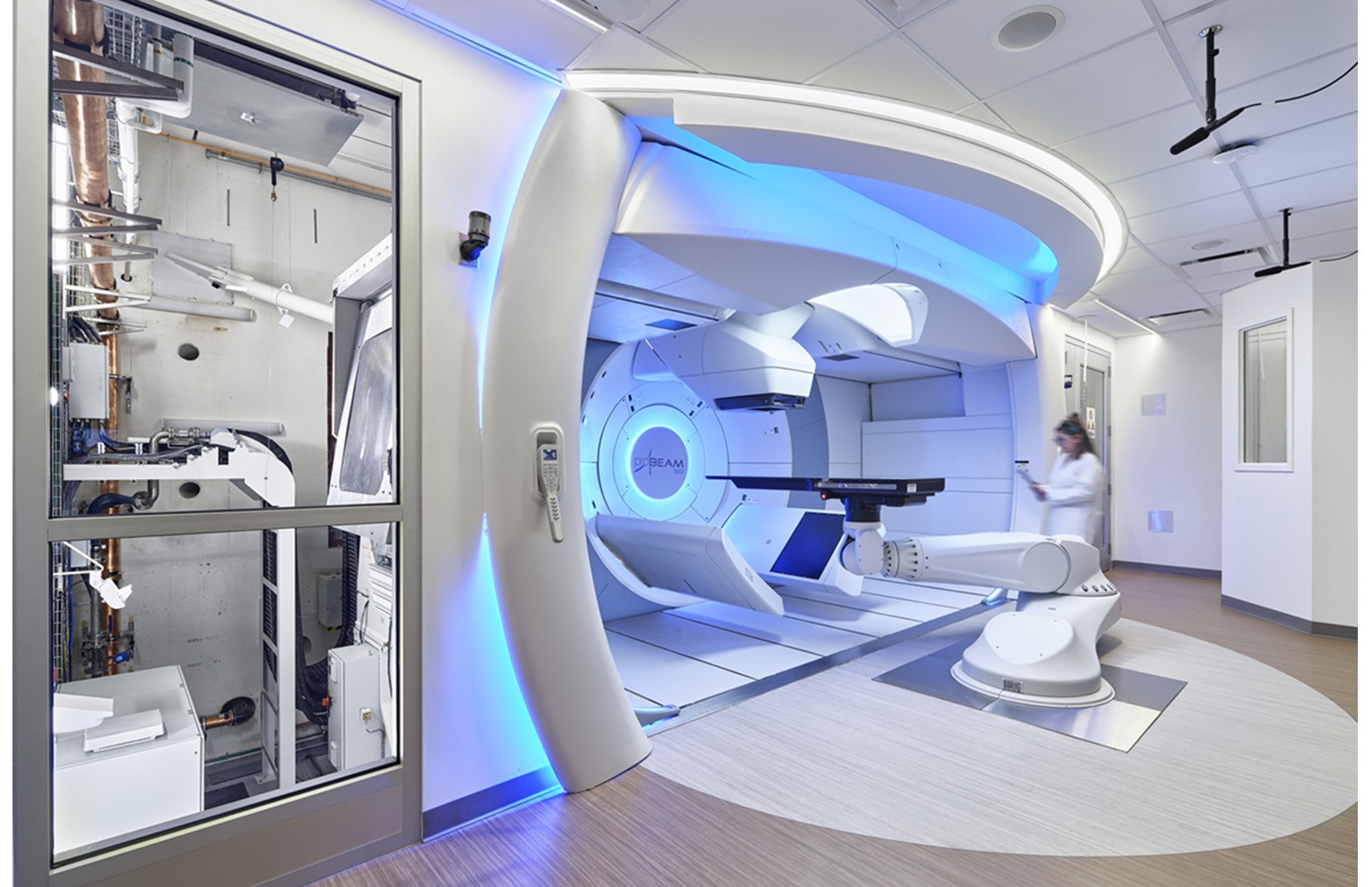
Radiation therapy is entering a new era defined by accuracy, personalization, and increasingly compact technology that makes advanced care more accessible to patients. Health systems across New Jersey, including Atlantic Health and Penn Medicine | Virtua Health, are investing heavily in these next‑generation tools.
Proton therapy is a big part of that evolution. The treatment uses positively charged particles to precisely deliver radiation. Unlike traditional X‑ray beams, which pass through the body and can damage healthy tissue, proton therapy deposits most of its energy directly into the tumor, sparing nearby organs.
“Radiation oncology is moving toward greater precision,” said Dr. Catherine Kim, chief of radiation oncology at Virtua Health. “Our imaging is better, our targeting is better, and our technologies are getting smarter.”
Virtua opened a $45 million proton therapy facility on its Voorhees campus in 2023, part of its partnership with Penn Medicine to bring academic-level medical care closer to home.
“It was critical to place a proton center here because South Jersey patients used to have to travel far for this treatment,” Kim said. “We wanted to elevate the patient experience and eliminate the travel burden.”
New Jersey now has three proton therapy centers — in Voorhees, Somerset and New Brunswick, but building them has historically required massive infrastructure. Virtua’s 8,600‑square‑foot facility took three years to construct, including a radiation-shielded vault built with 300 truckloads of concrete, enough to fill an Olympic-size pool.

Proton therapy is driven by a cyclotron, a machine that accelerates protons to the precise energies needed for treatment. That device at Virtua weighs 90 tons. The one inside Penn’s Roberts Proton Therapy center in Philadelphia, built more than a decade earlier, weighs 200 tons.
As proton technology evolves, the aim is for equipment to become smaller, lighter, and less expensive. This would allow hospitals to integrate proton therapy into their existing radiation treatment spaces.
One of the newest systems, the MEVION S250‑FIT, is designed to fit inside a standard radiation vault. The first clinical treatment using the S250‑FIT was completed in June at Stanford Medicine Cancer Center.
Proton therapy has been around since the 1990s, but the equipment’s size and cost have been obstacles to wide adoption. Mevion Medical Systems, based in Massachusetts, was founded in 2004 to tackle those issues. Its first system received FDA clearance in 2012. The S250-FIT was introduced in 2022 and received FDA clearance in 2025.
Atlantic Health’s Morristown Medical Center is installing the device after raising more than $12 million from donors, and expects to begin treating patients next year. Morristown will be the first in New Jersey, and among only four institutions nationwide, to offer this compact proton technology.
One of the biggest advances in the latest system is upright seating. For a patient with lung cancer, it can be more comfortable sitting up. In addition, an upright position allows the whole lung to expand, which creates a better position to be treated, said Dr. Eric Whitman, medical director of Atlantic Health’s oncology services.
“Our success in putting this into an existing vault, I think, will allow other centers around the world to do the same thing,” Whitman said.
Proton therapy is valuable in highly sensitive areas like the heart, brain and spinal cord, and on cancers that cannot be completely removed by surgery. It is increasingly being used for breast cancer patients, especially those with left-side tumors, which are closer to the heart.
Other benefits include milder side effects, the ability to treat cancers that have already received radiation, and the ability to combine proton therapy with chemotherapy, immunotherapy, or surgery.
“We’re excited to be at the forefront of this,” Whitman said. “New technology, new capabilities, and new hope for patients in our area.”
For information about Atlantic Health, go to atlantichealth.org.
For information about Penn Medicine, go to Penn Medicine.
For information about Virtua Health, go to virtua.org.


