


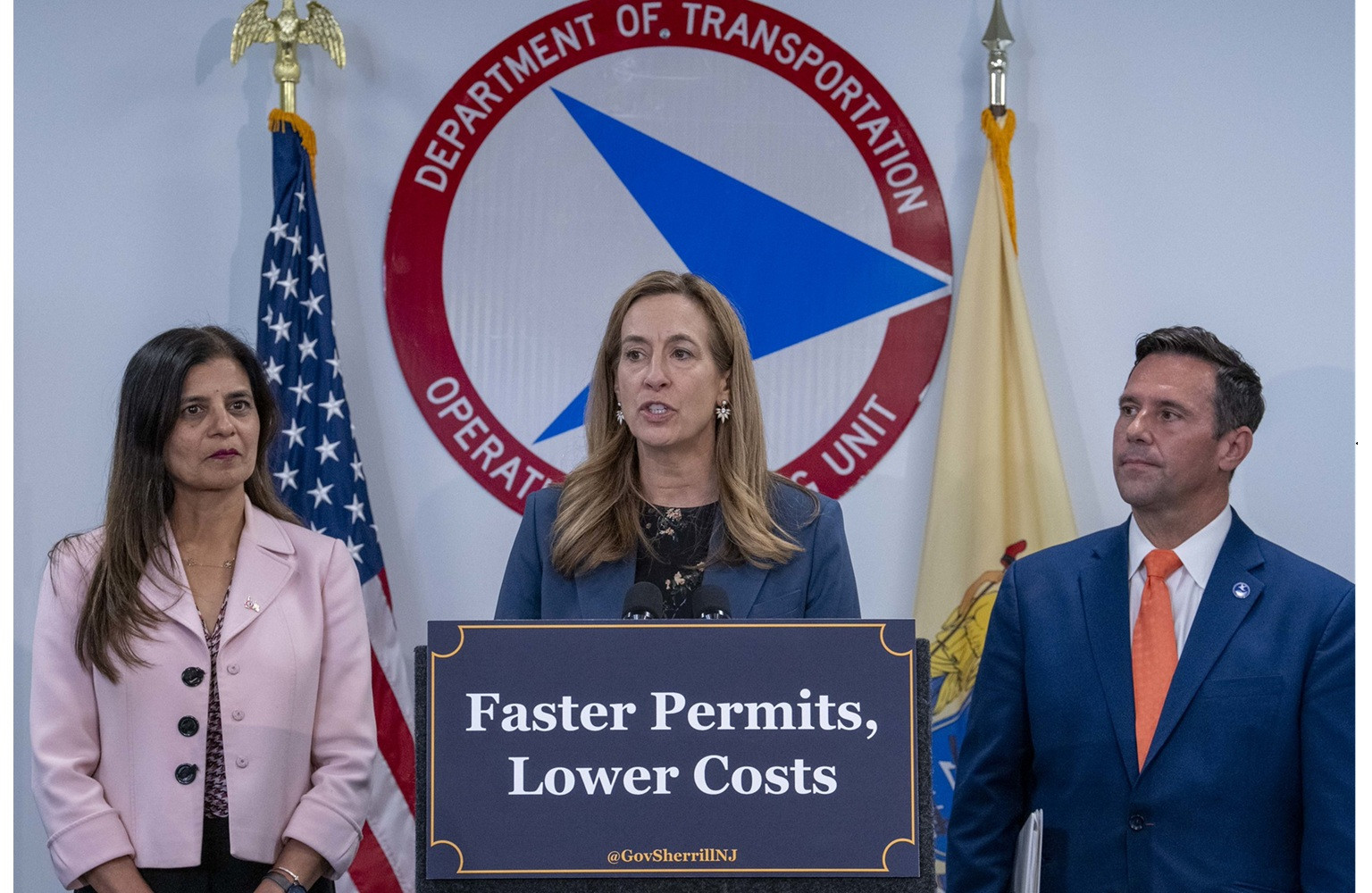
In an effort to further increase transparency and accountability of one of her signature issues, Gov. Mikie Sherrill on Wednesday launched the public view of the New Jersey Permitting Dashboard Pilot, giving residents a real-time look at how projects move through state review.
The Permits.NJ.gov portal is the latest in measure of progress in her efforts to cut permitting delays, deliver faster reviews, and decrease costs for New Jersey families and businesses.
Expanding on the Permitting Dashboard Pilot launched in June, the new public view at Permits.NJ.gov lets anyone follow the 10 pilot projects as they move through review at DEP, DOT, and the Department of Community Affairs.
For each project, the dashboard shows every permit that the project has applied for, the responsible agency, and progress through each step of the review process, from application to completeness review, technical review, and final decision, with dates showing when each milestone was completed.
The DEP and the New Jersey Innovation Authority are now automating the dashboard to reduce manual data entry and allow significantly more projects to be added in the coming months.
“When I took office, I promised to save New Jerseyans time and money,” Sherrill said. “Slow permits mean higher costs for everyone, from families waiting on new homes to businesses ready to hire.
“In less than a year, we’ve cleared backlogs, changed how agencies work, and moved critical projects forward. And because accountability matters, we’re opening the books, so every resident can see the progress for themselves via the New Jersey Permitting Dashboard Pilot. Faster reviews help build a more affordable New Jersey, and we’re just getting started.”
Since taking office on Jan. 20, state agencies have made substantial progress in reducing permitting backlogs by reviewing and resolving long-pending permit applications, including:
DEP Freshwater Wetlands Letters of Interpretation: There has been a 74 percent reduction in permit backlog, with applications pending for 6+ months falling from 927 to 240. These letters confirm whether wetlands are present on a property and where their boundaries fall, a necessary step that a project must complete before it can start engineering design work.
DOT Minor Access Permit: There has been an 83 percent reduction in permit backlog, with total pending applications falling from 653 to 108 – including the resolution of 523 stalled permits. These permits allow small- to medium-sized housing projects and businesses to build or modify driveways and entrances onto state highways, which are required for many projects statewide to move forward.
Building on that progress, DEP and DOT have started additional backlog reduction efforts in just the last few months, with immediate results:
DEP Remedial Action Permit: There has been a 25 percent reduction in permit backlog, with total pending applications falling from 656 to 493. This permit is necessary for redeveloping previously contaminated “Brownfield” sites into safe and productive commercial, industrial, or residential properties.
DOT Major Access Permit: There has been a 19 percent reduction in permit backlog, with total pending applications falling from 262 to 211. These permits allow large housing projects and businesses to build or modify driveways and entrances onto state highways, which are required for many projects statewide to move forward.
New Jersey State agencies have reorganized their permitting offices and created new strike teams to increase collaboration and efficiency within their permit processes.
DEP has created Operation FAST to specifically streamline permitting for clean energy projects, and this new initiative currently includes over 25 solar and battery storage projects.
DEP has also created strike teams focused on Remedial Action Permits and Watershed & Land Management permits, with the goal of expediting the review process and reducing backlogs for some of the most complex permits that the agency issues.
DOT has designed and recently completed a reorganization to shift all permitting functions under one division – the Division of Transportation Permitting – to prevent bureaucratic obstacles from causing permitting delays.
DOT has also fully digitized its Major Access Permit process.
In collaboration with the Permitting Governing Council, agencies have also taken new steps to keep projects moving, including:
New reviewers on the job: Through new funding in Governor Sherrill’s FY 2027 budget, DEP has hired and onboarded 49 new staff to expand review capacity.
Process mapping: DEP and DOT completed full process maps and recommendations for key permits, including the Freshwater Wetlands General Permit and Major Access Permit, to identify barriers and develop recommendations to reduce costs and delays.
Energy coordination: A new Energy Cross-Agency Working Group brings together BPU, DEP, DCA, and the Department of Agriculture to align reviews for energy projects.
Department of Community Affairs Commissioner Jacquelyn Suárez applauded the efforts.
“Housing and other building projects depend on construction permitting moving efficiently,” she said. “A developer can have the funding, the site, and the community support, but if permitting creates months of unpredictable delays, projects stall. Governor Sherrill has made it clear that our job at DCA is to remove those obstacles while maintaining the safety standards that protect residents.
“In partnership with the New Jersey Innovation Authority, we are building a unified construction permitting system – a single online platform covering the full permit lifecycle from application to certificate of occupancy – to accelerate processing on routine permits and make the system more consistent across the board.”


