


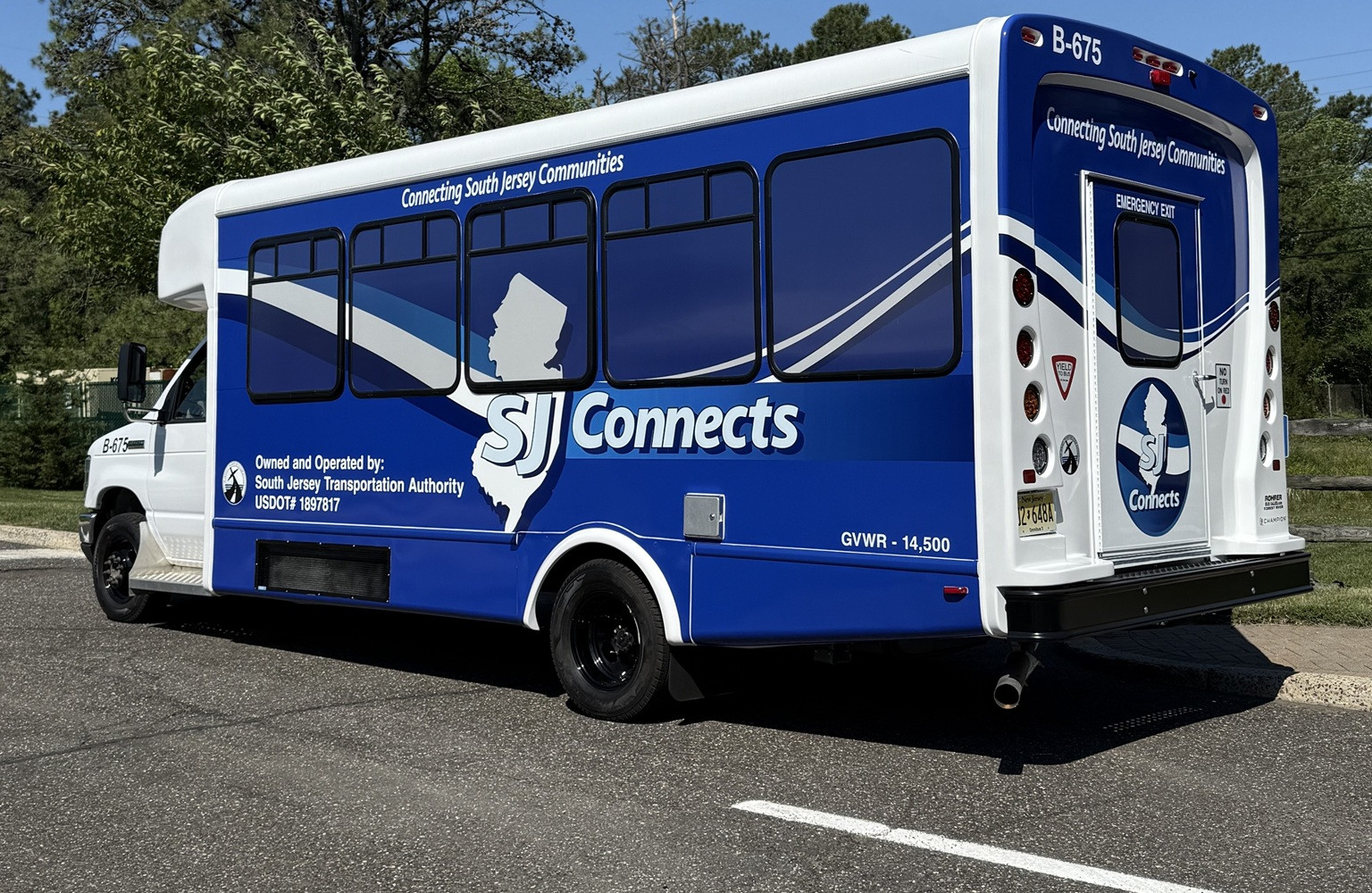
It’s important to note all of the social benefits that will come from SJ Connects — the transportation pilot project launched Monday morning in Hammonton.
- The resident who will be able to get to their medical appointment;
- The family that will have access to social services;
- The student who will be able to get to class;
- The resident who couldn’t get to fresh food grown just miles away.
But the $5 million program, which involves six routes on 20-person mini-buses that will serve Atlantic, Burlington, Camden, Cape May, Cumberland, Gloucester and Salem counties, also has the potential to be a massive economic driver for the region.
SJ Connects, which is free to use, can connect residents to jobs, fueling the growth the region craves and is ready to embrace.
That’s what made Assembly Majority Leader Lou Greenwald such a fan — and a supporter.
“Why can’t it be both,” he told BINJE. “I think social benefits and economic benefits go hand-in-hand.
“When you’re able to increase your education, gain access to better jobs, increase the quality of your health care, everybody wins.”
Greenwald isn’t the only one who feels that way.
The event, at the Frank S. Farley Service Plaza on the Atlantic City Expressway, drew a who’s who of regional leaders, including State Sen. Michael Testa, South Jersey Transit Authority Executive Director Stephen Dougherty, South Jersey Chamber CEO Christina Renna, Inspira Health Senior VP for External Affairs and chamber chair Robin Walton, Salem Community College President Michael Gorman and many more.
“This is about educational opportunities that lead to upward economic mobility,” Testa said. “This is exactly what South Jersey needs — and has needed for a long time.”
Kris Kolluri hinted at this project in a recent BINJE article.
The funding comes from revenues collected from the Corporate Business Tax. But getting those funds was not as simple as it seems.
South Jersey, led by the strong advocacy of Renna and others, argued the region was being asked to subsidize NJ Transit — which operates outside of South Jersey.
It was a true example of taxation without representation in a country born on that principle 250 years ago.
Gov. Mikie Sherrill said she is glad the state is righting that wrong.
“For too many South Jersey families, transportation challenges limit access to opportunity,” she said. “SJ Connects is an important step toward changing that reality by creating stronger connections between communities and the jobs, schools, healthcare providers, and services that help residents succeed.
“This free service reflects our administration’s commitment to ensuring South Jersey continues to receive the investment and attention it deserves.”
Over the past year, the SJTA, the chamber, health care organizations, transportation agencies, educational institutions and community partners worked to identify underserved areas and develop routes designed to provide the greatest regional impact.
Dougherty said SJ Connects represents a major operational investment in regional mobility throughout South Jersey.
“From professional drivers and brand-new vehicles to route planning, safety protocols, and day-to-day service reliability, our team has worked diligently to build a system residents can depend on,” he said. “We’re proud of everyone involved in helping deliver this service and committed to providing safe, reliable, and accessible transportation connections throughout the region.”
Renna said the chamber was thrilled to fulfill its role.
“A chamber’s job is to remove barriers to economic growth and in South Jersey, lack of access to reliable transportation has been one of the biggest ones,” she said. “SJ Connects puts free, dependable transit on corridors where our employers are hiring and our workforce is trying to show up.
“That’s not just a social service, that’s an economic investment, and it’s one that’s going to pay dividends for this region for years to come.”
Walton stressed the healthcare benefits.
“Transportation access is closely tied to healthcare access,” she said. “Programs like SJ Connects can help reduce barriers for patients seeking care while also supporting the thousands of healthcare employees who rely on dependable transportation to get to work each day.”
On this day, only two questions remained.
How to not only make the pilot program a permanent part of the budget, but get its allocation increased.
“We have to have an awareness campaign,” Testa said. “We need to make sure everyone knows it’s available — and everyone knows how impactful it is.”
The other question: What does the impact look like at scale?
Greenwald has a vision.
“I think this can create the foundation of a housing boom,” he said. “Young people are looking for housing, but they need transportation opportunities as a part of it.
“They’re looking for a Hoboken-type feel in South Jersey, and I think we’re really close to having that in Camden and now in Atlantic City. If you can combine that with access to public transportation — so it’s easy to get to education, to their job — I think you have the foundation for growth.”


