


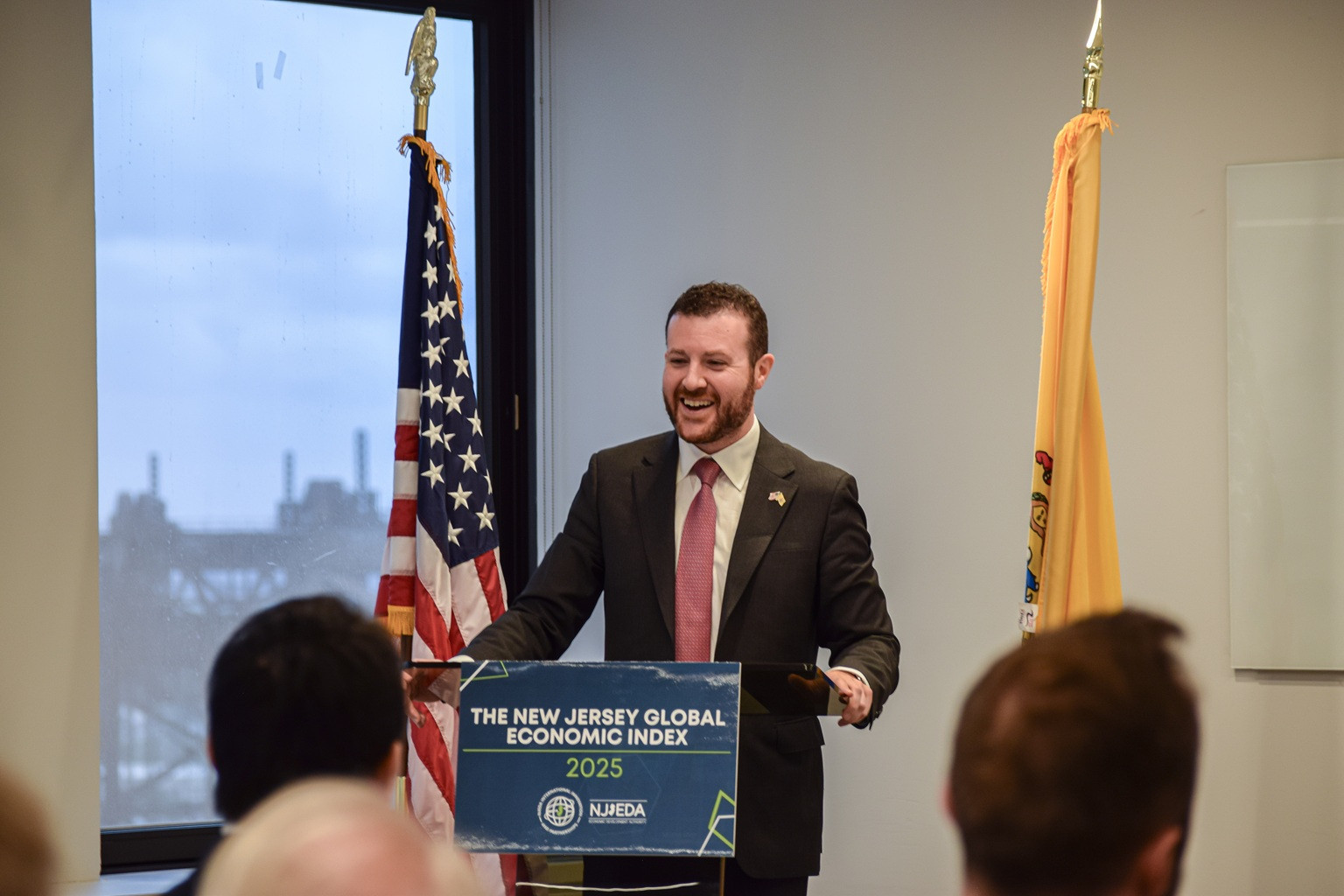
After seven and a half years in state government — the last three and a half spent running international economic relations at the N.J. Economic Development Authority — Andrew Gross is heading to a new mission.
Gross has been named the regional director of the American Jewish Committee, covering the metropolitan area where he’ll take on civil rights, foreign policy, politics and the fight against antisemitism, BINJE has learned.
It’s a shift from courting foreign investment to defending a community, but in Gross’s mind, the two missions aren’t as far apart as they sound.
“Those relationships are not just about Israel,” Gross said of the alliances AJC works to build. “Those are relationships like Ukraine and Taiwan, and today our Gulf allies who are being attacked by Iran. It’s about strengthening our bonds with our allies in Europe. It’s about strengthening democracy in Latin America.
“What’s good for Jewish people usually tends to be good for all Americans.”
Gross spoke to BINJE about the new role, what he’s bringing with him from his time in state government, and why he sees the fight against antisemitism as inseparable from the broader project of American alliances abroad.
Here’s a look at the conversation, edited for length and clarity.
BINJE: Walk us through the new job. What exactly will you be doing at AJC?
GROSS: I’ll be focusing on a combination of issues that affect the Jewish community deeply, including civil rights, foreign policy, and politics, and especially the fight against antisemitism. I’m very excited to be entering this new chapter of my life.
BINJE: You’ve built a career around international economic relations. Is there an economic development component to this new role?
GROSS: Yes. I believe that America’s prosperity means that all communities need to be uplifted, and that includes the Jewish community — and that means fighting for ideas that support our foundation as a capitalist society and advocating for economic policies that are good for America and good for the Jewish community. I will definitely bring my expertise in international economic relations to this job. I’ve learned a tremendous amount these years working for New Jersey, and I’m excited to think about ways to fuse that with the work of AJC.
BINJE: You’re clearly capable of doing this job from anywhere — Los Angeles, Paris, wherever. But you do have a regional tie here. Does that end up helping New York and New Jersey specifically?
GROSS: Absolutely. I understand a lot about what goes into making this part of America economically strong and understanding where in the world we should be looking for economic partnerships that are good for us.
In the past eight years, we saw at least $14 billion invested in New Jersey from abroad in foreign direct investment, leading to approximately 27,000 jobs in the state. There’s a great opportunity that exists in the world, and New Jersey, New York, and every state in America needs to work hard and fight for those jobs and that investment.
This region is ripe for investment — AI, tech, smaller startups, advanced manufacturing, food — and both New York and New Jersey need to work hard to compete for those opportunities.
BINJE: These successes do not happen in a vacuum. How has support in New Jersey helped in the effort?
GROSS: It means everything. I want to compliment Gov. Sherrill, who has continued to think creatively about how we’re going to create these jobs in New Jersey and retain the foreign companies we already have. I also want to give credit to Evan Weiss, our EDA CEO, and Sean Kennedy, his chief of staff, who understand how important this is and are thinking of ways to strengthen our international business community and keep a strong external pipeline.
And, of course, it all started with the efforts of Gov. Murphy, who made direct foreign investment — from Israel and around the world — a top priority.
BINJE: That priority sent you around the globe. Let us in on your passport.
GROSS: From 2023 to 2025, I made 19 international trips to 13 key partners (Europe/Africa/Middle East: Israel, Saudi Arabia, Bahrain, Oman, UAE; Asia/South Asia: Japan, Korea, Taiwan, India; South/Central and North America: Canada, Mexico, Panama, Brazil.)
BINJE: Let’s talk about the Jewish community. Someone once described it to me as three buckets: people who are firmly pro-Israel, people who are firmly anti-Israel and a large middle that’s confused by all the noise and doesn’t really understand the issues. Is that the group AJC needs to focus on educating?
GROSS: I generally agree with that. And it’s important to understand that one of the largest economic drivers in America today is a very small country that gets an outsized amount of attention.
In New Jersey, Israel is approximately the tenth-largest foreign investor in the state, and it’s a country of about 9 million people — roughly the size of New Jersey. It’s had a tremendous impact on our economy, and there are thousands of New Jerseyans working today because of Israeli companies and innovation that came here.
That’s a point that’s totally apolitical — it has to do with good business and good economics. The majority of Israeli Americans living in New Jersey aren’t here for political purposes; they’re here because they want to live and thrive in America.
BINJE: How do you bring all these factions together — or is that an unrealistic aim?
GROSS: There are some people who are never going to be convinced. I think we need to think creatively about how we bring together communities who can respect different opinions — and do a better job of explaining Israel’s role in the world and in America.
We’re not going to solve all the issues in the Middle East here in America. I try to think about Israel in terms of problem-solving and practical solutions — people who want to hate or sow division aren’t helping resolve anything. They’re just breeding the antisemitism that’s grown and metastasized in America. We all need to take a deep breath and think about what we can do together, rather than shouting at one another.
BINJE: When you say ‘together,’ I know you mean the entire world. Tell me how this role is about more than just Israel and the United States.
GROSS: The AJC’s role is to create alliances around the world that are good for Americans and particularly American Jews — but those relationships aren’t just about Israel. They’re about Ukraine and Taiwan, our Gulf allies being attacked by Iran, strengthening our bonds in Europe, and strengthening democracy in Latin America so there aren’t anti-West, anti-America regimes working against our interests.
What’s good for Jewish people usually tends to be good for all Americans. Jewish people are a small minority who need to work extra hard to make sure they’re protected, but good partnerships and good economic opportunities abroad are good for everybody, Jews and non-Jews together.
BINJE: For you personally, you’re stepping into a role that comes with real security concerns that other jobs don’t have. What’s it like putting yourself out there like that?
GROSS: Yes, there’s an extreme, heightened security risk to the Jewish community today that’s unacceptable. That’s been produced by a lot of forces coming together at once — how we consume information, the role AI has played, how information gets disseminated, and actors around the world who’ve taken advantage to sow distrust in American society. Antisemitism is a sickness. It’s a sign of a deeper problem in a society. But that’s not going to dissuade me from this mission.
Every American deserves to live in safety, and every American deserves to live freely and exercise their beliefs. It’s enshrined in our constitution, and AJC at its core is a civil rights organization. I believe in that mission.


