


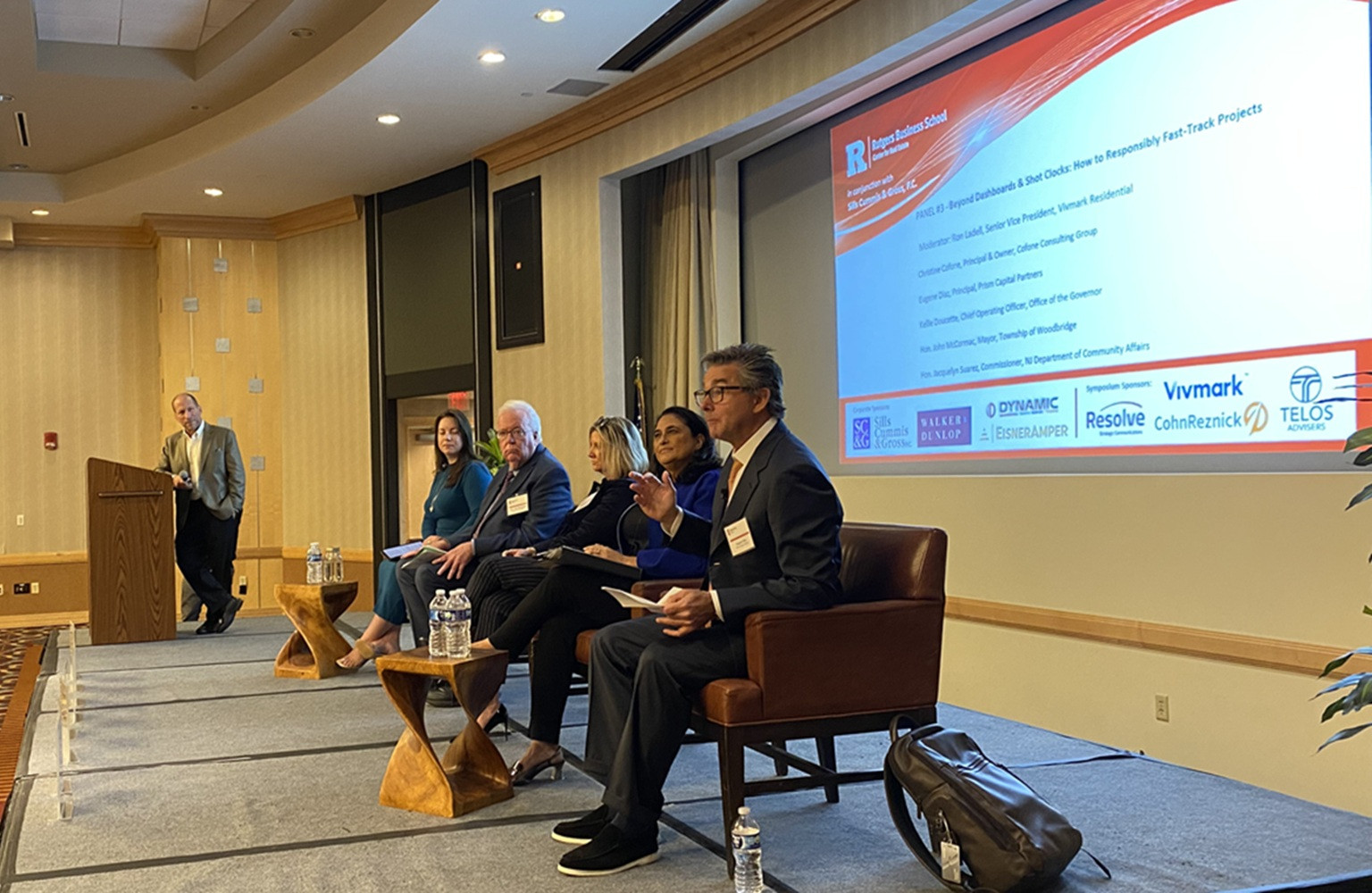

Gene Diaz didn’t wait long.
Moments after the state’s Chief Operating Officer, Kellie Doucette, finished a long walk through the Sherrill administration’s permitting reforms, Diaz served notice to the few hundred in the room at the Rutgers Center for Real Estate symposium Tuesday at The Heldrich in New Brunswick.
“The reality is that shot clocks and dashboards really don’t work,” he said. “They don’t really help.”
For those who know Diaz — the principal at Prism Capital Partners and the developer behind ON3, the Nutley/Clifton project that caps a long career in New Jersey — it wasn’t a surprise. He always has been a tell-it-like-it-is talker.
Tuesday was next level.
To be sure, the tone was polite. But the friction was palpable. A panel of platitudes and unchecked explanations this was not going to be.
***
Diaz gave the administration credit for recognizing the problem. His issue was the pace.
Doucette had just described a pilot dashboard tracking 10 projects. To Diaz, that was the problem in a nutshell.
“The state loves to do a study, do a focus group, have a little test case, move it along,” he said. “And at the end of the day, our projects continue to bleed on and bleed on and bleed on.”
Diaz said he understands why government works this way.
“Baby steps, I get it,” he said. “For the government officials in the room, it’s great for government. It’s comfortable for government.”
But baby steps, he said, won’t help a state competing for projects against Virginia, Maryland, Pennsylvania and the Carolinas.
“We need swift, final, firm, active decisions, not continued studies and small baby steps,” he said.
Then he went further. The real problem, Diaz said, isn’t the rules. It’s the culture of the people enforcing them.
“We have a cultural problem here in the state of New Jersey,” he said.
He pointed to the Federal Reserve, which has a dual mandate: inflation and employment. Every state agency, he said, should have one, too — enforce the rules, but also help get good projects done.
“You’re not here to kill deals,” he said.
And Diaz said the state isn’t even the biggest headache. State permits take months. Local land use approvals can take years — in part, he said, because local officials are wary of a single objector with a big social media following.
“The single objector has a huge megaphone on social media today,” he said.
***
Doucette didn’t let it sit.
And she wasn’t going to let moderator Ron Ladell move to the next question or the next panelist without offering a retort.
She jumped back in.
“I did not mean to give the impression that we were moving slowly on things,” she said.
Doucette, who ran Sherrill’s transition, said the administration screened every candidate to lead a state agency for one thing above all.
“A customer service and bias to action mindset were our number one things that we were looking for,” she said.
The practical steps, she said, are the foundation for bigger moves — not a substitute for them.
“We really do understand these big swings,” she said.
Her case rested on what she’d laid out at the start. The governor created the COO position in January and, on her first day, signed Executive Order 5, which required every state agency to catalog all of its permits within 180 days, along with whatever data existed on deadlines and whether they were being met. Doucette said it’s the first time anyone knows of that it had been done.
That catalog led to the pilot dashboard. The goal is a real-time tool that lets anyone with a state permit see exactly where it stands. And the shot clocks — set target times for permit decisions — aren’t optional.
“This is not something that we’re suggesting,” she said. “This is a requirement in the executive order, so we have to get there.”
Later, she came with numbers. DEP has cut the backlog on one of its most complicated permitting processes by 74%, she said. DOT has eliminated the backlog for its minor access permit, one of its most frequently used. And she said the governor soon would have more announcements on the permitting dashboard.
Doucette also described what the business community wants most: not just speed, but predictability.
“Sometimes the answer is going to be no,” she said. “But we should get to a quick, ‘No,’ if it’s a ‘No.’”
***
Community Affairs Commissioner Jacquelyn Suarez, who has served in the department across three administrations, tried to bridge the two.
She said she hears the frustration constantly.
“Nobody calls me to tell us that they’re having a good day,” she said.
Suarez said transparency helps. When a developer is told plans are stuck in a “black hole” at DCA, she offers access to the department’s ePlans system, where every submission, comment and release is timestamped.
And she offered a different way to look at baby steps.
“I hear that sometimes it seems like baby steps, but these are going to turn to run,” she said. “I have a toddler who started walking on Father’s Day. She’s running around the house.”
She didn’t get the last word.
Christine Cofone, principal of Cofone Consulting, brought it back to the ground level when she got into the mix.
Cofone, a planner who said she has appeared before about 450 planning and zoning boards over 30 years, gave the administration credit for its progress on state permits. But she sided with Diaz on where the real logjam is.
“It’s an outlier when you have great local municipal support for your project,” she said.
She described review letters arriving at 4 p.m. on the day of a hearing. A seventh review letter that raises new issues. Developers paying architects, engineers, traffic experts and planners to come back again and again.
“To bring that team back over and over and over in the land use process is excruciatingly painful and expensive,” she said.
Asked whether the administration’s push has trickled down to municipal officials, she gave a long answer — then summed it up.
“I could have just said, ‘No,’” she said.
***
The panel ran out of time. The talking didn’t stop.
Diaz and Doucette did not go their separate ways. In fact, they began a private conversation that went on so long they had to be called over for the post-event photo.
This is a good thing. And it shows the value of Doucette’s newly created position. She is a listening ear.
Doucette certainly has heard plenty of hard truths on her listening tour of the state, whether from South Jersey leaders or heads of diversity groups. She has shown a real ability to take it in. And she repeatedly says she wants the truth — because it’s the only way the state can help.
On Tuesday, she showed a willingness to fight back a bit, too.
Politely. Constructively.
For those of us on the circuit, where one business panel too often sounds like the next, it was a refreshing change.


