


Soccer in the United States has had its share of big moments. The Cosmos playing before 77,000 people at Giants Stadium in 1977. The country hosting the World Cup in 1994. Launching Major League Soccer. And, of course, the iconic image of Brandi Chastain from the 1999 Women’s World Cup.
But if St. Benedict’s Prep boys’ soccer coach Jim Wandling is right, what’s coming in 2026 will be something else entirely.
 He calls it the “iPhone moment” for U.S. soccer.
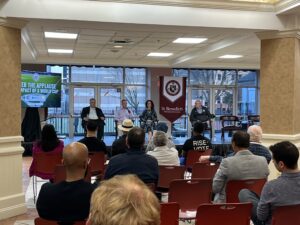
“Back in 1994, the World Cup was considered to be a legacy moment, because what followed was the creation of Major League Soccer,” Wandling told a crowd at St. Benedict’s Prep in Newark Tuesday night.
“I’ve heard this World Cup being coined as the iPhone moment for U.S. soccer in that, if you recall back in 2007 when the iPhone was introduced, it kind of turned everything upside down.”
That’s the scale of change many in the game are quietly expecting when the world’s biggest sporting event comes to the U.S., including eight games at MetLife Stadium — including the final on July 19.
Wandling isn’t just talking about a bump in TV ratings. He’s talking about a surge in kids trying out for teams, a spike in club and franchise values and a new generation of fans.
If that momentum is harnessed, he believes, it can permanently reshape the sport’s place in American culture.
What that legacy looks like in New Jersey and the region was the central question behind the St. Benedict’s event — ‘After the Applause: The Impact of a World Cup’ — hosted in partnership with Latina Surge National, UNITY/Evolvere Chamber and the New Jersey Small Business Growth Council.
Lauren LaRusso of the NY/NJ World Cup Host Committee, Luis De La Hoz of PNC Bank and the Statewide Hispanic Chamber, Erik Stover, CEO of the Cosmos and Wandling discussed what 2026 will be remembered for:
- Growth of the game at the grassroots level;
- An economic boom — or bust — for local businesses;
- Unprecedented global branding for the region;
- Or a rare moment of unity in an increasingly divided world.
If 1994 helped build the foundation, the panel suggested, 2026 is the upgrade that could change everything.
For New Jersey’s tourism industry, 2026 is a once-in-a-generation showcase. De La Hoz called it the biggest economic opportunity for main street businesses in New Jersey, noting that visitors won’t just need tickets — they’ll want food, entertainment, transportation and authentic local experiences.
“We have food from every country of the world,” he said, pointing to places like Newark’s Ironbound, Elizabeth, Jersey City and Paterson as natural magnets for visiting fans. “The better we treat those tourists that are coming, the more referrals we get.”
In other words, the World Cup isn’t just a three‑week event, it’s a three‑week audition for years of repeat tourism.
LaRusso said the host committee is already building tools to make that happen.
From business initiatives (more will be announced soon, she said) to influencer campaigns to new website features that will steer visitors toward local restaurants, neighborhoods and attractions, the goal is simple: Convert global attention into local foot traffic, she said.
For Eric Stover and the New York Cosmos, 2026 is not just about crowds and merchandise, it’s about reviving a historic brand in a way that’s anchored in community.
Stover is bringing the Cosmos back at Hinchliffe Stadium in Paterson as part of the $100 million restoration of one of just five remaining Negro League ballparks in the country. The World Cup, he said, creates exactly the kind of spotlight that can turn that stadium into a year‑round destination.
“It’s a really unique moment in time,” he said. “We feel a tremendous responsibility to keep (the stadium) going and use it as an economic driver.”
During the tournament, Stover said the Cosmos plan to host free public viewing parties at Hinchliffe, opening the gates to neighborhood kids and families who will never get near a
World Cup ticket price — but who can still feel what it’s like to watch a match in a stadium, together.
At the same time, the Cosmos will lean into their global recognition. A planned World Cup exhibit at the on‑site Negro League museum will tell the story of the tournament through former Cosmos players — from Pelé to modern U.S. internationals — reinforcing the club’s role as a bridge between eras and cultures, he said.
Longer term, Stover expects the heightened interest in the sport to fuel demand for both the club’s men’s side and its planned women’s team, creating more professional opportunities for local talent on and off the field.
The panel was equally clear that the women’s game stands to gain, too.
LaRusso said the men’s World Cup can be a powerful gateway for young girls: more role models on screen, more demand for fields and facilities, more pressure to invest.
Wandling agreed, pointing out that the surge in interest and investment won’t be gendered — if the sport explodes, it explodes for everyone.
Stover went a step further, announcing plans to launch a women’s professional team under the Cosmos crest, arguing that “there’s so much talent here, and there’s not nearly enough jobs for women players.”
Then there’s this: The hope that event can showcase a model of how diversity connects us rather than tears us apart.
At St. Benedict’s, Wandling is working to do just that.
“Diversity can be our greatest strength or greatest weakness,” he said. “(We) choose to celebrate the diversity as opposed to allowing it to divide us.”
LaRusso said she hoped the final will provide a global stage to show how a region defined by difference can still come together.
We can all hope.
The panel included a number of great thoughts. Here are a few more:
Lauren LaRusso
- “We were born out of the city of New York and the state of New Jersey’s efforts to host, so as our founding fathers and mothers, we are working with them to make sure we are a destination that folks want to come to again and again and again.”
- “We have to lean into the notion that soccer and sport unite. We have to capture that and make sure that we are still that welcoming environment when people come.”
Luis De La Hoz
- “This is the biggest economic opportunity for main street businesses in New Jersey, because the amount of people that are coming, the time that they would spend here, the money that they would spend here.”
- “The people who are coming will find something from their country or region and something that they never tried before.”
Jim Wandling
- “We run a residential program that’s open to kids from around the world. So, at any given moment, we will have upwards of 20 players that will span four or five different continents.”
- “This is a real opportunity to bring people together in the streets, in fan festivals, at the stadium – to celebrate each other’s differences, embrace the diversity that this country possesses and make it a celebration that will be remembered for years to come.”
Erik Stover
- “We try not to talk about politics. We try to focus on issues, whether it’s food insecurity or immigration, whatever it is, we’re dealing with those every day with our club, and we’re trying to bring the club mentality to unify everybody.”
- “A big driver for us is opportunity in community. For the last 30 plus years, in communities like Newark and Paterson, it’s been extremely difficult to make it to the professional ranks. We see it as an obligation for us to get into the community, find those players and give them opportunities that they would not have otherwise.”

