


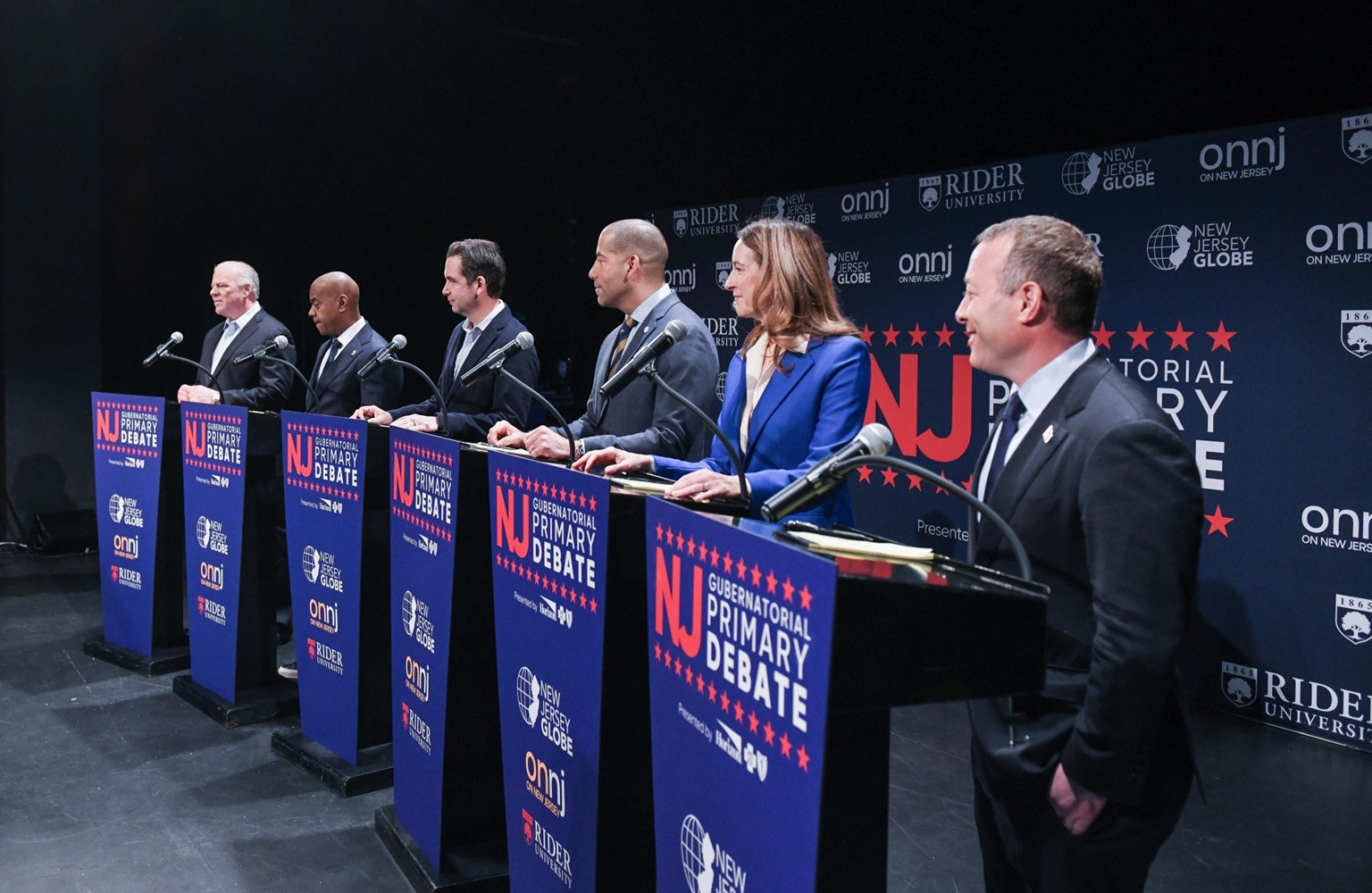
George Norcross said the race to be the next governor of New Jersey is unlike any other in decades, for a few unique reasons:
- The number of qualified candidates from both parties has never been higher
- The influence of national politics and issues has never been greater
- The quality of media coverage of the candidates has never been lighter
All of this leads to point No. 4: The interest of voters has never been lower.
“Most people in New Jersey don’t even know there’s a gubernatorial election coming up,” he said. “We’re (a few) weeks out, they still don’t know.
“In the polls I’ve seen, a little more than 50% of the Democratic voters don’t know the candidates. They don’t even know who they’re voting for.”
Norcross made his comments in mid-April, during an interview for the launch of BINJE. But there’s no reason to believe any of this has changed in the past few weeks, for one big reason: No one is talking about the issues, especially at the statewide or local level.
“Politics has become nationalized,” Norcross said. “The mayor running in Cherry Hill deals with how people feel about Democrats or Republicans on a national basis and secondarily about their own town.
“We’ve become that nationalized because people, when they watch the local news, are largely hearing about what’s going on in Washington (D.C.), which I don’t think is particularly good, given the challenges going on in the country.”
Ben Dworkin, the founding director of the Rowan Institute for Public Policy & Citizenship, agreed — but reached a slightly different conclusion.
Yes, Dworkin said, all the talk is about Washington. But there are two good reasons for that:
- Washington is interesting right now
- New Jersey … not so much
“I think the race for governor in New Jersey is very interesting, and we have top-level people running, but what’s going on in Washington is even more interesting — it takes up all of the oxygen in the room,” he said.
Then, there’s this. The candidates for governor, especially on the Democratic side, have — thus far — been running ho-hum campaigns.
“On the Democratic side, they’ve been generally nice to each other — we’ve seen very little contrasting messaging,” he said. “A few candidates have slightly attacked another, but generally, the Democrat messaging has largely been biography, with a little bit of (President Donald) Trump opposition and a little bit of ‘make New Jersey affordable.’
“The challenge for the Democrats is that the base wants them to stand up to Trump, but the conventional wisdom after 2024 is that standing up to Trump is not the message that’s going to win you over young people, working-class people and Hispanics, all of whom are drifting away from the Democrats.”
The challenge just to get attention? That’s nothing new for either party.
So said Patrick Murray, who should know.
The longtime head of the Monmouth University Polling Institute — who just recently founded his own firm, stimsight.com — acknowledges that the field of candidates is top notch, but Murray said the interest in them is similar to those in year’s past.
“Even on the rare occasion that we have had competitive primaries, New Jersey voters just tune in late,” he said.
The candidates shouldn’t be offended, Murray said.
“They tune in late for general elections, too,” he said.
How this will change is tough to say. Media attention isn’t what it was — and it’s never been great, Murray said.
“Our media environment always has been dominated by New York and Philadelphia news,” he said. “So, the casual voter is not getting New Jersey information all that frequently. That always has been part of the problem. And now, even people who are still watching broadcast TV aren’t watching the ads. If they have DVR’d the program, they are fast-forwarding through it.
“That’s why we have these polls coming out that show significant portions of the electorate on both sides saying that ‘I have no idea who I’m going to vote for.’”
Getting people to tune in to the news won’t necessarily solve the problem, Norcross said. He’s bothered by what he sees when he does tune in.
“Every night, cable television will tell you who to hate — which I find deplorable on both sides,” he said. “I don’t know where Walter Cronkite is, but I wish he was around, because I don’t know where to turn to get factual news.”
In theory, interest in the races will pick up in the coming weeks, heading into June 10. Once the two candidates are selected, the coverage should be tighter — and, likely, greater.
“Right or not, the race for governor in New Jersey — and Virginia, for that matter — always is viewed as referendum on the president,” Dworkin said.
It would be nice if it were all about New Jersey. After all, there are some terrific races going on.
The candidates — from both parties — rarely have been stronger, Norcross said.
“This is a very unique election,” he said. “There hasn’t been one like this in my lifetime. The last time you had a field like this was probably 1977, when you had a Democratic primary against an incumbent governor.”
On the Democratic side, Norcross said he will continue to support his longtime friend, former state Senate President Steve Sweeney. But, he said Newark Mayor Ras Baraka has run the best campaign to this point.
“He’s been assertive, he’s been aggressive, he’s been affirmative,” he said. “Whether you subscribe to his political beliefs or not, he’s made his presence known and he’s very likable.
“The other candidates generally have either not done much yet or relied on paid media to get their message out — and it’s not penetrating yet. Anybody can win this race.”


