


It’s easy to talk about the really big numbers (more than $3 billion in assistance in 2025 alone) and the singularly impactful ones (nearly 200 units of affordable and mixed-rate housing in the past two years).
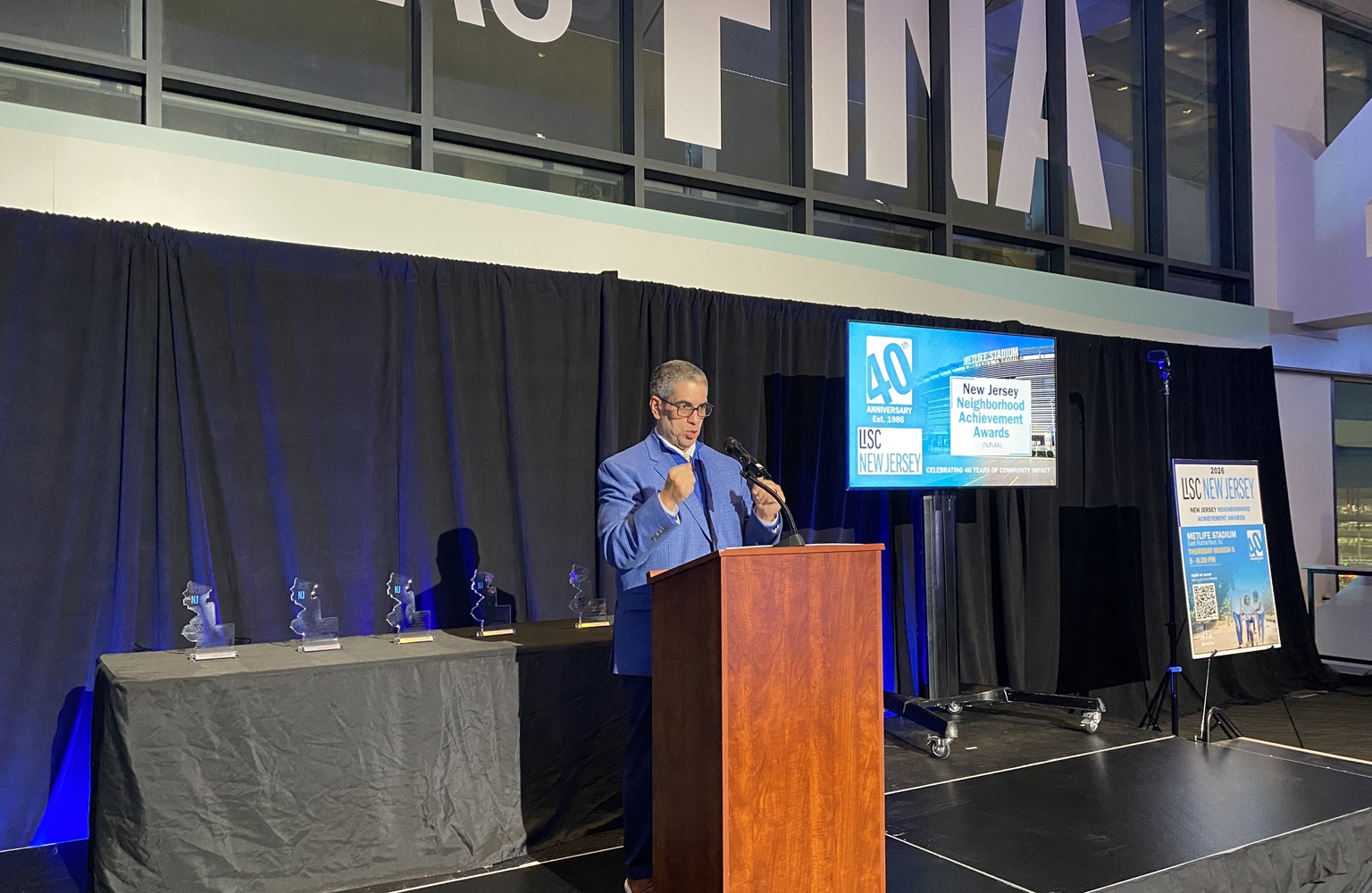
It’s the reason LISC New Jersey had so much to cheer Thursday night at MetLife Stadium, when the state chapter of the national Local Initiatives Support Corporation celebrated its 40th anniversary.
But you don’t do the good things that LISC does without talking about — and taking on — the tough issues it faces while working to have true social impact in the communities it serves.
“I’d be lying to you if I didn’t say the past year has been really tough,” Executive Director Jorge Cruz told BINJE.
LISC has long been known as the organization that helps build resilient, inclusive communities by providing capital, strategy and support to local partners. A noble cause, but one that has come under fire in the anti-DIE sentiment coming from Washington, D.C.
“We are fairly dependent on federal funding and federal contracts — and more importantly, our partners are,” Cruz said. “Just about every project we support has some sort of federal money. So, it’s been a tough, tough year.”
A revealing one, too.
The continued support of philanthropic organizations such as the Geraldine R. Dodge Foundation and the Victoria Foundation means the world, Cruz said.
“Their long-time support is everything to us,” he said.
As is the support of the corporate community, the companies who have not been deterred in their desire to help build communities. Cruz rattles off statewide stalwarts Prudential, PSE&G and RWJBarnabas, among others.
“This is forcing some hands, but we’re seeing where the real commitment to equity is,” he said. “We’re doubling down on our focus on DEI. And what we’ve learned while doing that is the companies who are real about their commitment to equity, figure it out.”
That commitment extends to state government, too.

Cruz said LISC always has been grateful for the help of the N.J. Economic Development Authority and the Department of Community Affairs, but he gave an extra tip of the hat to Gov. Mikie Sherill and Lt. Gov. Dale Caldwell (who, as is his norm, not only came to the event and gave a rousing speech, but also stuck around for a meet-and-greet to the delight of the nearly 200 in attendance).
Cruz said LISC knows the budget process is going to be tough, but he’s confident that if LISC works with its state partners — packaging what is available as opposed to complaining about what is not — they can find solutions.
It’s the spirit of the organization. Has been since Day One, Cruz said.
“We’re not a high-volume lender; that’s not who we are,” he said. “We don’t want to be about single projects and one-off transactions. We want to be more about how we can cluster our investments, our resources into a single block in a single town.
“We’ll support any project or any organization that is serving a low-income community or low-income population.”
Then Cruz adds the kicker.
“It’s not only what we support, but who we support,” he said. “We’re making sure we support developers of color, women-owned development firms, nonprofit developers. Those are the developers who are working to build more than a building.”
That’s how communities are built and jobs are created in the areas that need them the most, Cruz said.
LISC was born in Newark, but it has long grown well beyond its borders. LISC does a lot of work in neighboring Orange, East Orange and Irvington — and a lot of work in nearby Jersey City.
LISC also serves other needed pockets in the state: Elizabeth, Paterson, Perth Amboy, Plainfield, Trenton and Camden.
By any means possible, Cruz said.
“We’re particularly proud of our ability to string together disparate programs: capacity-building grants, technical assistance programs and training to gain access to capital,” he said.
It’s how you overcome the challenges of the day.
Cruz is proud of the organization’s long history of doing that.
“We think about the generation before us,” he said. “They had it a lot tougher than we do. They got through it, so we can get through it.”


