


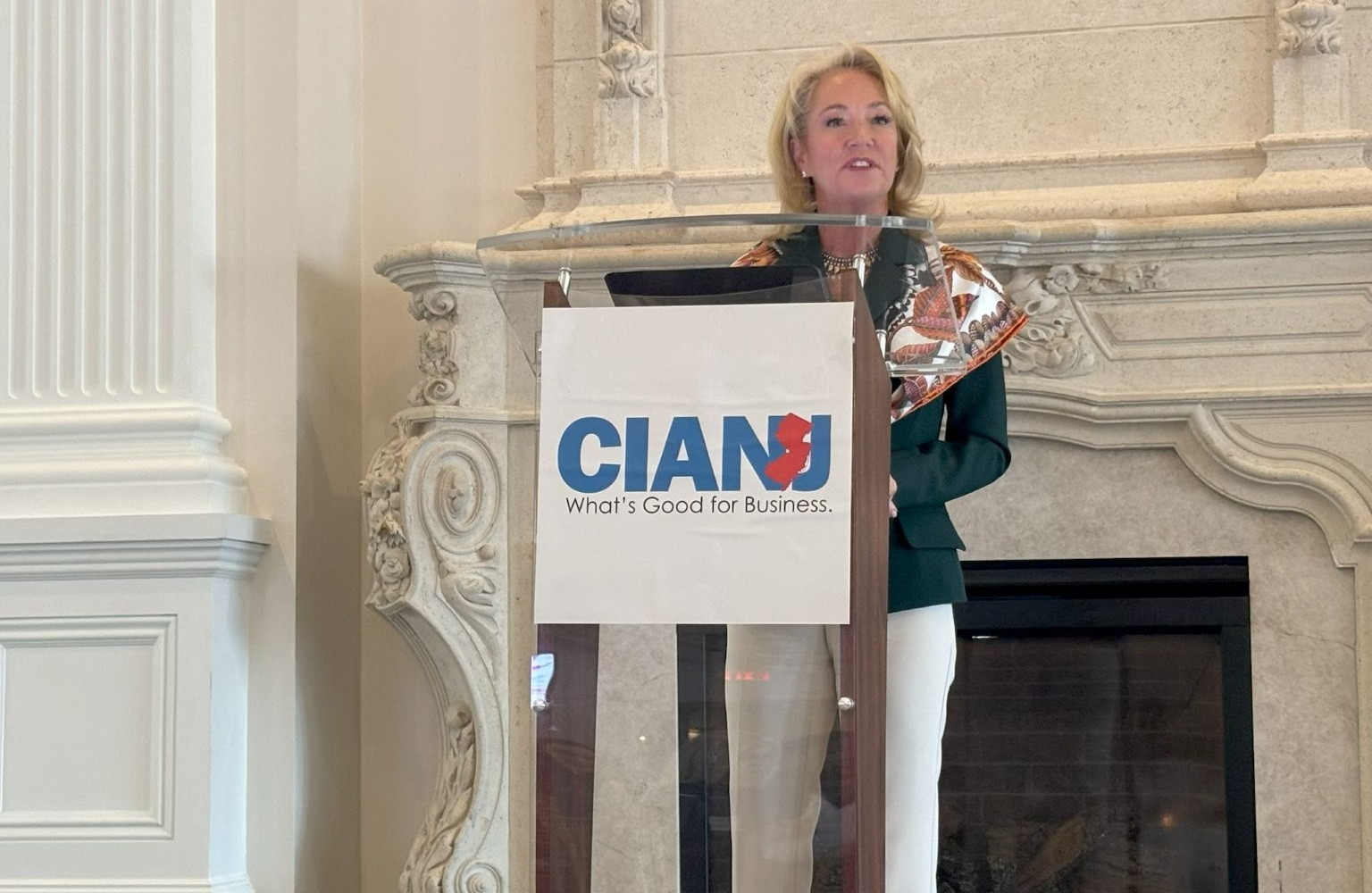
Amy Towers was quick to state the obvious: Women have spent decades pushing to break the glass ceiling.
No one illustrates better than Towers herself, a successful businesswoman, global entrepreneur and now chair of the Rutgers Board of Governors.
But when Towers recently gave the keynote address at CIANJ’s Building the Future Together Women’s History Month event, she made one point clear: Breaking through wasn’t the end of the story.
“When I entered the finance and banking world more than 30 years ago, there were few women in leadership roles,” she said. “My mentors were men. And I don’t say that with any malice, I say that with appreciation. The colleagues I worked for, and with, taught me valuable lessons about competence, persistence and commitment to your work.”
Towers said she never set out to be a trailblazer.
“In the early days of my career I certainly did not think that I was ‘paving the way’ or ‘redefining roles and opportunities,’” she said. “I was quite simply working hard to succeed and build my own career path, whatever that took.”
And while the landscape has shifted dramatically since then — women now make up nearly 60% of U.S. college students and almost half the labor force — Towers said progress alone is no longer enough.
The question now, she said, is what women need next. For Towers, the answer is clear: access to capital, and mentorship.
***
Towers has always been in the financial sector. It’s no wonder why that’s where she started.
“Where once we were pushing for access, I would suggest to you, we must now drive for agency,” she said.
She emphasized that while women are graduating in record numbers, launching companies at record pace, and holding leadership roles across sectors, the fundamental barrier remains unchanged: unequal access to meaningful capital.
“We must have access to the capital, the networks and the markets to drive our businesses to the next level,” she said.
Towers pointed to both her global work and U.S. experience: “Economic opportunity and independence is the pathway to agency; to innovation, to growth and to powerful outcomes.”
She described creating women’s cooperatives in Niger, Ethiopia and Zimbabwe — groups that pooled resources, built networks, and generated shared financial capacity. The lesson was universal: capital fuels transformation, not only for individuals, but entire communities.
“Access to meaningful capital produces outcomes that can start with the ability to send children to school and lead all the way to funding an idea this world desperately needs to scale,” she said.
Towers was direct about the bottom line.
“In 2024, women-founded businesses received only about 1% of total capital invested in U.S. venture-backed startups,” she said.
At the current pace, parity may not arrive until 2065.
“These numbers are sobering, but they are also a roadmap,” she said. “The gap tells us exactly where the leverage points are.”
She urged women to use data more effectively, strengthen networks intentionally, and build momentum through collective financial power: “Our collective financial resources and economic success will increase the capacity of women funders for women founders.”
***
Money alone isn’t enough, Towers said.
She said the second requirement for women’s advancement is mentorship.
“My personal mantra has always been, ‘Be the mentor you wish you had,’” she told the crowd.
Towers spoke candidly about wanting to pave easier paths for the women coming behind her.
“You’ll recall I said, ‘Early in my career I was quite simply working hard to succeed and build my own career path,’” she said. “Today, I have a different focus. Today my focus is on helping to create and support career paths for future leaders.”
She urged the audience to make mentorship active, not reactive.
“Give someone the opportunity you wish you had, help her develop the unspoken skills she might not otherwise learn, advocate for her when she has earned the promotion and lead with intention and thoughtfulness,” she said.
And Towers warned that progress slows when women must repeatedly relearn the same lessons.
“I simply don’t want our women leaders of today to have to re‑learn or re‑experience the challenges I faced early in my career,” she said. “We won’t get ahead fast enough that way.”


