


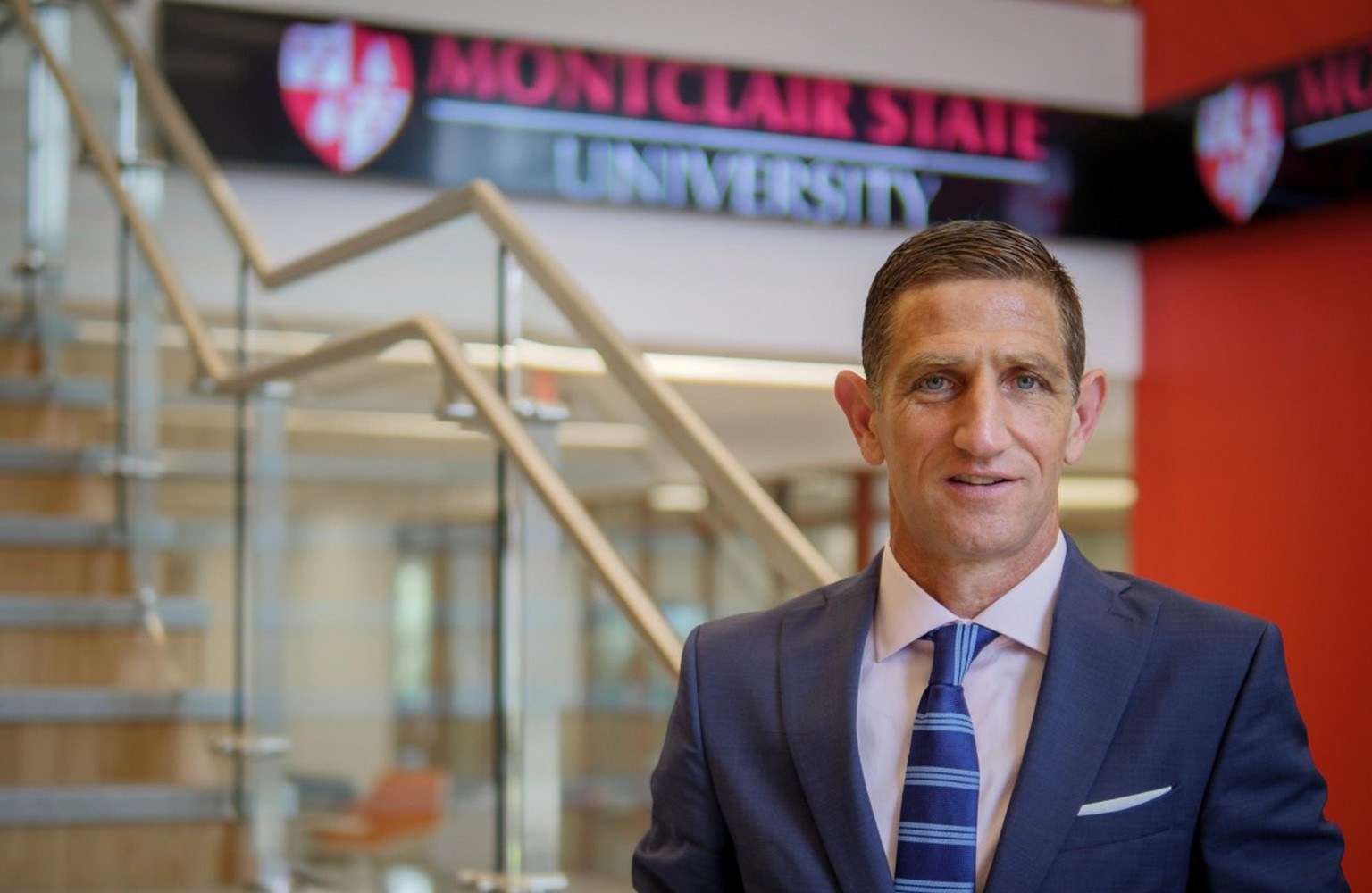
Keith Strudler, the dean of Montclair’s College of Communication and Media, is about to build a television news operation at a public university — which means his budget, his emails and his hiring decisions are all potentially subject to Open Public Records Act requests.
He’s fine with that.
“We believe in open records,” he said. “That’s just standard fare at a public university. And honestly, I think in a lot of ways it’s very natural for journalists — the freedom to follow truth where it leads is kind of baked into university culture.”
Read More on Montclair State/ NJ PBS
- NJ PBS license is going to Montclair State — and a lot of questions come with it
- Montclair State to begin operating NJ PBS starting July 1
- Montclair’s Strudler: NJ PBS will be a professional news operation — not a student project
- Q&A: New NJ PBS leader on why being at a public university is a help, not a hindrance
There’s just one caveat.
The reporters, Strudler noted, are a different matter. Shield laws protect journalists’ communications and sources — and those protections apply regardless of who signs their paychecks.
“All the rules that would apply to protections for journalists apply,” he said. “The reporters will be protected by shield laws.”
When Montclair State was named Wednesday as the new operator of New Jersey’s four FCC-licensed public television stations, some raised concern over whether being tied to the university would hamper the ability to function smoothly because it is tied to numerous rules and regulations as a public entity.
Strudler isn’t worried. He said the transparency that comes with being a state institution is a selling point for NJ PBS — not a liability. And the same logic applies to the one thing people most fear about a university running a television station: the bureaucracy.
Will HR slow down the GM search? Will salary bands make it impossible to compete for talent? Strudler says the fears don’t match the reality.
“HR is not going to come in and say we don’t want this person,” he said. “We have committees in the college, I’m technically the hiring manager, and we’ll be interviewing a myriad of candidates. It’s a fair and open process — but it’s our process to run.”
Strudler touched on a lot of topics during a 45-minute conversation with BINJE Wednesday afternoon. His primary focus is building a staff that can deliver the professional product he envisions — and do it by Oct. 1, when the school takes over production of the nightly newscast.
Here’s more of that conversation, edited lightly for space and flow.
BINJE: Let’s talk about how you cover an entire state with a lean staff.
STRUDLER: We’ll have staff reporters — North, Central and South Jersey coverage to start, with a full-time Trenton reporter as an aspiration. But the bigger story is what’s already out there.
There are hundreds of content creators across New Jersey — people doing serious storytelling on YouTube, TikTok, Instagram, local news sites — who already have audiences and are already doing good work. Our goal, working with the Center for Cooperative Media, is to figure out how we partner with those people. How we give them a bigger platform. How we extend our reach without pretending we can do everything ourselves.
BINJE: When you say content creators, people immediately think TikTok influencers doing dances.
STRUDLER: Right, and I get why. But that goes to the least common denominator. There are people doing genuinely serious journalism on those platforms — finding audiences, telling important stories, meeting community needs.
The Center for Cooperative Media has been better than almost anyone in the country at building networks of storytellers across platforms. That’s going to be a real asset. And the best approach is to go to those communities and ask what they need — not come in from the top down and say we know what New Jersey wants.
BINJE: You mentioned partnering with content creators. But you also got nearly every university president in New Jersey to sign on. What does that actually mean in practice?
STRUDLER: It means a lot, honestly. And I won’t pretend it was easy — getting all of those university presidents aligned is not a small thing.
But the number of universities — independent, private, public — that signed on to be part of this is pretty remarkable. What it means practically is shared resources, shared courses, professors working together, students at Rowan or William Paterson or Rutgers or TCNJ who can participate in content creation, in learning opportunities, in the kind of collaborative journalism that no single institution could pull off alone. There are also real cost savings that come from institutions working together.
But more than anything, it means NJ PBS has a genuine statewide academic infrastructure behind it — not just Montclair, but the whole of New Jersey higher education pointing in the same direction.
BINJE: Let’s talk money. The fundraising and underwriting model has long been a challenge at every PBS station everywhere. It’s why pledge drives are so noted. How are you approaching it differently?
STRUDLER: We will absolutely have an underwriting and membership team. That’s a primary initial focus. And look — the biggest advantage we have is that we’re starting lean rather than getting lean. It’s a lot easier to start lean than to get lean. The old model had a lot more federal funding available, and when that gets scaled back, you’re left asking, ‘Who do we lay off,’ and ‘What does that do to the operation.’
We’re not in that position. Our proposal is deliberately conservative, and that gives us a much better foundation to build from.
BINJE: Speaking of building. What’s the upside on membership? Is there real untapped potential in New Jersey?
STRUDLER: Significant. New Jersey is squeezed between two massive media markets — New York and Philadelphia — and I think that’s actually suppressed membership, because people have never had a reason to identify specifically with a New Jersey public media outlet.
If we can build something that feels genuinely like New Jersey’s — that covers the state, shows up at events, represents the diversity of communities here — I think there is a ton of untapped membership potential. And beyond individual members, there’s a real opportunity with foundations and corporate philanthropy. But all of that starts with building something people actually want.
BINJE: And something people want to support. Selling media can be challenging. What’s your pitch to an underwriter who just wants to buy programmatic ads on Facebook?
STRUDLER: Not all ads are the same. A community-based news organization creates a context where people feel good about what they’re reading, where they feel like they’re getting something. That’s very different from a pop-up ad while someone’s scrolling.
Radio figured this out — the best local radio salespeople know how to sell a sense of community, and that affinity translates to the products advertised in that space. That’s what we have to figure out how to sell. What makes us special. Because if we don’t, we lose to programmatic every time.
BINJE: And you need that revenue to grow the staff. Of course, any question about paying for talent goes back to the original thought on how the university connection will impact the operation. Can you actually compete for top talent, or are you locked into university pay ranges?
STRUDLER: There are ranges, yes. And I’ll be honest — we’re being fiscally conservative, so I don’t imagine we’re making outlandish offers. If Scott Pelley called, we probably can’t afford him.
But here’s what I genuinely believe: working at New Jersey Public Television at Montclair State is a really great job. Good benefits, job security, a meaningful mission and the kind of freedom that university environments provide. The people we want are people who want to be here. That matters.


