


For years, New Jersey has worked hard to bring companies in. Nobody, it turns out, was assigned to keep them.
That was a key revelation from the state’s top economic development officials Thursday at the 10th Annual Middlesex County Business Summit.
Todd Fisher, senior director for strategic initiatives and economic opportunity in the governor’s office, was very straight forward in what appears to be the administration’s first extended public response to a string of high-profile corporate departures this year.
“One of the things that we recognize is that truly there has been nobody in the government whose job is to focus on the great businesses that are already here in New Jersey, that are growing in New Jersey,” he said.
“Engaging with our businesses in a more regular and sophisticated way is something that historically is not part of the DNA of the state apparatus. We want to change that, and in particular, we want Choose New Jersey to be the tip of the spear.”
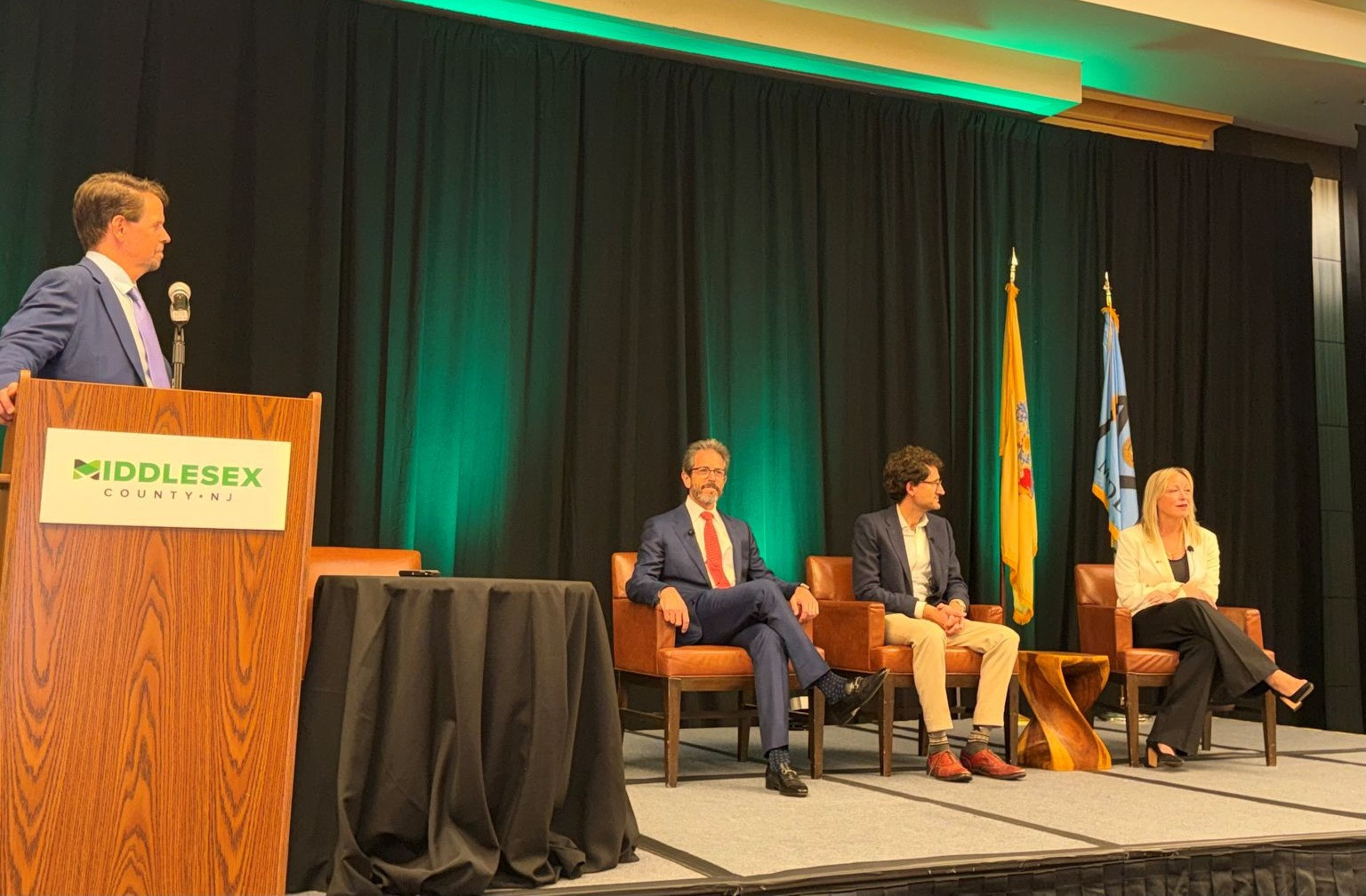
Fisher was joined on the panel by Choose New Jersey CEO Amy Herbold and N.J. Economic Development Authority CEO Evan Weiss.
Herbold said his comments represent a shift for Choose New Jersey, the business-funded nonprofit that has focused largely on attracting companies from overseas.
“We need to give that same kind of effort to the businesses that are here and focus on how do we grow here,” she said. “It’s cheaper for you to grow here probably than to pick up and move your entire operation.”
Herbold said the focus is about being more proactive and intentional, but she also was blunt about the limits.
“These are conversations that have been happening probably for four or five years within these companies,” she said. “There’s nothing I’m going to do tomorrow that’s probably going to change some of the decisions that have been in the works for five years.”
The comments addressed one of the biggest issues the Sherrill administration has faced in its first year. And, assuredly, economic development leaders of the Murphy administration would say retention was a major point of emphasis from them, too.
What cannot be debated is this: The departures have piled up.
In June, Samsung said it would move its U.S. headquarters — and about 1,000 jobs — from Englewood Cliffs to Plano, Texas. In July, Mars Wrigley is closing its Newark office, eliminating about 300 jobs as it expands its headquarters in Chicago.
Last month, Burlington Stores announced it was moving its headquarters from Burlington to Philadelphia — a crushing loss, many business leaders said.
ExxonMobil’s exit earlier this year was different, but no less symbolic.
In July, the company — which traces its roots to Standard Oil of New Jersey and had been incorporated in the state for more than a century — moved its legal home to Texas.
The move was a legal one, not a physical one. But it took one of the most storied names in American business off New Jersey’s corporate roster.
Fisher said the new approach to stopping these exits will be personal.
Fisher said he, Herbold and Weiss, often joined by the governor, are sitting down with CEOs who are weighing their plans.
The message, he said, is straightforward: “We’re going to make it easy for you to either come here, or build here, or expand here.”
It comes with realistic expectations.
“We’re not going to change this overnight,” Fisher said. “These decisions don’t happen like that. They’re planned for years, but if we keep doing that, we’ll get better at it, and we’ll start to change mindset.”
Fisher said there are early signs. A large company recently called him with a question.
“What if we were thinking about expanding here?” Fisher recalled being asked. “What would we actually do?”
A deeper conversation followed, he said.


