


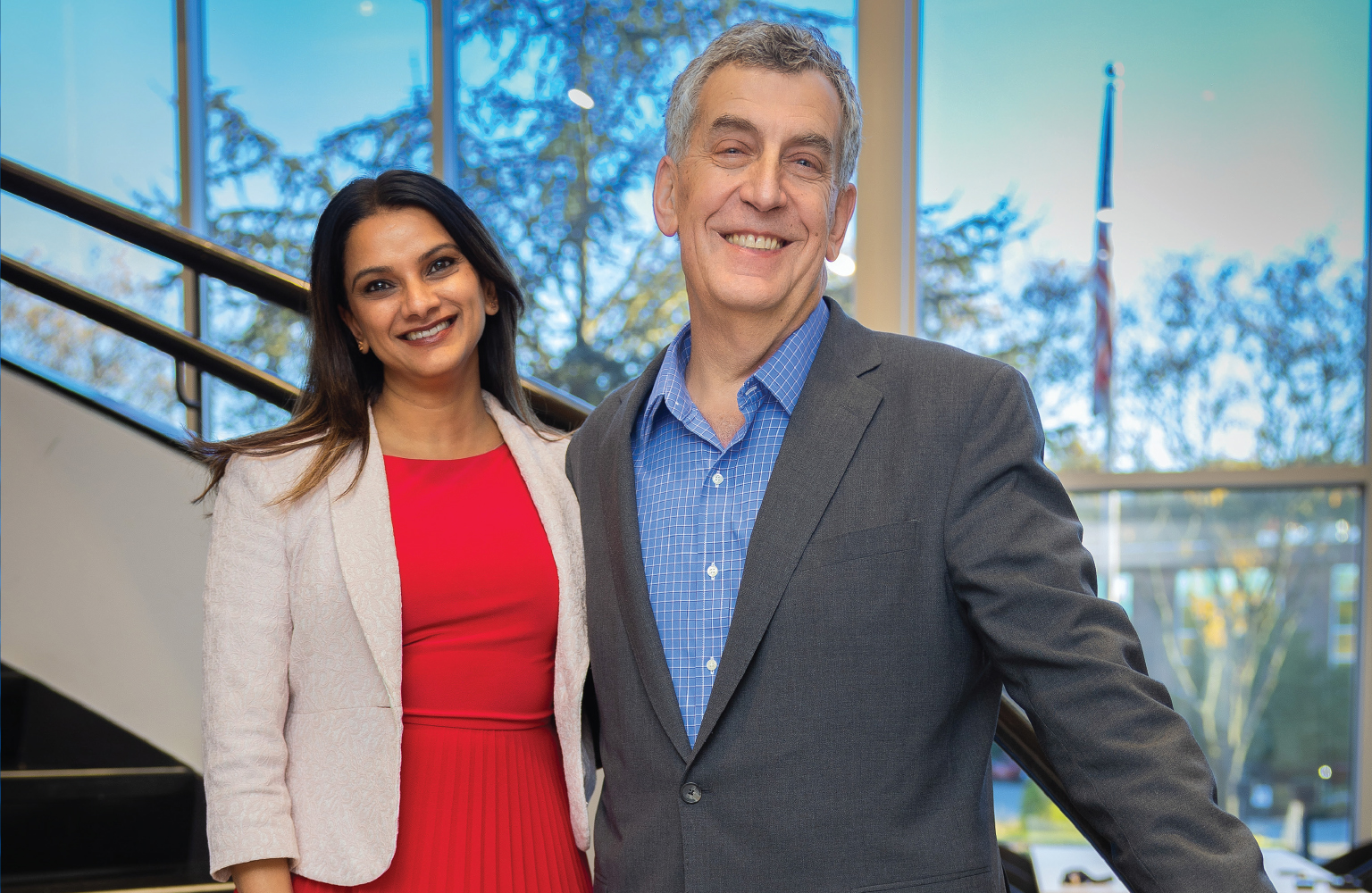
In the never-ending battle to find cures for cancer, Atlantic Health recently received a unique gift that will keep on giving, perpetually providing funding for research.
Earlier this month, prominent New Jersey philanthropists Bruce Jacobs and Ken Levy pledged $5 million to establish The Jacobs Levy Clinical Research and Innovation Endowment at Atlantic Health under the Atlantic Health Clinical Research and Innovation Institute, known as AHCRII. It’s the largest research gift in Atlantic Health’s history.
The money will be invested, and its earnings will fund cancer research every year, indefinitely.
The money will let Atlantic’s physician-researchers design their own studies from the ground up, pay for novel tests and treatments that insurers and drug companies won’t, and move promising trials forward without stalling to hunt for funding.
But it does more than pay the bills. Leaders say it’s a statement of confidence in the work already happening there.
Dr. Mahalaxmi Aburi, Atlantic Health’s vice president of research, said it represents an extraordinary vote of confidence in research and innovation that’s happening across Atlantic Health, particularly in oncology.
“It’s a recognition of the meaningful cancer research that we can now do from the ground up, and the medical discoveries that are happening right here in New Jersey,” she said.
Dr. Eric Whitman, system medical director of Atlantic Health’s oncology service line, said the permanence of an endowment sends that message.
“I think endowment is a great way of showing confidence in how this is going to continue,” he said.
An endowment, he said, will “continually spin off funds to support research” in perpetuity.
***
Funding for medical research can be tricky.
Many cancer studies are backed by a drug or device company. The sponsor covers the infrastructure, the drugs and the devices. The study lasts as long as it has funding.
When a physician designs a study from scratch, the money has to come from somewhere else.
“If you design a study on your own from the ground up, you have to have funding for it,” Whitman said. “And if you can’t find the funding outside, then you have to have internal funding.”
That could mean a genetic test insurance won’t cover, or a drug or device a researcher wants to try.
“Now I know I can pay for that,” he said. “It’s really exciting to have that kind of support from the community.”
Aburi said the money also means she doesn’t have to pick between good ideas.
“Funds like this allow AHCRII to fund melanoma research, pancreatic research,” she said, rattling off just some of the options she now has. “I don’t have to choose.”
It also keeps studies moving, she said. A promising phase two trial can roll straight into phase three without stalling while researchers hunt for funding. For patients, that time matters.
“When you have cancer, you’re in the business of buying time,” she said.
***
Bruce Jacobs and Ken Levy are co-founders of Jacobs Levy Equity Management in Florham Park. The gift was made in honor of their firm’s 40th anniversary. The firm has previously contributed more than $1.4 million to Atlantic Health in support of patient care, medical research, and other programs. Their philanthropic history has included a $1 million gift to establish the Jacobs Levy Genomic Medicine and Research Program at Atlantic Health.
Jacobs said the institute matched how his firm works, which is where academic theory meets investment practice.
“As soon as I heard about this clinical research and innovation institute, it totally resonated with me, because I see this as the interface between science, oncology science in particular, and practice,” he said.
The institute is new, at least in name. Aburi relaunched the Atlantic Center for Research as AHCRII within the past year, and Whitman said it was more than a rebranding.
“That is more than just a name change,” he said. “It’s also a philosophical and vision change.”
Whitman credited that shift, and the infrastructure Aburi built, with helping attract the endowment.
“Part of the reason we’re getting this endowment is because of what she has created,” he said.
Both Whitman and Aburi said they hope it inspires others.
“Hopefully this endowment is just the beginning,” Aburi said.
***
Whitman and Aburi both said the bigger story is where this research happens.
Medical breakthroughs are usually credited to big academic medical centers. But that’s not where most patients go.
“How many organizations are academic medical centers? Less than 10%,” Aburi said. “The rest is community hospitals. That’s where the patients are.”
Whitman put it another way: About 80% of cancer patients are treated at community hospitals.
Atlantic Health, Aburi said, isn’t just bringing in what others discover.
“We are actually generating the evidence, doing the discovery, shaping the future right here,” she said.
The health system runs nearly 180 clinical trials in oncology, including early-stage studies, according to Atlantic. Aburi said it is the second-highest enroller in a glioblastoma vaccine trial, a vaccine for brain cancer.
The pace of change in the field is striking, Whitman said. Twenty years ago, the big news at the national oncology meeting was whether patients should get chemotherapy every two weeks or every four. Now the FDA seems to approve something new every day.
He sees it in his own melanoma practice.
“My office hours are busier now because people are surviving,” he said.
***
Whitman, Aburi and the entire Atlantic Health team will tell you the overall goal is simple: Keep the best care, and the research behind it, close to home.
“Patients should never have to leave their communities to access better care,” Aburi said.
Whitman said Atlantic Health wants to offer more than patients could get at any cancer program.
“We want to be something special,” he said.
When he first heard about the endowment, Whitman said his first thought wasn’t about the money. It was about the ideas he’d need to be worthy of it.
“We have to come up with some really cutting-edge, exciting plans and new research concepts to shepherd the incredibly generous donation,” he said.
He already has one. He won’t say what it is yet.
“I have my first cool research project that I’m in the process of designing,” he said. “We will go forward with it and make it a reality.”
For information about Atlantic Health, go to atlantichealth.org/home


