


Rob Owen is ready to call it: AI is going to be regulated and then taxed, no matter who wins the next election.
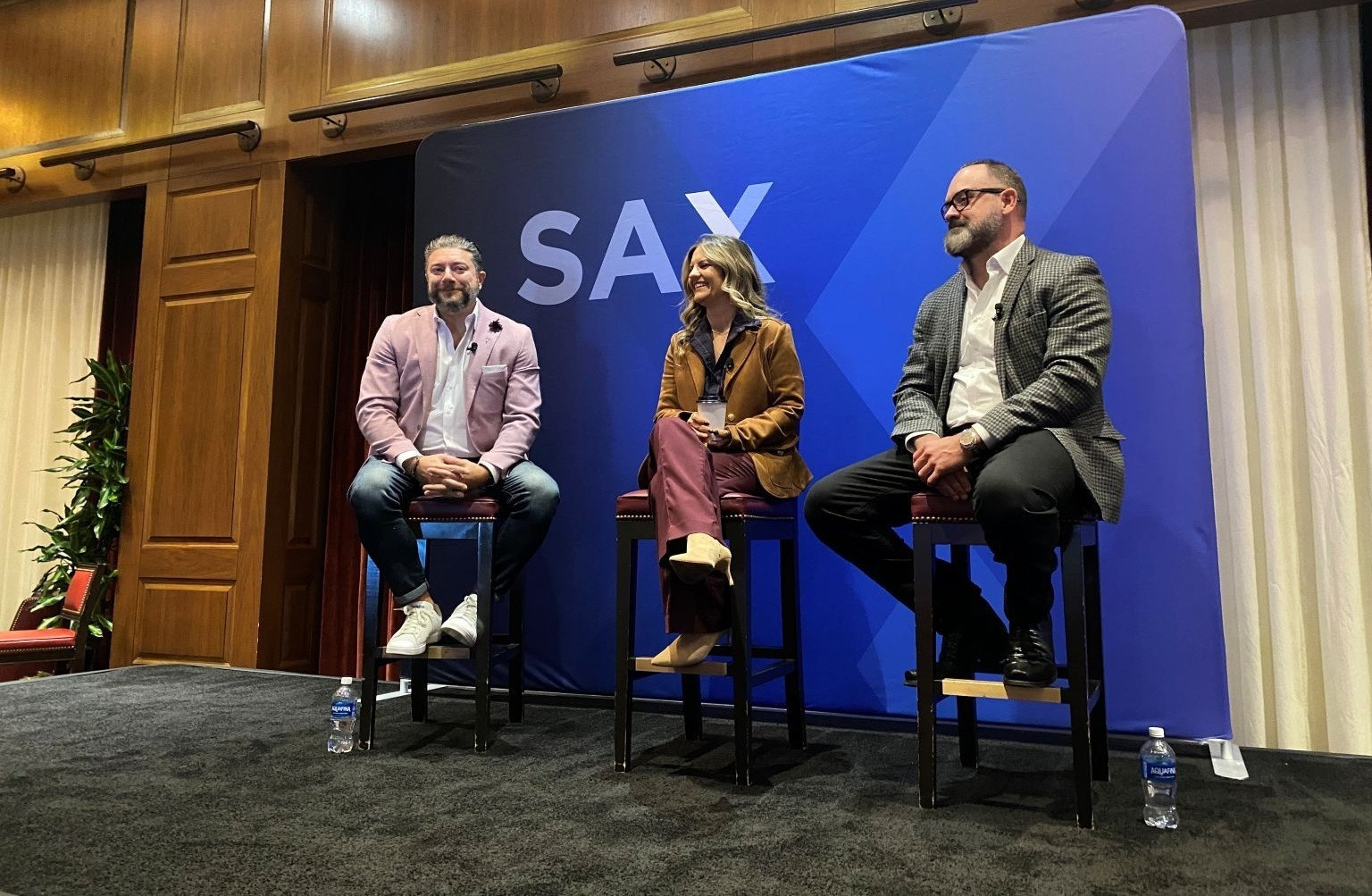
Owen, Chief Information Officer and a Partner at SAX, made the prediction during a fireside chat on AI in the workplace at the SAX Symposium, held last week at MetLife Stadium. He shared the stage with Maria Koller, Vice President of AI & Edge Infrastructure Growth at Verizon Business. Leon Grassi, a SAX Partner who leads SAX Technology Advisors with Owen, moderated.
Owen’s reasoning on regulation is simple. AI runs on computing power, which is a limited resource. And when something is a commodity, government follows.
“Anytime there’s a commodity available, you’re going to see the government regulate and then tax,” he said. “We haven’t gotten there yet, but it’s clearly coming.”
Owen said the companies behind the leading AI models, such as Anthropic, OpenAI and Elon Musk’s Grok, are lining up with Washington to protect their spot against cheaper models from overseas. Chinese models like DeepSeek can do a lot of work at a fraction of the cost, he said, “but you sort of lose control of data privacy.”
“It’s not going to matter who wins,” he said. “You’re going to see bipartisan regulation. I’m predicting this right now, which will lead to taxation.”
Koller said the money involved is staggering. She cited a recent Goldman Sachs report that puts AI capital investment at $1 trillion this year, covering infrastructure, models and chips.
“You’re not spending a trillion dollars as an industry because it’s moving slow,” she said.
Here are eight other things we heard.
8. AI isn’t new
Owen has a saying he uses a lot: “Everything that has happened before will happen again.”
“AI is not new,” he said. “I was doing algorithmic stuff in the late ‘90s and early 2000s. … Financial companies were doing algorithmic trading 25 years ago.”
What’s different, he said, is that a language model now sits on top of those algorithms and puts the power in everyone’s hands.
7. It’s the next step after phones, the internet and the cloud
Koller traced the path from landline phones to the internet to mobile broadband to the cloud. AI, she said, builds on all of it.
“AI is actually basically leveraging all of those things into making you smarter and making you be able to be more efficient,” she said.
She already works that way. She starts her day at 5:30 a.m., and an AI agent has a to-do list ready for her.
“You have models that could be your chief of staff,” she said.
6. Companies need to start with the problem, not the tool
Koller said small and mid-size businesses face so many AI products that they don’t know where to start.
“You have to start with what business problem am I trying to solve for,” she said.
That might be administrative work. In a warehouse, it might be scanning. But you still need a person to analyze the results.
5. Automate the logic tree first
Owen said the first jobs to hand to AI are the predictable ones.
“Repeatable process that follows a logic tree is the first angle that people can operationalize, leveraging this technology to get better quality to their clients and also drive higher margins inside their business,” he said. “But that doesn’t mean you don’t need people.”
He compared it to Henry Ford’s assembly line. Robots build the cars now, but somebody still has to run the robots.
4. It may mean fewer employees, but better ones
Koller didn’t sugarcoat it. An office with 10 administrative workers might only need five with AI’s help.
“But you’re going to make those five really amazing five, because they’re going to be focused on more creativity, more ways to grow your business,” she said.
Owen said he’s living proof. With AI, he produces two to three times the work he did before, at higher quality, work that would have taken two or three more hires.
“AI-powered humans are going to be worth exponentially more,” he said.
3. Big bureaucracies are already behind
Owen said companies like SAX and Verizon are building things that are sometimes 18 to 24 months ahead of everyone else. Companies weighed down by bureaucracy, he said, “can’t get out of their own way” and are already falling behind.
2. Get ready for rules no one has written yet
A nonprofit leader whose agency relies on Medicaid funding asked how to prepare for AI regulation. Owen said even legal experts are behind on what’s coming. His advice: build a list of trusted sources and have AI do the watching.
“Set up a routine in whatever your platform of choice is to go out and spend some time building out a prompt that is constantly scraping for this information,” he said.
Koller said rules on sensitive data, like HIPAA in health care, are “the next shoe to drop.” Grassi said the best foundation in the meantime is secure infrastructure and following the rules already on the books.
1. The doomsday talk is “nonsense”
All three people on stage pushed back on the fear around AI
Owen blamed the media and social algorithms built on fear and anger.
“Doomsday sells advertising on TV,” he said.
Koller reminded the room of Y2K, when people expected everything to blow up on Jan. 1 and nothing happened. Grassi remembered that night well.
“Craziest New Years of my life, and the most boring,” he said.
Owen sees something better coming.
“Imagine a world where you don’t have to do mundane tasks, where you don’t have to do data entry anymore, where the data is at your fingertips,” he said. “That’s where this is all going.”


