


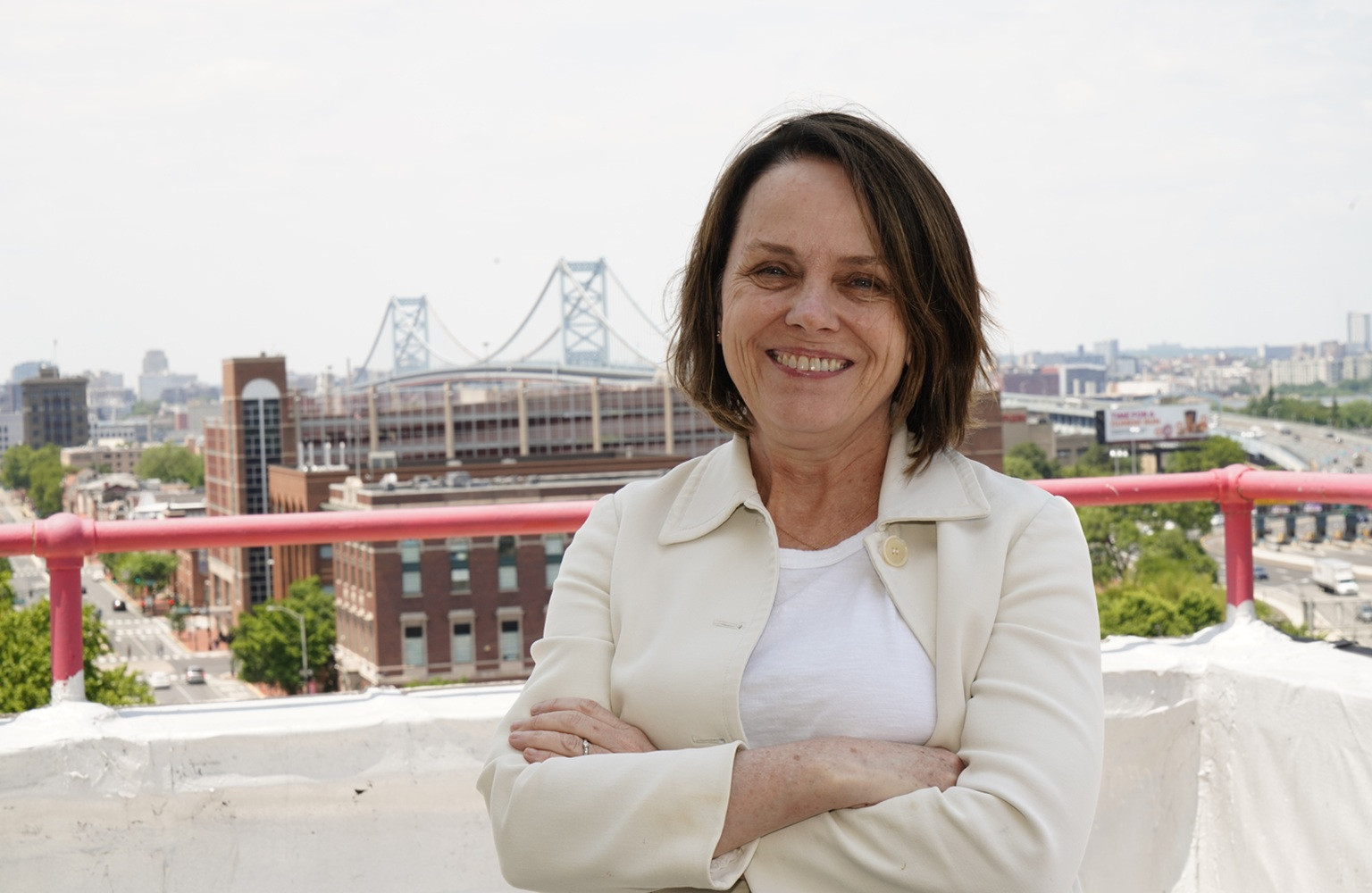
When Kathleen Noonan first took over as CEO of the Camden Coalition in 2018, most of the nonprofit’s funding came from philanthropy. Almost nine years later, grants and contracts account for the majority of its revenue.
The shift was deliberate. Noonan, who previously worked at the Children’s Hospital of Philadelphia, said she wanted to ensure that the Camden Coalition had reliable revenue to support its work helping people with complex health and social needs.
“We couldn’t sustain ourselves on philanthropy alone,” Noonan said. “Today, the vast majority of our funding comes from contracts.”
The coalition was founded in 2002 by Dr. Jeffrey Brenner as a breakfast meeting of primary care providers, social workers and community leaders looking to improve healthcare delivery in Camden. It has since expanded its reach in the state and nationally. Today, it is one of New Jersey’s four Regional Health Hubs, which help coordinate medical care with social services and community resources. (The others are the Trenton Health Team, Greater Newark Healthcare Coalition, and the Health Coalition of Passaic County.)
The organization created a National Center for Complex Health and Social Needs in 2016, sharing best practices across the country. Its annual national conference, Putting Care at the Center, attracted nearly 800 attendees to Oakland, California, in October.
Camden Coalition now has agreements with the state and county governments, as well as health systems and providers around the country that engage them for technical assistance and capacity building. With an annual budget of around $17 million and 70 employees, the organization works with major hospital partners in South Jersey, including Cooper, Virtua, Inspira, and Jefferson Health.
BINJE talked with Noonan recently about transforming the Camden Coalition’s funding model, expanding its national reach and the lessons she’s learned about helping people with complex health needs. Here’s more of the conversation, edited for length and clarity.
BINJE: How did you get into this field in the first place?
Noonan: I am the daughter of a cop. A cop who was a good cop, but not a great family person. And so I was raised by a single parent, essentially, and I was very aware of how your circumstances could sort of make or break things. And that just stuck with me.
For example, because I grew up in a middle-class community with good schools, I was able to do okay, even though we were one of the lower-income families. My mom was able to get a no-interest HUD loan. Because of those types of programs, my mom could get our roof repaired and our gutters cleaned out and all these things that were causing her so much stress. I saw the benefit of what public programs could do.
BINJE: What problem was the Camden Coalition created to solve?
Noonan: In the beginning, we focused on what seemed like a very narrow but very complex problem.
Our founder and his partners, because they started meeting as a breakfast group, saw their patients going in and out of the emergency room and the hospital and it seemed like an endless cycle. The idea was, what can we do outside of the hospital, between visits, to help them?
The first model that Camden Coalition tested, even before it was a nonprofit and while it was being incubated within Cooper Norcross Health Care, was this: If we had a team of a social worker, a nurse and a community health worker who could wrap around people who were repeatedly cycling through emergency rooms and hospitals, could we somehow stop that cycle?
BINJE: Have you solved that problem?
Noonan: We have learned a lot. I would say we are making progress, but it is slow going in some areas.
Certainly, the Camden Coalition’s work brought attention to the need for community navigators, community health workers and peers to supplement traditional medical care.
Many studies have shown that support really helps. Not only does it help people stem that tide of going in and out of hospitals, but it can also reduce medical costs.
What we haven’t yet solved is how to help the most complex people in that group.
A lot of our progress has been around people who have medical or social needs that are complex but not the most complex. We’re still trying to figure out how to help someone who goes to the emergency room 20 times a month or people who opt out of the system altogether.
That’s something we’re all still working on.
BINJE: How have you changed the way the organization approaches its finances?
Noonan: When I arrived at the coalition, we had many staff positions that were dependent on relatively short-term funding. Foundation funding cycles used to be three to five years. Now it is common to see grants that are only one year. Everything has shifted to shorter timelines.
I was speaking with a potential funder this week and they asked whether I already had staff ready to go if funding came through. That’s the challenge. Funders often want projects to begin immediately, but the funding isn’t there yet.
So we’re very careful about growth and making sure people have support between projects.
BINJE: What does the Camden Coalition do today that people might not realize?
Noonan: Although we started very narrowly focused on people using emergency departments and hospitals, over the years we’ve become very expert at connecting partners and analyzing data.
We run a very sophisticated health information exchange that allow hospitals and community organizations to share health information. A lot of our work in South Jersey focuses on those connections and on helping organizations work together more effectively.
BINJE: What does success look like five years from now?
Noonan: For a small nonprofit, success means we’re still here, we’re strong and we have strong contracts and strong revenue.
I would also say that we’re able, as a state, to take lessons learned from the north and implement them in the south, and take lessons learned from the south and implement them in the north. We need more cross-pollination.
BINJE: What’s one of your proudest moments at the coalition?
Noonan: The COVID work in Camden was really incredible. What touched me about the COVID experience was just how powerful our community messengers were in going door to door, educating the community so that they felt comfortable about getting vaccinated.
What COVID also taught us is that sometimes you have to knock on doors, and sometimes you have to knock 20 times. Knock and knock again. You can’t just put information online and expect people to come. We literally have to meet people where they are.


